🏛️ Cambodia's Architectural Marvel
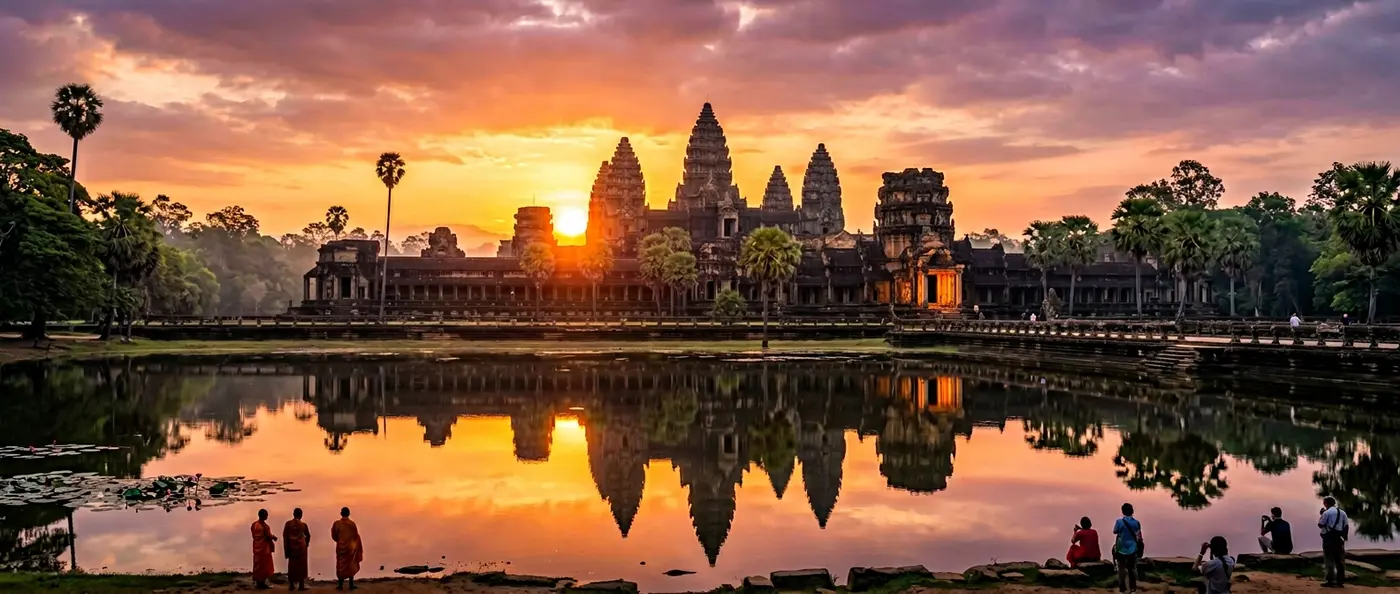
Angkor Wat, meaning "temple city" in Khmer, spans over 400 acres, making it the largest religious structure on the planet. Construction began in the first half of the 12th century under Khmer king Suryavarman VII (1113-1150 CE), who designed it as his magnificent funerary temple.
The central quincunx dominates the complex — five conical towers arranged in a cross pattern, with the central spire rising nearly 200 feet into the air. Each tower narrows upward in rows of carved lotus petals, representing Mount Meru — the mythical home of Hindu gods at the universe's center.
Access to the temple is gained through a 617-foot bridge that crosses the massive 623-foot-wide moat. This moat, extending nearly 3 miles in perimeter, served not only a defensive purpose but symbolized the oceans surrounding the world. The outer wall, standing 15 feet high, represents the mountains at the edge of the world, creating an earthly model of the universe in stone.
🔱 From Hinduism to Buddhism
Originally known as Vrah Visnuloka ("sacred dwelling of Vishnu"), Angkor Wat was dedicated to the three main Hindu deities: Vishnu, Shiva, and Brahma. The interior walls display intricate bas-reliefs carved with scenes from the Sanskrit epics Mahabharata and Ramayana, alongside ancient Khmer narratives.
The religious transition began approximately 30 years after Suryavarman VII's death. King Jayavarman VII ascended to the throne in 1181 CE and established Buddhism as the state religion. However, Angkor Wat remained a Hindu temple until the 1300s, when it was officially rededicated as a Buddhist place of worship.
Remarkably, due to Buddhist tolerance toward Hinduism, the iconography of the great bas-reliefs was neither destroyed nor replaced. Instead, Buddhist statues were added, creating a unique blend of religious art that reflects the cultural evolution of the region.
⚔️ The Khmer Empire at Its Peak
The Khmer flourished from the 9th to 15th centuries, with their rulers governing an extensive, prosperous, and sophisticated empire that stretched across much of mainland Southeast Asia, from present-day Myanmar to Vietnam. A network of river routes and elevated roads connected the empire's remote regions.
Agricultural production thrived during this period, possibly thanks to higher temperatures and nourishing rains during the so-called Medieval Warm Period. Angkor featured an extensive and advanced system of artificial canals, embankments, and reservoirs. The largest of these, the West Baray, measures 5 miles long and 1.5 miles wide — a remarkable feat of hydraulic engineering for its time.
This hydraulic network supplied nearly 750,000 inhabitants in the world's largest pre-industrial city and irrigated the rice fields that sustained them. It was a system so advanced that historians believe its destruction by a series of intense monsoons followed by drought contributed to Angkor's decline.
💡 Did You Know?
Angkor Wat is the only temple in the complex that was never abandoned. Between the late 14th and early 15th centuries, Buddhist monks converted it into a pilgrimage site, saving it from complete jungle takeover.
🗿 Comparison with Laos' Vat Phou
While Angkor Wat attracts approximately 6 million tourists annually, there's a lesser-known but equally impressive temple that shares the same Khmer heritage. Vat Phou in Laos, with its lotus-filled pools and carved stone columns, bears striking similarity to Angkor Wat — but without the crowds.
Both sites were built as religious centers during the Khmer period (802-1431 CE) and are located along the Ancient Angkor Road, one of the medieval highways that began from the Khmer Empire's seat in Siem Reap. Both are recognized as UNESCO World Heritage Sites.
Though most of Vat Phou's visible ruins date from the 11th and 13th centuries, a 5th-century Sanskrit inscription and underlying foundations show the site predates Angkor Wat by centuries — possibly making it Southeast Asia's oldest place of worship.
⚖️ Angkor Wat vs Vat Phou
🏺 Daily Life in Ancient Angkor
At its peak in the 12th and 13th centuries, Angkor was not simply a religious center but an urban macro-complex. Some estimate the population at its height in the hundreds of thousands. The city hosted carved wooden palaces and lavishly decorated temples.
Beyond the city walls, stilt houses dotted the rice fields, lakes, and canals. Dense vegetation dominates the landscape today, and Angkor's temples appear isolated, like islands half-submerged by jungle. But in reality, the area was once a vibrant urban center with extensive infrastructure.
Agricultural production, particularly rice cultivation, was the backbone of the economy. The sophisticated irrigation system allowed multiple harvests annually, supporting the massive population. Residents also engaged in trade, crafts, and religious ceremonies that were an integral part of daily life.
Residential Architecture
Common citizens lived in wooden houses raised on stilts for flood protection. Only temples and royal buildings were constructed from stone.
Agricultural Economy
The sophisticated irrigation system allowed up to three rice harvests annually, making Angkor self-sufficient in food production.
Religious Life
Daily rituals included offerings to gods, purification ceremonies, and participation in religious festivals that strengthened social cohesion.
🔬 New Archaeological Discoveries
Modern technologies continue to reveal new aspects of Angkor Wat and the broader region. The use of LiDAR (Light Detection and Ranging) has uncovered extensive networks of roads, canals, and dwellings beneath the dense forest canopy, proving that Angkor was much larger than previously believed.
Recent excavations have also brought to light new evidence about the temple's construction. Archaeologists discovered that more than 5 million tons of sandstone were used in construction, transported from quarries more than 30 miles away. How exactly these massive quantities of stone were transported remains one of the great mysteries of ancient engineering.
Modern analysis of the bas-reliefs shows details invisible to the naked eye. Traces of pigments indicate that the walls were once vibrantly painted, creating a spectacle that would have been even more impressive than today's appearance.
🌅 Decline and Survival
Around the 1430s, Khmer rulers abandoned the great Angkor complexes and relocated to the newly established Phnom Penh in the south. The decline resulted from a complex mix of factors, including climate change, wars with neighboring kingdoms, and internal conflicts.
The jungle soon reclaimed the area. Massive silk cotton trees sprouted through fallen towers, their silver roots wrapping around columns and walls until jungle and ruins became inseparable. But one temple was never abandoned: Angkor Wat itself.
Europeans began arriving at Angkor in the mid-16th century — first Portuguese traders around 1555, then missionaries seeking to spread Catholicism in the region. Portuguese merchant and historian Diogo do Couto described how Cambodia's jungle concealed an abandoned city whose walls "are entirely built with carved stone, so perfect and so well placed that they seem to form only one stone — which is... almost like marble."
"It's somewhat of a shock how little we know about the Khmer. This finding is quite significant."
🗺️ Angkor Wat Today
Today, Angkor Wat is not merely a tourist attraction but a living place of worship. Buddhist monks continue to conduct ceremonies in the ancient spaces, and thousands of Cambodians visit the temple for religious reasons. It appears on Cambodia's current flag as a symbol of national pride and cultural identity.
Managing and maintaining the monument presents enormous challenges. With 6 million visitors annually, wear and tear is inevitable. International conservation teams work continuously to stabilize structures, clean bas-reliefs, and protect the monument from further deterioration.
Meanwhile, new discoveries continue to enrich our understanding of this architectural marvel. Each year, archaeologists uncover new evidence that sheds light on the lives of the people who built and inhabited this magnificent stone city. Angkor Wat remains not only the world's largest religious monument but also one of the most mysterious, with many of its secrets still waiting to be revealed.