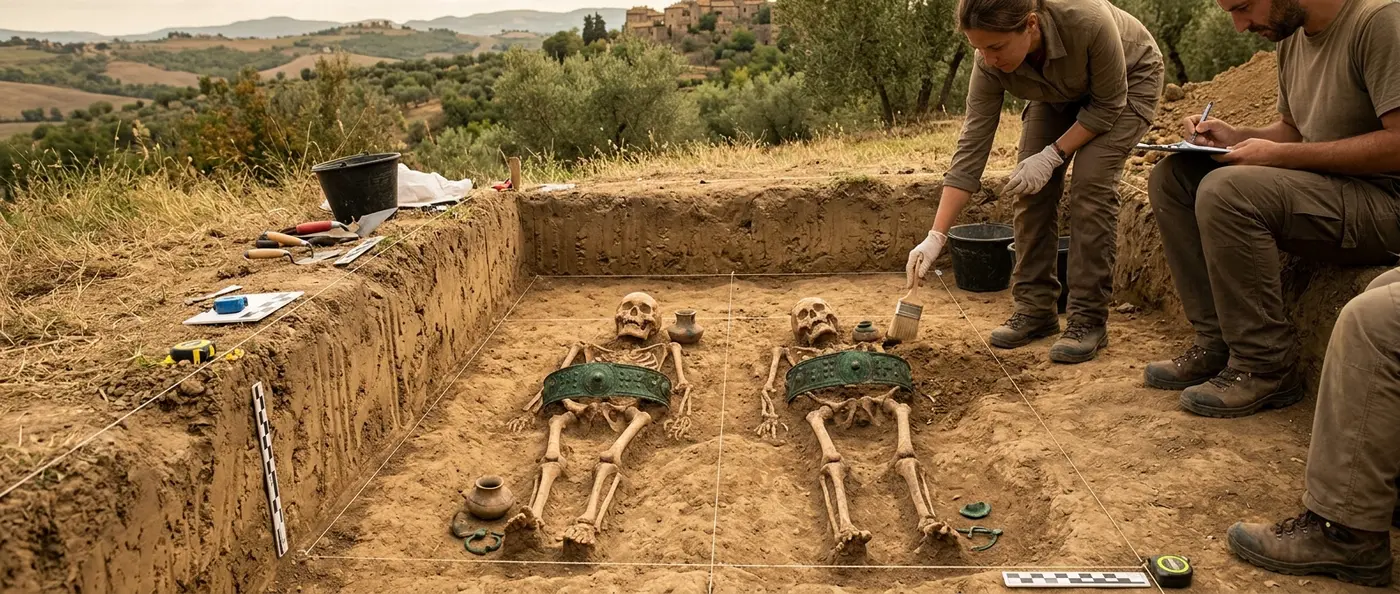
A 5-year-old child shouldn't be buried with a warrior's belt. Yet at the Pontecagnano cemetery in southern Italy, archaeologists pulled two children from the earth wearing massive bronze belts — accessories reserved for adult male fighters in the pre-Roman Samnite culture. These kids, aged just 5 to 10 years old, died 2,500 years ago but their burials are rewriting what we know about how ancient Italian societies viewed death, childhood, and the transition to adulthood.
🏺 The Discovery That Stunned Archaeologists
The excavation started routine enough. Archaeologists were clearing ground for a construction project at a former tobacco factory in Pontecagnano, a city in Italy's Campania region. What they found was a section of ancient cemetery containing 34 burials dating to the 4th and 3rd centuries BCE. Half of those graves held children between 2 and 10 years old.
Pontecagnano isn't new to archaeology. Since the early 1960s, digs here have uncovered more than 10,000 burials across three cemeteries spanning the 9th to 3rd centuries BCE. The site has revealed burial practices spanning six centuries of cultural change in ancient Italy.
But this discovery was different. Two children, aged 5 to 10, had been buried wearing large bronze belts — accessories that normally appeared only in adult male warrior graves from the Samnite culture. These weren't decorative trinkets. In Samnite society, bronze belts were symbols of prestige and warrior identity that accompanied dead fighters into the afterlife.
💡 Why This Discovery Matters
Bronze belts in the Samnite world weren't fashion statements. They were symbols of status and martial identity, reserved for warriors who had earned their place through combat. Finding them on children who never held a sword challenges everything archaeologists thought they knew about Samnite burial customs.
🗿 The Samnites: Warriors of Ancient Italy
The Samnites controlled this discovery's significance. These warlike tribes inhabited the mountains of southern Italy and spoke a language called Oscan. By the 5th century BCE, Samnites had moved into Pontecagnano, transforming it into a major center of their culture.
The city remained under Samnite control until Rome conquered southern Italy in the 3rd century BCE. During this period, Pontecagnano was a bustling trade hub where merchants from Greece, Phoenicia, and other parts of Italy converged.
Samnite society was deeply hierarchical and gender-specific. Men were warriors first, defined by their ability to fight and defend their communities. Women managed households and raised children. This rigid social structure was reflected in their burial practices — until now.
⚔️ Burial Practices: A Code of Honor and Gender
Pontecagnano's cemeteries have revealed detailed information about Samnite burial customs. Graves were organized by family units, most taking the form of earthen pits covered with tiles.
Grave goods varied widely but certain objects were strictly gendered. Men were buried with items symbolizing the warrior: spear points, javelins, and bronze belts. Women were accompanied by rings and fibulae (decorative brooches).
This strict division makes the discovery of children with warrior belts even more mysterious and significant. These weren't random grave goods — they were deliberate choices that carried deep cultural meaning.
The bronze belts themselves were substantial pieces, often decorated with intricate patterns and requiring significant metalworking skill to create. They weren't just symbols — they were valuable objects that represented considerable investment by the families burying these children.
🏺 The Mystery of Child Warriors
Other child warriors have emerged from Pontecagnano before. Previously, they discovered at least one other example — a 12-year-old child buried with a bronze belt. According to archaeologist Gina Tomay, who spoke to Italian news agency ANSA in 2021, the boy lived in the 4th century BCE and was buried with ceramic cups to ensure he'd have food and wine in the afterlife.
But why were these children buried with an accessory typically reserved for warriors? Experts aren't certain, but several compelling theories have emerged.
Social Status
The children may have come from high-status families where warrior identity was inherited from birth, regardless of age or actual combat experience.
Symbolic Protection
The belts might have served as protective amulets for the journey to the underworld, ensuring the safety of young souls in the afterlife.
Future Identity
The warrior symbols may have represented the men these children would have become if they had lived long enough to reach adulthood.
🌍 Parallels from Other Cultures
The practice of burying children with warrior equipment isn't unique to the Samnites. Similar discoveries have been made in other ancient cultures, offering valuable comparisons.
In Britain, archaeologists have found Anglo-Saxon child burials from the 6th century CE containing belts and other warrior equipment. In a recent excavation led by Professor Duncan Sayer of the University of Central Lancashire, researchers found a 10-12 year old child buried with a spear and shield. The child's curved spine made it unlikely they could have used these weapons effectively.
Another even younger child, just 2-3 years old, was found with a large silver belt buckle that was obviously too big to wear. These large buckles were symbols of power in late Roman and early medieval times.
The practice appears across cultures and centuries, from Britain to Italy, suggesting shared beliefs about childhood, death, and warrior identity.
⚔️ Cross-Cultural Burial Practices
🔬 What This Means for Understanding the Past
The Pontecagnano discoveries offer valuable insights into how ancient cultures approached death, identity, and the transition from childhood to adulthood. These aren't just archaeological finds — they're windows into the human psyche and the beliefs of our ancestors.
The presence of warrior symbols in child burials suggests that warrior identity in Samnite society wasn't something acquired only through combat experience. It may have been inherited, anticipated, or even imposed from birth.
These burials also remind us that child death was a tragic reality in the ancient world. Parents and communities had to find ways to cope with this loss and give meaning to lives cut short. The warrior belts may have been a way to honor what these children might have become, or to ensure they were properly equipped for whatever challenges awaited them in the afterlife.
The discovery also highlights the complexity of ancient social structures. Modern assumptions about childhood as a distinct life stage separate from adult responsibilities may not apply to ancient societies, where social roles and identities could be assigned much earlier.
📜 The Broader Historical Context
Pontecagnano has a long and rich history that predates the Samnites by centuries. The city was originally founded in the 9th century BCE by people of the Villanovan culture, who introduced advanced metalworking techniques to southern Italy.
Two centuries later, groups of Etruscans transformed Pontecagnano into a trading hub for Greek, Phoenician, and Italian merchants. This cosmopolitan atmosphere contributed to the development of a unique cultural blend reflected in the archaeological record.
When the Samnites took over the city in the 5th century BCE, they inherited and enriched this cultural tradition. Their burial practices, as revealed by recent discoveries, were complex and laden with symbolism that we're only beginning to understand.
🗺️ Pontecagnano on the Map of Ancient Italy
The strategic location of Pontecagnano in Campania made it an ideal meeting point of cultures. It was close enough to the Greek colonies of the south to benefit from trade, but far enough north to maintain contact with the Etruscans and other Italian peoples.
🔍 Ongoing Research and Future Prospects
Excavations at Pontecagnano continue in various parts of the city due to public and private construction projects. This means new discoveries are likely and may shed more light on the mystery of the children with warrior belts.
The Archaeological, Fine Arts and Landscape Service of Salerno and Avellino plans to announce the full results of the excavations once research is complete. This will include detailed analyses of the finds, comparisons with other sites, and perhaps new interpretations of the meaning of these unusual burials.
Meanwhile, archaeologists continue to study the finds using modern techniques such as DNA and isotope analysis to learn more about the lives and deaths of these ancient children. Each new piece of evidence adds another piece to the puzzle of understanding the past.
The story of Pontecagnano's children with warrior belts reminds us that the past is full of surprises. Even after decades of excavation, new discoveries can overturn our assumptions and make us see ancient civilizations with fresh eyes. These children, who lived and died 2,500 years ago, continue to teach us about the complexity of human experience and the ways societies deal with life's most fundamental challenges.