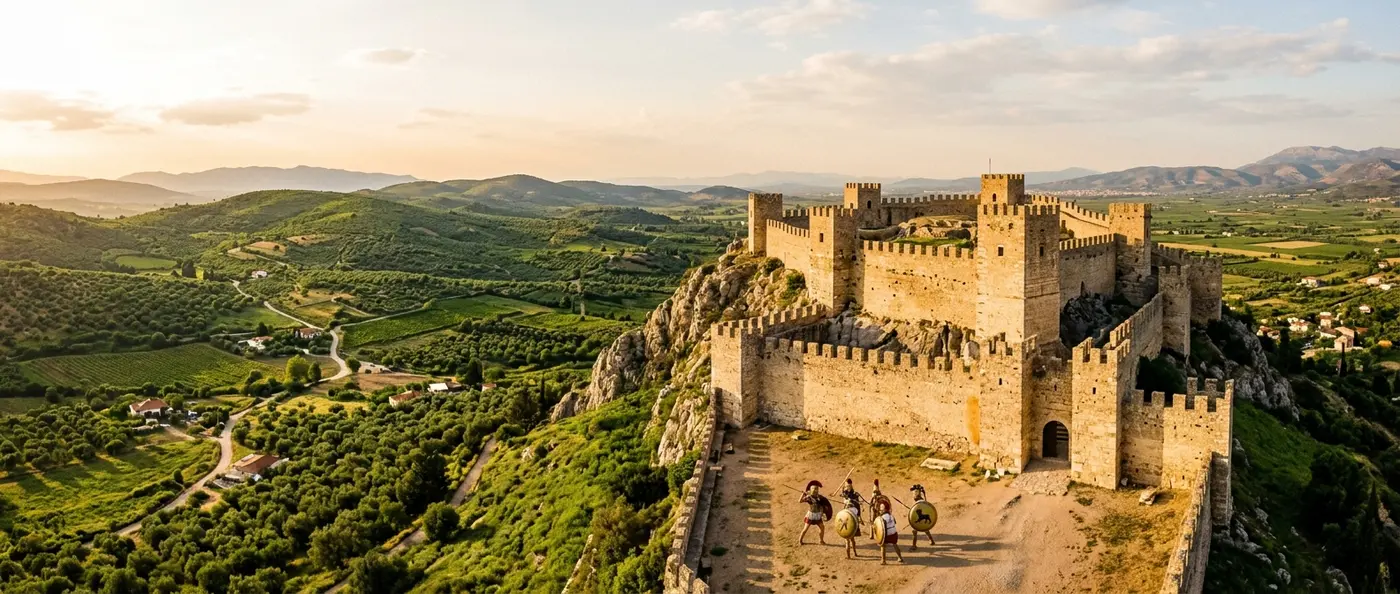
In the shadow of the Parthenon and Athens' acropolis, another ancient Greek city was writing its own glorious history. Thebes, which today seems forgotten compared to Athens' fame, was once the most fearsome rival of the democratic city-state. From the mythical age of Oedipus to its hegemony under Epaminondas, Thebes played a decisive role in shaping ancient Greek history.
🏛️ The Mythical Foundation and Early Centuries
Thebes' history begins long before Athens, steeped in the myths and legends of ancient Greece. According to mythology, the city was founded by Cadmus, the Phoenician prince who arrived in Boeotia searching for his sister Europa. Cadmus sowed dragon's teeth in the earth, and from them sprang the Spartoi, Thebes' first warriors.
The Thebans believed this myth gave them a pedigree older than Athens - a claim that would fuel their ambitions for centuries. The city with seven gates, as the ancients called it, became the setting for some of the most tragic stories in Greek mythology - from Oedipus who killed his father and married his mother, to the Seven Against Thebes and the fraternal conflict between Eteocles and Polynices.
Archaeological finds from the Cadmeia area, Thebes' acropolis, confirm that the city was inhabited as early as the Mycenaean period. Clay tablets with Linear B script found there reveal an organized society with a palace, workshops, and extensive trade. Bronze Age Thebes was one of the most important centers of the Mycenaean world.
⚔️ The Rise to Power: From the Persian Wars to Hegemony
During the Persian Wars, Thebes made a choice that would define its reputation for generations. Unlike Athens and Sparta, Thebes chose to ally with the Persians - a decision that cost dearly in reputation. After the Persian defeat, the Thebans found themselves on the margins of the Greek world, stigmatized as "medizers."
But Thebes didn't remain in the shadows for long. During the Peloponnesian War (431-404 BC), the city exploited the rivalry between Athens and Sparta to strengthen its position. Allying with Sparta, the Thebans played a significant role in Athens' final defeat. The Battle of Delium in 424 BC, where the Thebans defeated the Athenians, was one of the first indications of their military capability.
Victory made Sparta drunk with power, and Thebes became their next target. The Spartans, intoxicated by their victory, attempted to impose their hegemony over all of Greece. For Thebes, this meant the installation of a Spartan garrison on the Cadmeia in 382 BC - a humiliation that the proud Thebans could not tolerate.
🗡️ The Age of Epaminondas: When Thebes Ruled Greece
In 379 BC, a group of Theban exiles led by Pelopidas managed to expel the Spartan garrison and liberate the city. This marked the beginning of the most glorious period in Thebes' history. Under the leadership of two exceptional generals, Epaminondas and Pelopidas, Thebes transformed from a regional power into the hegemon of Greece.
Epaminondas changed warfare itself. Where others saw tradition, he saw weakness to exploit. He introduced the oblique phalanx, an innovation that gave the Thebans a decisive advantage in battle. Instead of placing his best soldiers on the right, as was tradition, he concentrated them on the left in a depth of 50 men, creating a "hammer" that could break any battle line.
The effectiveness of this tactic was demonstrated at the Battle of Leuctra in 371 BC. There, the Thebans faced the previously undefeated Spartan army. The result shocked the Greek world: the Spartans suffered a crushing defeat, losing 400 of the 700 Spartan citizens who participated in the battle, including their king Cleombrotus.
Oblique Phalanx
Epaminondas' revolutionary tactic that concentrated force at one point to break the enemy line. Depth of 50 men instead of the usual 8-12.
Sacred Band
Elite unit of 300 men composed of 150 pairs of lovers. They were considered invincible until the Battle of Chaeronea in 338 BC.
Peloponnesian Campaigns
Epaminondas invaded Laconia four times, liberated the helots, and founded Messene and Megalopolis.
🏺 Culture and Society: The Other Side of Thebes
Thebes was more than armies and tactics. The city was the birthplace of Pindar, perhaps the greatest lyric poet of antiquity. His victory odes, celebrating athletic champions, were considered masterpieces of Greek poetry. Even Alexander the Great, when he destroyed Thebes in 335 BC, ordered Pindar's house to be preserved as a mark of respect.
Theban society had some unique characteristics. Unlike Athens, where women lived in relative seclusion, Theban women enjoyed greater freedom. They participated in religious ceremonies and had a more active role in public life. The worship of Dionysus was particularly strong in Thebes, and women played a central role in Dionysiac festivals.
Economically, Thebes relied on the agriculture of fertile Boeotia. The region was known for its grain and livestock. The Thebans had also developed trade with other Greek cities, though never to the extent of Athens or Corinth. The city had its own coinage, with coins bearing the characteristic Boeotian shield.
💡 Did You Know?
Thebes' Sacred Band, the elite military unit composed of pairs of lovers, was inspired by the idea that men would fight more bravely to protect and impress their beloved. The unit remained undefeated for 40 years until the Battle of Chaeronea.
🌅 The Decline of Theban Hegemony
Thirteen years. That's how long Thebes ruled the Greek world. In 362 BC, at the Battle of Mantinea, Epaminondas achieved another victory against the Spartans and their allies, but fell mortally wounded. His last words, according to ancient historians, were to advise the Thebans to make peace, as there was no one capable of succeeding him.
Without Epaminondas, Thebes gradually lost its leading position. The rise of Macedon under Philip II created a new threat. At the Battle of Chaeronea in 338 BC, the Thebans and Athenians, former enemies now allies, faced the Macedonians. The defeat was catastrophic. The Sacred Band fought to the last man, preferring death to submission.
The final blow came in 335 BC, when Thebes revolted against Alexander. The young king, wanting to make an example, completely destroyed the city. Only the Cadmeia and Pindar's house survived. The inhabitants were sold into slavery, and the once-proud city ceased to exist.
🔍 The Legacy of the Forgotten Power
Despite its destruction, Thebes' legacy survived. Epaminondas' tactics influenced later generals, including Philip of Macedon himself, who had lived as a hostage in Thebes in his youth. The ideas of freedom and autonomy that Thebes promoted against Spartan hegemony became part of the Greek political vocabulary.
Today, modern Thebes stands over the ruins of the ancient city. Archaeological excavations have revealed parts of the Mycenaean palaces, ancient walls, and various architectural remains. While it cannot compare to Athens' monuments, these finds remind us that Thebes was once one of the greatest powers of the ancient world.
⚖️ Thebes vs Athens: The Comparison
Thebes' history teaches us that power and glory in the ancient world were ephemeral. A city that for a decade ruled Greece, that defeated "invincible" Sparta and challenged Athens, is today almost forgotten. But its contribution to Greek history remains undeniable. Thebes proved that even the greatest powers can be defeated, that innovation can overcome tradition, and that freedom is worth any sacrifice.
At Chaeronea, Thebes and Athens - enemies for three centuries - stood together for the first and last time. This last alliance, though defeated, symbolizes the end of the era of independent Greek city-states and the beginning of a new age. Thebes may not have left behind Parthenons and philosophical schools, but its story remains a fascinating chapter in the book of ancient Greek civilization.