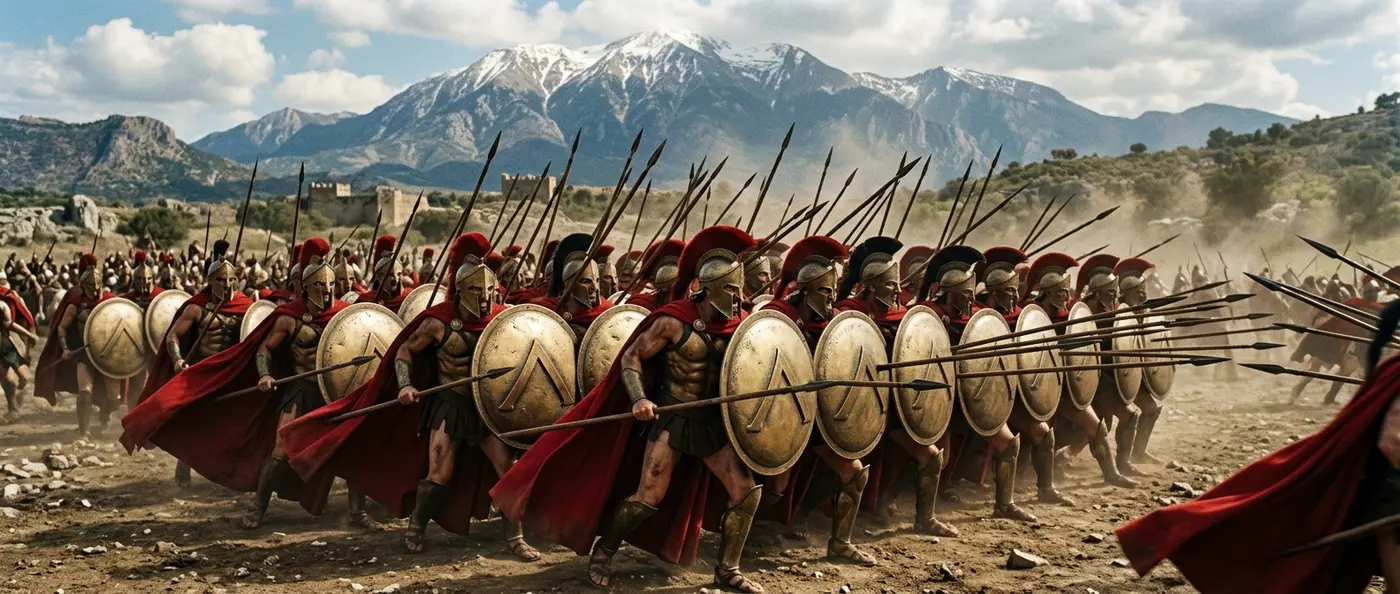
On the slopes of Mount Taygetus, where the Eurotas River cuts through the valley of Laconia, once stood a city destined to become legend. Sparta had no walls — it didn't need them. Its warriors were the wall.
🏛️ Birth of a Military Superpower
Ancient Sparta emerged as the dominant force in the Peloponnese around the 10th century BC, when Dorian invaders settled in the fertile valley of the Eurotas. What began as a simple settlement became a military state where every aspect of life served one purpose: war.
Sparta's transformation into a military machine wasn't accidental. After conquering Messenia in the 8th century BC and enslaving its population as helots, the Spartans found themselves in a precarious position. The enslaved helots vastly outnumbered the Spartans, creating a constant threat of rebellion. The answer was to create a society where every free Spartan male would be a professional warrior.
The reforms attributed to the mythical lawgiver Lycurgus, probably in the 7th century BC, laid the foundation for the Spartan system. Sparta's constitution, known as the Great Rhetra, governed every aspect of citizens' lives. From birth to death, a Spartan belonged to the state.
⚔️ The Agoge: Forging Warriors
The Spartan educational system, known as the agoge, turned boys into killing machines. It began from the moment of birth. Every newborn was examined by tribal elders. If the infant was deemed weak or physically disabled, its fate was uncertain — though modern archaeological research shows that the practice of exposing infants wasn't as systematic as Plutarch describes.
At age seven, boys were taken from their families and entered the agoge. They lived in communal barracks called agelas, where they underwent harsh physical training, discipline, and deprivation. Education wasn't limited to military arts. It included music, dance, and basic literacy — but always with emphasis on creating warriors.
Young Spartans learned to endure pain without complaint. They walked barefoot in all seasons, ate meager meals, and slept on beds of reeds they gathered themselves from the banks of the Eurotas. Stealing food was permitted, but punishment for getting caught was severe — not for the theft, but for the failure to avoid detection.
🛡️ The Spartan Hoplite
The fully trained Spartan warrior was a marvel of military efficiency. His equipment, known as panoply, was standardized and carefully maintained. According to descriptions from the Iliad and other sources, the panoply included:
Helmet
The Corinthian-style bronze helmet covered the entire head, leaving only a narrow slit for eyes and mouth. A horsehair crest adorned the top.
Shield (Hoplon)
The round shield, about 90 centimeters in diameter, made of wood and bronze-plated. It bore the characteristic lambda (Λ) of Lacedaemon.
Breastplate
Bronze or linen cuirass reinforced with metal plates. It protected the torso without excessively restricting movement.
Greaves
Bronze shin guards that protected the legs from knees to ankles.
Spear
The primary weapon, a spear 2-3 meters long with bronze point and butt-spike.
Sword
Short sword (xiphos) for close combat when the spear broke or fighting became too tight.
🏰 The Phalanx: Art of War
The true strength of the Spartans lay not in individual heroism but in their collective discipline. The Spartan phalanx was a living organism, where each warrior protected with his shield not only himself but also his neighbor. This interdependence created an unbreakable bond between warriors.
Spartans trained to move as one man, maintaining their line even under battle pressure. They advanced slowly and steadily, accompanied by the sound of flutes playing the paean, the war hymn. This slow, methodical advance terrorized enemies accustomed to more chaotic attacks.
Training in formations was continuous. Spartans practiced complex maneuvers that allowed them to change formation mid-battle, create gaps to trap enemies, or quickly close holes in their line. No other Greek city could match this level of military specialization.
💡 The Secret of Spartan Superiority
While other Greek cities relied on citizen-soldiers who trained a few weeks per year, every Spartan was a professional warrior. He was forbidden from practicing any trade — his only job was war.
🗿 The Society Behind the Warriors
Spartan society was strictly stratified. At the top were the Spartans or Equals, full citizens who had completed the agoge and maintained participation in the syssitia, communal meals. Below them were the perioeci, free inhabitants living in surrounding areas who served in the army but had no political rights.
At the pyramid's base were the helots, essentially state slaves who cultivated the land and provided the economic foundation that allowed Spartans to dedicate themselves exclusively to war. The relationship with helots was violent and oppressive. Each year, the ephors formally declared war on the helots, allowing young Spartans to kill them without pollution during the krypteia, a kind of secret police.
Women in Sparta enjoyed more freedoms than in other Greek cities. They exercised physically, could own property, and had significant influence in the family. Their role was to bear healthy future warriors. The phrase attributed to Spartan mothers — "either with your shield or on it" — summarizes the warrior culture that permeated every aspect of society.
⚓ Great Battles and Legacy
Sparta's military reputation was established through a series of legendary battles. The most famous is the Battle of Thermopylae in 480 BC, where King Leonidas with 300 Spartans and allies resisted for three days against Xerxes' massive Persian army. Though the battle was lost, the heroic resistance inspired all of Greece.
Less known but strategically more important was the Battle of Plataea in 479 BC, where Spartans under Pausanias led the Greek victory that definitively eliminated the Persian threat. The Spartan phalanx proved its superiority against lightly armed Persians.
During the Peloponnesian War (431-404 BC), Sparta faced Athens in a conflict lasting nearly three decades. Despite initial difficulties against Athenian naval power, Sparta ultimately prevailed, briefly establishing its hegemony over the Greek world.
⚔️ Sparta vs Athens Comparison
🌅 The Decline of the Myth
History's irony is that Sparta's very success became the cause of its decline. After victory in the Peloponnesian War, the rigid Spartan society began to erode. Wealth flowing from the empire corrupted traditional austerity. The number of Spartans continuously decreased due to strict citizenship criteria and constant wars.
The crushing defeat by the Thebans at Leuctra in 371 BC destroyed the myth of Spartan invincibility. Epaminondas with his innovative oblique phalanx beat the Spartans at their own game. The liberation of Messenia that followed deprived Sparta of its economic base.
Within centuries, Sparta became a tourist attraction. Roman visitors paid to watch descendants of legendary warriors perform ritual dances, shadows reenacting a glorious past. The warriors had become actors.
📜 The Eternal Legacy
Sparta's fall didn't erase its influence. Military academies worldwide still study Spartan phalanx tactics. The Spartan ideal of discipline and self-sacrifice echoes through every drill sergeant's command.
Simultaneously, Sparta remains a warning about the limits of militarism. A society that sacrifices everything to military supremacy may achieve greatness, but at enormous human cost. The absence of art, philosophy, and literature — beyond laconic aphorisms — shows what's lost when a culture focuses exclusively on war.
Today, archaeological research continues revealing new aspects of Spartan life. Excavations in ancient Sparta have uncovered pottery, weapons, and inscriptions that help reconstruct a more complete picture of this unique society. Each new discovery adds a piece to the puzzle, helping us understand how the people who became legend lived, fought, and died.
Sparta remains one of ancient history's most fascinating chapters. A city without walls that relied on its warriors' courage. A society that achieved the impossible but was ultimately defeated by its own contradictions. The Spartans may not have left great monuments or artworks, but they left something perhaps more lasting: a myth that continues to move and challenge us millennia later.