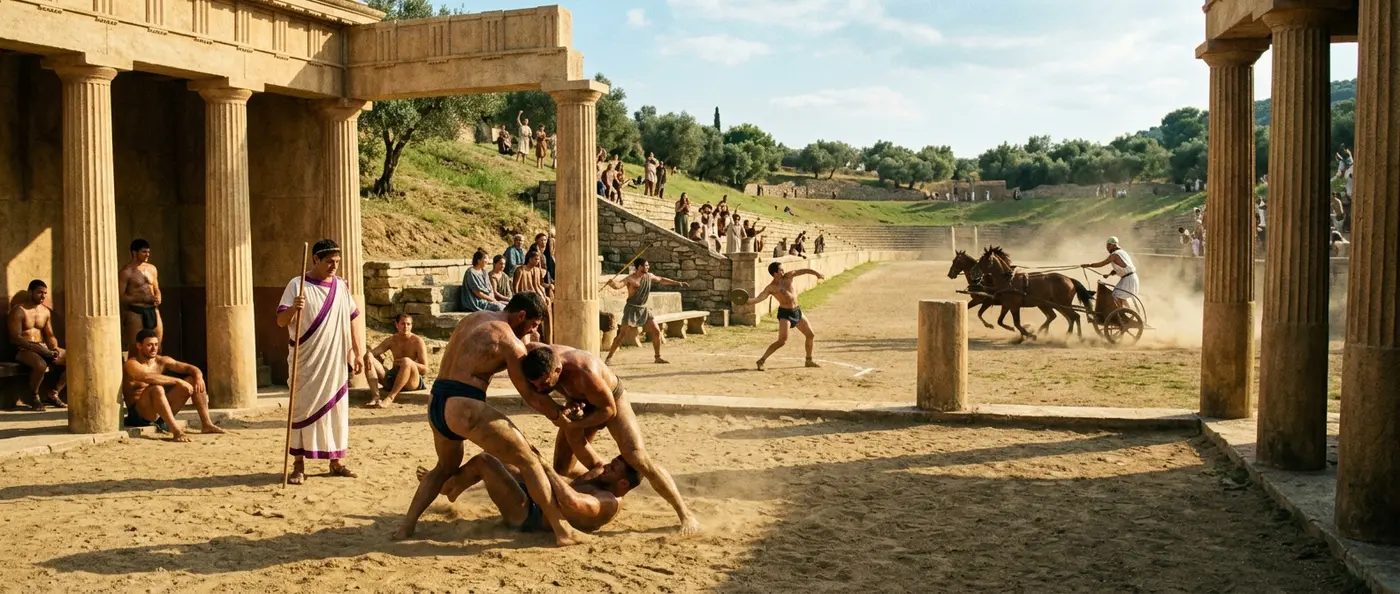
The modern Olympics, revived in 1896, kept only the most "civilized" sports from their ancient predecessors. The stadion (sprint), wrestling, and boxing survived in some form. But what happened to pankration, where athletes could break bones and strangle their opponents? Or the hoplitodromos, where runners raced naked wearing only a helmet and shield?
📖 Read more: 2026 Excavation Unveils 6th-Century Poseidon Temple
These lost sports reveal a different side of ancient Greek civilization — a society that valued toughness and endurance over safety, where victory could cost an athlete their life. Let's explore five of the most fascinating sports that once dominated Olympia but today exist only in the pages of history.
🥊 Pankration: The Ultimate Combat Sport
Pankration stood as the ancient Olympics' most brutal contest. It combined elements of boxing and wrestling in a contest with virtually no rules. The only restrictions were prohibitions against biting and eye-gouging — everything else was allowed. Strangulation, joint breaks, kicks to the head, even strikes to the genitals were legal techniques.
Matches had no rounds or time limits. They continued until one athlete surrendered by raising his index finger or lost consciousness. Deaths were not uncommon. Arrhichion of Phigalia became legendary when he died during the final but won because his opponent surrendered just before Arrhichion died from strangulation.
💀 The Dead Champion Paradox
At the ancient Olympics of 564 BC, Arrhichion was crowned pankration champion while dead. As his opponent strangled him, he managed to break the man's ankle, forcing him to surrender. The judges declared Arrhichion the winner, placing the olive wreath on his lifeless body.
Pankration required exceptional physical conditioning and technique. Athletes trained for years, learning complex submission techniques and strikes. The Greeks viewed this violence as an art demanding strategy over raw strength.
🛡️ Hoplitodromos: The Warriors' Race
Imagine running 400 meters under the scorching Greek sun, completely naked except for a heavy bronze helmet and a shield weighing about 15 pounds. This was the hoplitodromos, a sport that combined the speed of running with military readiness.
The event was added to the Olympics in 520 BC as a way to honor military virtue. Runners had to maintain their balance while carrying the heavy shield, while the helmet restricted their vision. Many fell or lost their equipment, providing comic relief for spectators.
The hoplitodromos had deep symbolism. It represented the transition from war to peace — warriors running naked with only their defensive weapons. It was also the final event of the Olympics, marking the end of the sacred truce.
🏇 Apene: The Deadly Mule Cart Race
Formula 1 drivers face nothing compared to the apene. The apene was a chariot race pulled by mules — yes, mules, not horses. Four mules pulled a light two-wheeled cart around the hippodrome for 14 laps, about 8 miles total.
Mules were more unpredictable than horses, making the race extremely dangerous. Charioteers had to manage four strong-willed animals at speeds reaching 22 mph, navigating tight turns where chariots frequently collided.
Why Mules?
Mules were considered more resilient than horses in heat and had greater endurance. However, they were also more stubborn, making their control a real challenge for charioteers.
Fatal Accidents
Collisions were so frequent that spectators anticipated them eagerly. Charioteers died when thrown from their carts or trampled by the animals.
In 500 BC, the apene was removed from the Olympics. The reasons aren't clear, but likely the excessive mortality rate and the low prestige of mules compared to horses played a role. The sport had lasted only 84 years in the Olympic program.
🎺 Trumpeters and Heralds Competition: The Battle of Lungs
Not all Olympic sports required muscular strength. From 396 BC, the Olympics included competitions for trumpeters and heralds. Yes, you read correctly — there were Olympic contests for who could shout loudest or play the trumpet most impressively.
Trumpeters competed to produce the loudest and clearest sound audible throughout the stadium. They had to hold a note for as long as possible without taking a breath. Some fainted from the effort.
Heralds were judged on the intensity, clarity, and endurance of their voices. They had to recite entire lists of winners and official announcements without becoming hoarse. The winner earned the privilege of announcing the winners of other events.
🎵 Musical Competition Comparison
These contests had practical purposes. In an era without microphones and sound systems, trumpeters and heralds were essential for organizing the games. Their ability to be heard by thousands of spectators was crucial for the smooth running of the Olympics.
🏺 Pentathlon: The Ultimate Athletic Test
The ancient pentathlon was very different from the modern version. It included five events: stadion (sprint), long jump, discus, javelin, and wrestling. All five events took place in a single day, demanding excellence across every discipline.
The scoring system remains a mystery. We know that if someone won the first three events, they were immediately declared champion. Otherwise, the top athletes continued to wrestling for the final winner. This meant an exceptional wrestler could overturn everything at the end.
The long jump was particularly interesting. Athletes held heavy weights (stone or metal) in their hands and swung them back and forth to gain momentum. At the peak of the jump, they threw the weights backward, theoretically increasing their distance.
The pentathlon was considered the most complete sport, requiring speed, strength, flexibility, technique, and endurance. Pentathlon winners enjoyed special respect as they were considered the most well-rounded athletes.
🔮 Why Did These Sports Disappear?
These sports died a slow death as the ancient world transformed. As the Greco-Roman world changed, so did its values. In 393 AD, Christian Emperor Theodosius I banned the Olympics as a pagan festival. For more than 1,500 years, these sports existed only in ancient texts and pottery depictions.
When Pierre de Coubertin revived the Olympics in 1896, he carefully chose which sports to include. Pankration was too violent for the Victorian era. The hoplitodromos seemed strange without its military context. Trumpeter contests didn't fit the idea of modern athletics.
🏛️ Modern Revival Attempts
In 2010, a group of Greek athletes tried to revive pankration as a modern sport with safety rules. Despite their efforts, the International Olympic Committee has shown no interest in bringing back any of the lost ancient sports.
These sports belonged to an era when death lurked behind every competition. They remind us that the ancient Greeks, despite their philosophy and art, lived in a world where violence was spectacle and victory was worth any sacrifice.
Today, as we watch the modern Olympics with their strict safety rules and emphasis on fair play, let's remember these lost sports. They teach us that athletics, like every human activity, reflects the values and priorities of its time. And perhaps they make us appreciate more the fact that today's athletes can compete for glory without risking their lives.