🏛️ Architecture of Royal Tombs
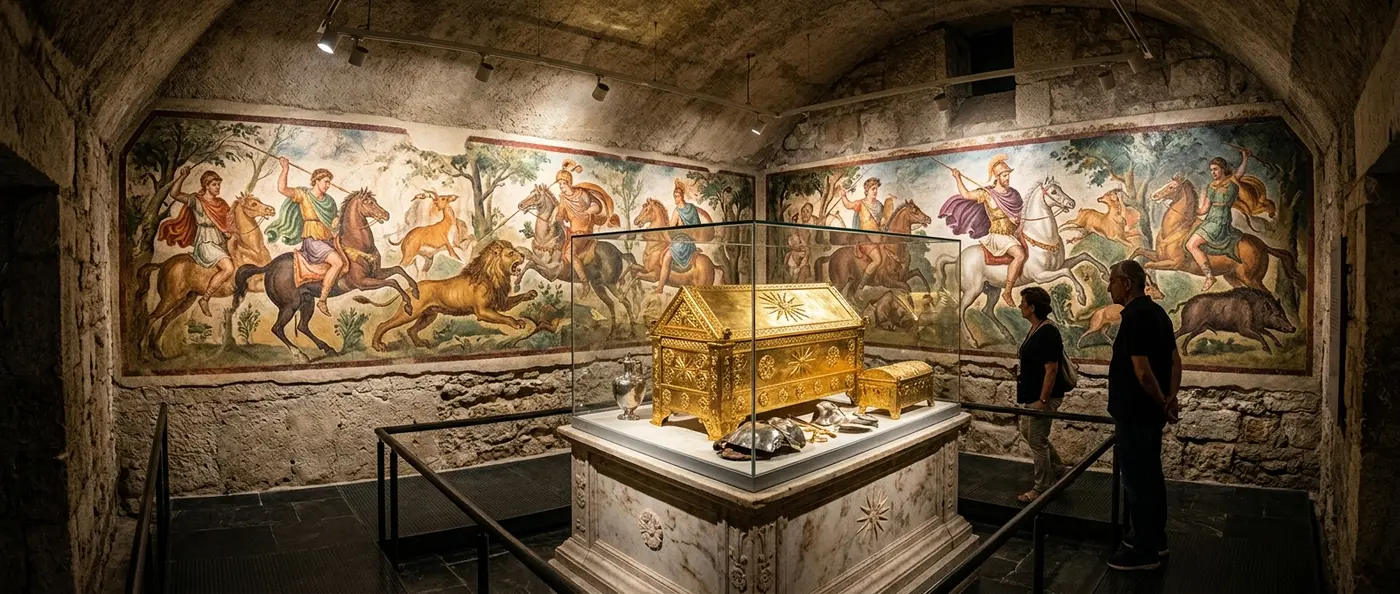
The royal tombs of ancient Macedonia stand as monuments to power that blends Greek and local traditions. The vaulted tombs, known as "Macedonian tombs," are characterized by imposing facades that mimic temples, complete with columns, architraves, and pediments. Entrances were sealed with marble doors, while interiors featured frescoes depicting mythological scenes and episodes from the deceased's life.
Constructing these tombs required specialized craftsmen and enormous resources. Architects had to calculate the vault's statics with precision, while painters created artworks that would remain hidden for centuries. The result was underground "temples" symbolizing the transition from life to death while preserving the deceased's social status.
Structural Elements
Barrel-vaulted ceiling with false dome, marble facade with Doric or Ionic columns, antechamber and main burial chamber.
Decoration
Frescoes depicting hunting scenes, symposiums, and mythological representations. Use of purple and gold to emphasize royal status.
Symbolism
Architecture reflected the deceased's power and prestige, with elements referencing heroic cult worship.
👑 The Royal Cemetery of Aigai
Aigai, the ancient capital of the Macedonian kingdom (modern Vergina), hosts the most significant collection of royal tombs. Here, beneath the Great Tumulus, intact tombs dating from the 4th century BC were discovered. The most famous is Tomb II, which many researchers attribute to Philip II, father of Alexander the Great.
The discovery was made in 1977 by archaeologist Manolis Andronikos and shocked the international archaeological community. Inside the tomb were found golden larnakes containing the bones of the deceased king and his wife, precious jewelry, weapons, and the famous golden oak wreath. The quality of the finds and their excellent preservation provide unique insights into royal burial practices.
Beyond Tomb II, over 500 tombs from various periods have been excavated at Aigai. Among them stand out the "Prince's Tomb" with exceptional frescoes and the "Tomb of Persephone" featuring the unique depiction of the goddess's abduction by Pluto. Each tomb constitutes a small museum narrating the story of people who lived and ruled in ancient Macedonia.
🗿 Grave Goods: Treasures for Eternity
The grave goods accompanying deceased kings reveal the wealth and power of the Macedonian kingdom. Golden and silver vessels, jewelry of exceptional craftsmanship, weapons with precious decoration, and personal objects were carefully placed around the deceased. These items weren't merely symbols of wealth but held practical significance for the journey to the underworld.
Particularly fascinating are the golden wreaths that mimic with stunning accuracy leaves of oak, myrtle, or olive. Their construction technique demonstrates the high specialization of Macedonian goldsmiths. Additionally, silver symposium vessels, kraters, and wine jugs indicate the importance of symposiums in Macedonian aristocracy, a tradition that continued symbolically after death.
⚔️ Weapons and Armor: The Warrior King
The presence of weapons in royal tombs underscores the military character of Macedonian monarchy. Kings were primarily military leaders who personally led their armies into battle. Iron cuirasses with golden decoration, helmets, shields, and swords were placed beside the deceased, often in special cases or stands.
The most impressive find is the iron panoply from Tomb II at Aigai. The cuirass, decorated with golden lion heads, and the helmet with its characteristic crest represent masterpieces of ancient metalwork. The shield, covered with gold and ivory, bore complex decoration combining geometric motifs with symbolic representations.
Besides defensive weapons, tombs contained offensive weapons like sarissas (long Macedonian spears), kopis-type swords, and bows. Their construction quality and luxurious decoration show these were specially commissioned for royal burial rather than weapons used in actual battles.
🏺 Rituals and Burial Practices
Macedonian royal funeral rituals were complex procedures lasting several days. After death, the king's body was prepared with special aromatics and oils. This was followed by the laying out of the deceased (prothesis) where subjects could pay their respects. Cremation occurred on a specially constructed pyre, often with horse sacrifices to accompany the deceased on his journey.
After cremation, bones were carefully collected, cleaned with wine, and placed in golden or silver larnakes. Placement in the tomb was accompanied by sacrifices and offerings. Food, drinks, and everyday objects were placed in the tomb to serve the deceased in the afterlife. Finally, the tomb was sealed and covered with an earthen tumulus.
💡 The Mystery of Identity
The identity of the buried king sparks fierce academic debates. While many support that Tomb II belongs to Philip II, others propose Philip III Arrhidaeus, Alexander the Great's half-brother. Modern DNA analyses and anthropological study of bones continue providing new evidence.
🔬 Modern Discoveries and Technologies
Recent archaeological research in Macedonia employs advanced technologies for discovering new tombs and studying known ones. Lidar technology enables detection of underground structures without excavation, while 3D imaging helps digitally restore damaged frescoes. Meanwhile, isotope analyses reveal information about the deceased's diet and origins.
New tombs have emerged at ancient Pella and Amphipolis. Though not royal tombs of Aigai's magnitude, they provide valuable information about burial practice evolution and royal influence on aristocracy. DNA study from bones opens new paths in understanding kinship relations among the deceased.
Scientists analyzing pigments in tomb frescoes discovered rare materials imported from across the Mediterranean. For example, analysis of pigments in frescoes showed use of rare materials imported from distant regions, highlighting the Macedonian kingdom's extensive trade relations.
🌍 Influence on Later Civilizations
Macedonia's royal cemeteries profoundly influenced Hellenistic period burial practices. After Alexander's conquests, the Macedonian model spread from Egypt to Bactria. The Ptolemies in Alexandria, Seleucids in Antioch, and other Hellenistic dynasties adopted similar practices, adapting them to local traditions.
Particularly impressive is the influence on Roman imperial burial architecture. Augustus's Mausoleum and Hadrian's Mausoleum in Rome bear elements reminiscent of Macedonian tumuli. The concept of the heroic tomb-monument elevating the deceased to superhuman status was preserved and evolved through the centuries.
🏛️ Comparison of Royal Cemeteries
📜 Inscriptions and Written Testimonies
While Macedonia's royal tombs don't contain extensive inscriptions like Egyptian ones, the few found are extremely significant. Names on vessels and weapons help identify the deceased. For example, the inscription "PHILIPPOU" on silver vessels from Tomb II strengthens the view that it belongs to Philip II.
Ancient writers like Diodorus Siculus and Plutarch provide valuable information about royal burials. They describe luxurious ceremonies, rich grave goods, and the importance proper burial held for the king's posthumous honor. These testimonies, combined with archaeological finds, enable reconstruction of the rituals.
Papyrus testimonies from Egypt referring to Alexander's burial are also interesting. Though the great conqueror's tomb hasn't been found, descriptions of the golden sarcophagus and mausoleum in Alexandria show continuity of Macedonian tradition in a new environment.
🗺️ Other Significant Macedonian Cemeteries
Beyond Aigai, Macedonia has numerous other significant cemeteries. At Derveni, near Thessalonica, tombs with exceptional metal vessels were discovered, including the famous Derveni Krater. In Aineia and Mende in Chalkidiki, local rulers' tombs mimic royal models on a smaller scale.
Amphipolis constitutes a special case. The enormous Kasta tumulus, with a perimeter of nearly 500 meters, conceals an impressive tomb dating to the late 4th century BC. Excavations revealed marble chambers with mosaic floors and high-quality sculptures. The deceased's identity remains mysterious, but the tomb's magnificence suggests a royal family member or high-ranking official.
Derveni
Tombs with bronze and silver vessels of exceptional craftsmanship, dating to the 4th century BC.
Amphipolis
Macedonia's largest tumulus with mysterious burial and impressive mosaics.
💎 Legacy of the Royal Cemeteries
Ancient Macedonia's royal cemeteries constitute a valuable source of knowledge about a civilization that changed history's course. Through the tombs, we see not only the kings' wealth and power but also their beliefs about the afterlife, the art they cultivated, and influences they received from other civilizations.
Study of these monuments continues with undiminished interest. Each new discovery adds a piece to the Macedonian history puzzle. Modern technologies promise even more revelations, while preservation and promotion of known tombs ensures future generations can admire these masterpieces of ancient art and architecture.
Macedonia's royal cemeteries remind us that death for the ancients wasn't the end but a transition. Kings who conquered the world continue living through their monuments, teaching us about art's power to defeat time and keep alive the memory of people who shaped history.