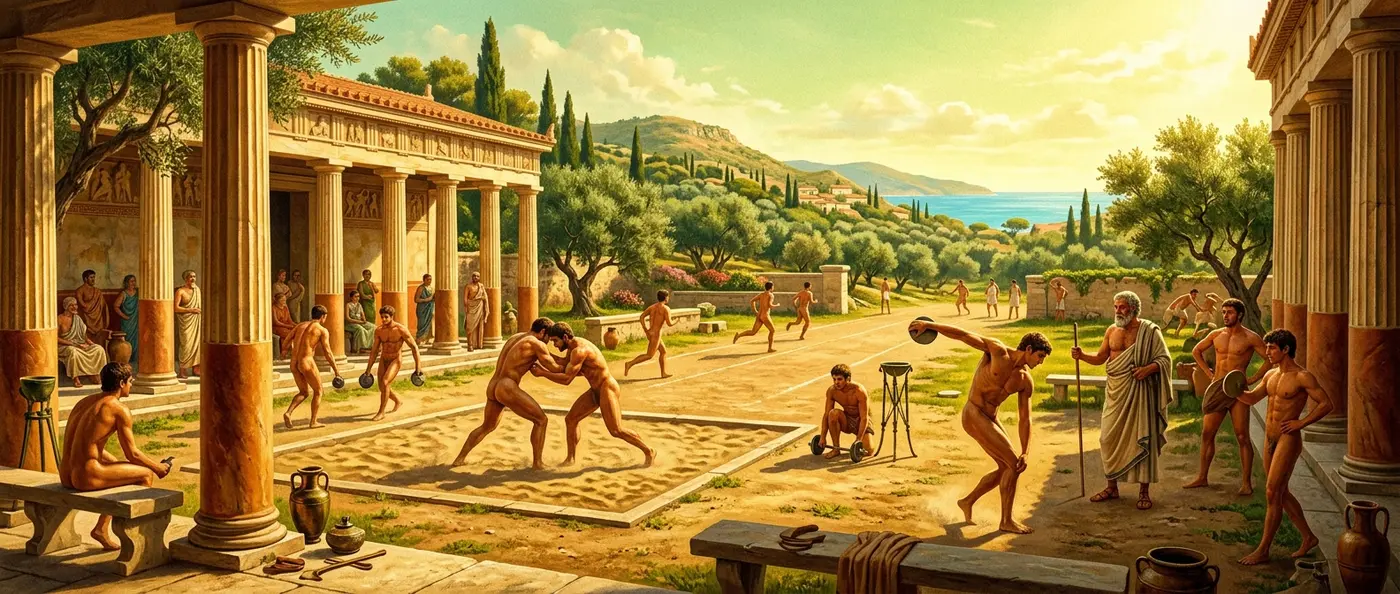
In ancient Olympia, where today we see only ruins, thousands of young men gathered every four years to compete naked before crowds of spectators. But the story of athletics didn't begin in the stadium — it began in the gymnasiums, training grounds that merged physical prowess with intellectual pursuit.
🏛️ The First Gymnasiums in History
The gymnasium in ancient Greece was far more than just a place for exercise. The word derives from "gymnos" (naked), as athletes trained without clothes — a practice that shocked other peoples of the time. The first organized gymnasiums appeared in the 6th century BCE in major cities like Athens, Sparta, and Corinth.
Each gymnasium featured extensive facilities including a palaestra for wrestling, running tracks, spaces for jumping and throwing events, and baths. The gymnasium at Athens' Lyceum, where Aristotle taught, extended across several acres.
Entry to gymnasiums was strictly controlled. Only free male citizens had the right to participate, while slaves and foreigners were excluded. The age of admission varied by city, but boys typically began frequenting the gymnasium around 12-14 years old.
Gymnasium Architecture
Gymnasiums were designed with large open courtyards surrounded by colonnades. The palaestra, the central wrestling space, was square with sides of approximately 50 meters.
Operating Regulations
Each gymnasium had a gymnasiarch who supervised operations and paidotribes who trained the athletes. There were strict rules for hygiene and behavior.
Social Role
Beyond athletics, gymnasiums functioned as centers for social interaction and intellectual cultivation of young men.
⚔️ The Spartan Approach to Athletics
The Spartans pushed athletics beyond all limits. In Sparta, physical education wasn't optional but mandatory, beginning at age seven. Boys endured daily exercises of brutal intensity.
What distinguished Sparta was that women also participated in athletic activities. Young Spartan women ran, wrestled, and threw discus, shocking visitors from other cities. The goal? To become strong mothers who would bear healthy warriors.
Spartan gymnasiums differed from other Greek facilities. Here there was no room for philosophical discussions or artistic pursuits. The emphasis was exclusively on harsh training and preparation for war. Exercises included combat with wooden weapons, endurance contests, and group tactics.
Ancient gymnasiums became the cradle of many sports that survive today. The pentathlon, which included running, jumping, discus, javelin, and wrestling, was considered the perfect test of athletic ability. Each sport had its own technique and required different skills.
Wrestling was perhaps the most popular sport. There were three types: upright wrestling, ground wrestling, and pankration — a violent combination of wrestling and boxing where almost anything was allowed. Pankration champions achieved fame across the Greek world.
Running included various distances: the stadion (192 meters), the diaulos (two stadia), and the dolichos (long distances). Jumping was performed with the help of halteres — weights that athletes held in their hands to increase their momentum.
🔱 The Religious Dimension of Athletics
For the ancient Greeks, athletics wasn't merely physical exercise — it was a form of worship. Every major competition was dedicated to a god: the Olympics to Zeus, the Pythian Games to Apollo, the Isthmian Games to Poseidon. Athletes made sacrifices and prayers before competitions.
Gymnasiums contained altars dedicated to Heracles and Hermes, the patron gods of athletes. Heracles was considered the mythical founder of many sports, while Hermes symbolized speed and agility. Victories in competitions were seen as divine favor.
The religious significance of athletics is evident from the fact that during the Olympic Games, a sacred truce was declared — a cessation of all wars. This holy armistice allowed athletes and spectators from hostile cities to travel safely to Olympia.
📜 From Gymnasium to Agora: Intellectual Athletics
Gymnasiums weren't just places for physical exercise. Over time they evolved into centers of intellectual cultivation. Philosophers like Plato and Aristotle taught in gymnasiums, combining physical with mental training.
Plato's Academy was founded in a gymnasium outside Athens. There, between exercises, students discussed philosophy, mathematics, and politics. Aristotle's Lyceum followed the same model. The idea of "a sound mind in a sound body" was born in these spaces.
No other ancient civilization linked physical and mental training so closely. While other civilizations separated physical from intellectual development, the Greeks considered them inseparable. A good citizen had to be equally capable in the palaestra and the agora.
💡 Did You Know?
Ancient Greeks used olive oil instead of soap after exercise. They would anoint their bodies with oil and then scrape it off with a special tool called a strigil, along with dust and sweat from training.
🏺 Women and Athletics: The Forbidden Subject
Women's participation in athletics was a complex issue in ancient Greece. In most cities, women were excluded from gymnasiums and official competitions. At the Olympic Games, the presence of married women even as spectators was punishable by death — specifically by being thrown from the Typaion cliff.
There were exceptions, however. The Heraia, running competitions for girls, were held at Olympia in honor of the goddess Hera. Young female athletes ran in short tunics that left the right shoulder and breast uncovered. Winners were crowned with olive branches and had the right to erect statues with their names.
Cynisca, sister of the Spartan king, became the first woman to win at the Olympic Games in 396 BCE — not as an athlete but as owner of the winning four-horse chariot. The inscription from her statue proudly declares that she was the "only woman in all of Greece" to achieve this victory.
Ancient gymnasiums shaped more than just athletic training. They created a model of holistic education that influenced all of Western civilization. The idea that physical exercise is essential for character and mental development was born in these spaces.
When the Romans conquered Greece, they adopted many elements of Greek athletics, though with their own interpretation. Roman thermae combined baths with exercise spaces, following the Greek model. However, Romans preferred more violent spectacles like gladiatorial contests.
The revival of the Olympic Games in 1896 was based on the ideals of ancient gymnasiums. Pierre de Coubertin, founder of the modern Olympics, was inspired by the Greek idea of fair play and the cultivation of body and mind. Today, every gym in the world is a descendant of those first Greek gymnasiums.
🏛️ Ancient vs Modern Gyms
🗿 Archaeological Findings and Modern Discoveries
Excavations at ancient gymnasiums continue to reveal new information about ancient athletics. At Amphipolis, archaeologists discovered a massive 4th century BCE gymnasium with impressive mosaics depicting athletes. At Messene, the unearthed gymnasium still features the ancient changing rooms.
Findings include athletic equipment like halteres, discuses, and strigils. Inscriptions with winners' names and competition rules provide valuable information. Vases with athletic scenes reveal technical details of sports not described in texts.
At the gymnasium of Eretria, archaeologists found lead tablets inscribed with curses against rival athletes. This shows that competition was so intense that some resorted to magical practices to win.
Study of bones from ancient athletes' graves reveals injuries that testify to the harshness of competitions. Fractures, dislocations, and head trauma were common, especially among pankration athletes. Nevertheless, athletes' average lifespan was longer than the general population, indicating the benefits of systematic exercise.