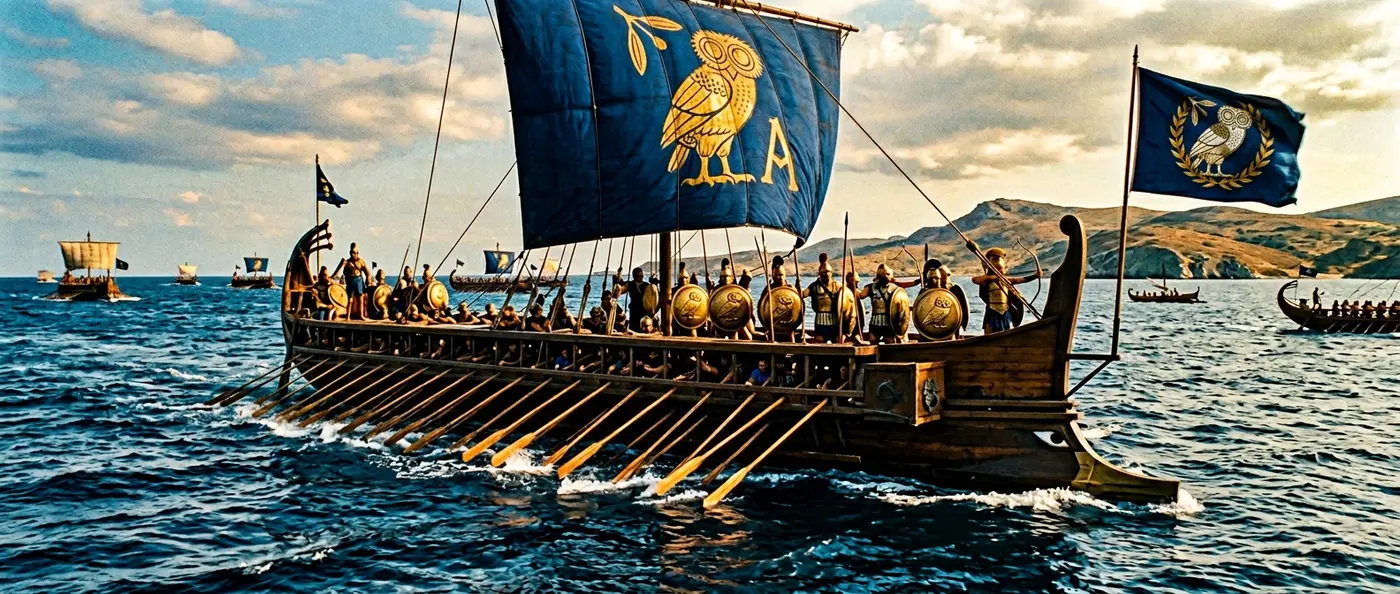
In the shipyards of Piraeus, 480 BC, hundreds of craftsmen worked feverishly to complete the vessels that would change the course of history. The triremes, with their three tiers of rowers and bronze rams, weren't just warships — they were the ultimate weapon that would secure Athens' dominance over the Mediterranean for an entire century.
🚢 The Evolution of Greek Shipbuilding
The story of Greek shipbuilding begins long before the legendary triremes appeared. In Homer's Iliad, written in the 8th century BC, ships like triaconters and penteconters are mentioned — vessels with 30 and 50 rowers respectively. These early ships laid the foundation for developing more sophisticated designs.
Biremes, ships with two tiers of rowers, emerged in the 8th century BC, as evidenced by reliefs from the period. Accumulated experience and technological innovations led to the development of the trireme in the early 7th century BC. According to Thucydides, the Corinthians were the first to introduce this design to the Greek world, though modern historians believe triremes may have been first built in Phoenicia.
The transition from simple rowing vessels to advanced triremes wasn't merely technological — it was revolutionary. The new ships combined speed, maneuverability, and destructive power in ways never before seen at sea.
Triaconters & Penteconters
The first Greek warships with 30-50 rowers. Simple in design but effective for their time, they established the foundation of naval tradition.
Biremes
The introduction of a second tier of rowers in the 8th century BC significantly increased ship speed and power, paving the way for the trireme.
Triremes
The pinnacle of ancient shipbuilding with three tiers of rowers. Speeds up to 10.4 mph and a bronze ram weighing 450 kilograms.
⚓ Anatomy of the Perfect War Machine
Greek shipwrights had solved an impossible puzzle. At 36-40 meters long and up to 5.8 meters wide, the ship was designed for maximum speed and agility. The empty trireme weighed just 19 tons, allowing it to achieve impressive velocities.
The trireme's most fearsome weapon was the bronze ram at the prow, weighing nearly 450 kilograms. This ram didn't just serve to pierce enemy ship hulls — it also reduced wave force at the bow, improving navigation. The oak keel extended from the prow to support the ram, as the ship's integrity depended on its strength.
Triremes featured two design types: the cataphract model had a deck protecting rowers from weather and projectiles, while the aphract model left the upper tier rowers exposed. During battle, the mast and main sail were removed to lighten the ship.
🏛️ The Crew: Soul of the Trireme
Each trireme had a crew of approximately 200 men, with 170 of them being rowers. The rowers were organized in three levels: the thalamites sat at the hull's base facing the worst conditions, the zygites were at the middle level, and the thranites at the top had to exert the greatest effort due to their higher position.
The Athenian fleet had one crucial advantage over its rivals. Unlike other naval powers, the Athenians had over 50,000 rowers, few of whom were slaves or foreigners. Most belonged to the thetes class — working-class citizens who couldn't afford their equipment as hoplites.
The development of the navy as a bulwark of Athenian democracy in the 5th century BC increased this social class's influence relative to the aristocracy. It's no coincidence that Greek philosophers like Plato and Athenian citizens began referring to their leaders as "helmsmen" guiding the "ship of state."
💡 The Cost of Naval Power
Building a trireme cost more than one talent (6,000 drachmas or 26 kilograms of silver). Crew wages were also one talent per month, an expense covered by the trierarch from his own pocket — a form of liturgy to the city.
⚔️ The Art of Naval Warfare
Naval battles with triremes were a deadly dance of speed and precision. The primary tactic was ramming — attempting to strike the enemy ship's side with the trireme's ram, either to open a hole in the hull or destroy the oars and immobilize it. Scholars calculate that maximum ramming speed reached 9 knots (10.4 mph).
Under sail, rowers followed the boatswain's commands, issued by voice or striking a piece of wood with a club. When wave noise or battle prevented the boatswain from being heard, a flute marked the rowing rhythm. Rowers participated with traditional songs to maintain tempo.
The trireme's maneuverability was as important as its speed. The ship could turn sharply, enabling impressive maneuvers like the diekplous (breaking through enemy lines) and periplous (circular movement around the enemy).
⚓ Naval Tactics Comparison
🌊 Daily Life at Sea
Life aboard a trireme wasn't easy. The ships had little space for storage or sleep, so they sailed only during daylight. At night, the trireme was pulled out of the water, both to protect the hull from wood-boring worms and to allow the crew to eat and rest.
Crew nutrition was critical to performance. A typical diet included salted fish, oat cakes, wine, cheese, vegetables, and about seven liters of water daily. Maintaining the crew in good physical condition was essential for any mission's success.
To the Greeks, each trireme had a soul. For this reason, ships received individual names, almost always feminine. The characteristic eyes found on both sides of the prow were used to "find their way at sea," the catwalks protruding from the bow were their "ears," and the sails were their "wings."
🏺 Athens' Legendary Triremes
Athens possessed two exceptional triremes, the Salaminia and the Paralos. Famous for their beauty, these flagships were often used for diplomatic missions or ceremonies, such as transporting Athenian athletes to the Olympic Games every four years.
In the 5th century BC, Athenian shipyards had the capacity to build and maintain over 300 triremes. With proper maintenance, triremes could remain in service for 20 to 25 years before being retired or sold as "war surplus." History has recorded some that sailed for more than 80 years.
Ships in the best condition were designated for military use, while older ones were used primarily for patrol and transport. Even when a ship sustained battle damage, it could be repaired and returned to service.
The Salaminia
Sacred trireme used for religious missions and carrying important messages. Named after the victory at Salamis.
The Paralos
Diplomatic vessel that carried embassies and official delegations. Considered sacred and enjoyed special protection.
🔱 The Legacy of Triremes
The trireme's bronze ram and three-tiered design spread across the Mediterranean like wildfire. Carthaginians copied it. Romans improved it. For centuries, no admiral dared go to sea without one.
Beyond its military significance, the trireme played a decisive role in developing Athenian democracy. The need for thousands of rowers gave political power to the lower classes, who became essential for the city's defense. This "naval democracy" forever changed Athens' social structure.
Today, our knowledge of triremes comes from archaeological finds, ancient texts, and modern reconstructions. In 1987, a complete trireme replica, the "Olympias," was built and tested, confirming many ancient descriptions of these exceptional ships' speed and maneuverability.
Ancient Greek shipbuilding and triremes represent one of the ancient world's greatest technological achievements. From the humble beginnings of triaconters to trireme dominance in the Mediterranean, the evolution of Greek shipbuilding is a story of innovation, courage, and strategic genius that continues to inspire today.