🌟 The Birth of Systematic Astronomy
Ancient Greek astronomy didn't begin with Hipparchus. As early as the 9th century BCE, Homer referenced the Pleiades, Boötes, and the Great Bear in the Odyssey — constellations that Greek sailors used for navigation. Odysseus observes "with steady gaze the Pleiades, Boötes who sets late, and the Great Bear, which others call the Wagon, which revolves, always watching Orion, and alone never dips into the waters of the deep."
Greek astronomy broke new ground by replacing mythological interpretation with mathematical analysis. Thales of Miletus, according to Cicero, constructed the first celestial sphere. Eudoxus of Cnidus mapped the stars that appear in the sky onto it. Later, the poet Aratus, in the 3rd century BCE, described 43 constellations in his work "Phaenomena," borrowing from Eudoxus's elegant design.
Greek astronomers revolutionized the field by using coordinates to record precise stellar positions. Around 450 BCE, the ecliptic — the sun's apparent path through the sky — was recognized and divided into 12 equal sections of the zodiac. This system, likely developed simultaneously in Greece and Babylon, became the foundation for measuring celestial bodies.
⭐ Hipparchus and the Lost Catalog
Hipparchus of Rhodes, who lived in the 2nd century BCE, is considered the greatest astronomer of antiquity. According to Victor Gysembergh, a historian of science at the French National Center for Scientific Research, "he was unquestionably the greatest ancient astronomer. At least the greatest we know by name."
Hipparchus created the first systematic star catalog. Using a coordinate system similar to geographical longitude and latitude, he recorded the precise positions of approximately 800 stars. This was the first time two coordinates were used to determine the position of each celestial object.
Unfortunately, Hipparchus's original catalog was lost to time. We knew of its existence only through the writings of later scientists, such as Ptolemy, who created his own star catalog around 150 CE and attributed an earlier one to Hipparchus.
🔬 Discovery of the Lost Coordinates
In 2022, a team of researchers discovered fragments from Hipparchus's catalog in a palimpsest — a manuscript that had been written and erased multiple times. The text was found in the Codex Climaci Rescriptus, a collection of parchments from the 10th or 11th century CE from Saint Catherine's Monastery in Egypt.
The discovery happened by chance. In 2012, biblical scholar Peter Williams from Cambridge University asked his students to study images of the codex. One of them, Jamie Klair, noticed Greek writing beneath the Syriac text. In 2017, the parchments were photographed with advanced multispectral imaging tools that revealed the hidden text.
The discovered coordinates concerned the four extreme stars of the Corona Borealis constellation. Remarkably, they were found to be accurate within one degree of modern values — an extraordinary achievement for someone working roughly 1,700 years before the invention of the telescope.
💡 The Precession Phenomenon
Using the phenomenon of precession — the wobble of Earth's axis as it rotates — researchers determined that the coordinates correspond to star positions as they appeared from Rhodes around 130 BCE. Ironically, Hipparchus was also the first scientist to describe the motion of precession!
🛠️ Tools of Ancient Astronomers
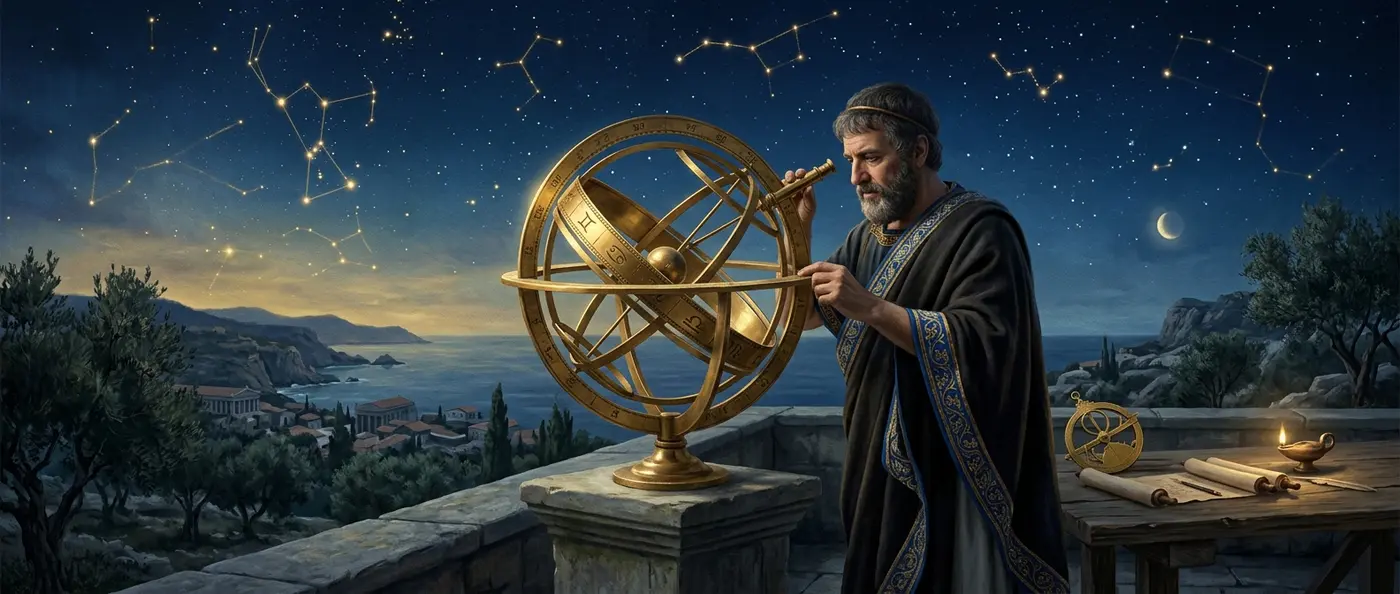
How did Hipparchus manage to measure stellar positions with such accuracy without modern instruments? Historians believe he used an armillary sphere — a mechanical device with rotating rings representing various parts of the celestial sphere.
According to James Evans, a physicist and historian of science at the University of Puget Sound, Hipparchus may also have used a dioptra, a type of surveying instrument. "The dioptra could be used for measuring angles in surveying work, but you can imagine something like that being used also for measuring angles of the sky."
The armillary sphere, named after the Latin word for bracelet, is a sphere of concentric rings that could have sights. "You could set it up and use it to measure angles," Evans explains.
Armillary Sphere
Mechanical device with rotating rings representing the celestial equator, ecliptic, and other celestial elements. Enabled precise angle measurements.
Dioptra
Surveying instrument with sights that could be adapted to an adjustable platform. Used for measuring angles both on Earth and in the sky.
Mathematical Calculations
Combination of Greek geometry with Babylonian observational methods. Use of trigonometry to calculate distances and positions.
🌍 The Synthesis of Two Worlds
Hipparchus merged two different astronomical traditions. On one hand, Babylonian astronomers had developed a system for measuring the distances of certain constellations from the ecliptic. By tracking the movements of zodiacal constellations, they could measure seasons and predict astronomical events like eclipses.
On the other hand, the Greeks had developed an approach based on geometry and natural philosophy. Hipparchus combined Babylonian practices of regular observation and recording with Greek concepts of mathematics and geometry.
"Modern astronomy really comes from the merger of these two different approaches," Evans emphasizes. "The Greek approach based on geometry and natural philosophy. The Babylonian approach based on regular observation and number crunching."
📜 Ptolemy's Catalog and the Legacy
Ptolemy's star catalog, included in his 2nd-century CE "Almagest," contains ecliptic coordinates and magnitudes (brightness measurements) for 1,022 stars, grouped into 48 constellations. For many centuries, many scholars believed Ptolemy simply borrowed his material from Hipparchus's lost catalog.
However, critical analysis of surviving Hipparchus fragments indicates that his catalog included no more than 850 stars and that Ptolemy likely obtained new coordinates even for those 850 stars. The evidence shows that Ptolemy, who for more than a century was considered merely a compiler, must be placed among the top astronomical observers of all time.
Ptolemy divided his stars into six categories of brightness or magnitude. He recorded 15 bright first-magnitude stars but comparatively few of the dim, much more numerous but barely visible sixth-magnitude stars. The magnitude system he established is still used today, albeit with more precise measurements.
📊 Ancient Catalog Comparison
⚙️ The Antikythera Mechanism
Ancient Greek astronomy left its mark beyond catalogs and charts. In 1901, sponge divers discovered near the island of Antikythera a device that has been called the world's oldest computer. The Antikythera Mechanism, created approximately 2,200 years ago, used bronze gears to track the movements of the sun, moon, and planets.
Recent 2024 research revealed that the mechanism followed the Greek lunar calendar, not the solar calendar used by the Egyptians. Using statistical techniques developed for detecting gravitational waves, researchers from the University of Glasgow determined that the mechanism's "calendar ring" likely had 354 or 355 holes — one for each day of the lunar year.
"The Glasgow team's results provide new evidence that one of the Antikythera Mechanism's components was likely used to track the Greek lunar year," the researchers reported. The precision of hole placement would have required extremely accurate measuring techniques and an incredibly steady hand to drill them.
🏛️ The Timeless Impact
Ancient Greek astronomy shaped much more than star catalogs. The Greeks introduced the concept of the celestial sphere — an imaginary sphere with Earth at its center, onto which stars are projected. Although the geocentric model is incorrect, the concept continues to be used by scientists for mapping objects in the sky.
The coordinate system they developed, analogous to geographical longitude and latitude, remains the basis of modern astronomical mapping. The celestial equator, celestial poles, the ecliptic — all these concepts we use today have their roots in ancient Greek thought.
Even the 88 constellations recognized today by the International Astronomical Union include many of the 48 recorded by Ptolemy, which in turn were based on earlier Greek and Babylonian traditions. Names like Orion, Ursa Major, Cassiopeia, and Andromeda connect modern astronomy with the myths and observations of the ancient Greeks.
"The Antikythera Mechanism is a gift that keeps on giving. Despite serious corrosion and many missing elements, the application of increasingly sophisticated technologies and innovative interdisciplinary analysis continues to provide remarkable insights into this extraordinary artifact."
🔭 From Hipparchus to Today
The accuracy of Hipparchus's measurements continues to impress modern scientists. The newly discovered fragments show that his measurements were more accurate than those of Ptolemy, despite the fact that the latter worked almost three centuries later with presumably better instruments.
His method of combining systematic observation with mathematical analysis set the standard for the scientific method. His discovery of Earth's axial precession — a phenomenon that causes the slow shift of star positions over centuries — was one of the most sophisticated achievements of ancient science.
Today, as astronomers use space telescopes and supercomputers to map billions of galaxies, the fundamental approach remains the same: measure, record, analyze. Hipparchus and the ancient Greek astronomers showed that the heavens could be understood through systematic observation and mathematics — an idea that forever changed how we view the universe.