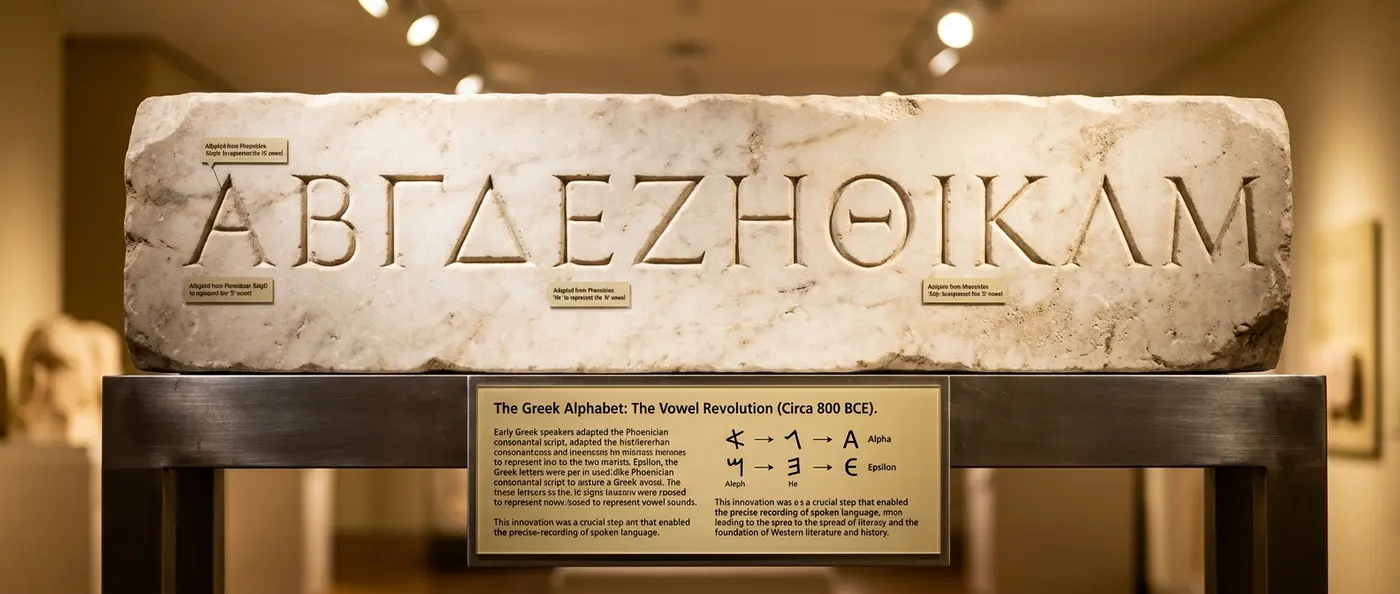
Imagine a world without written communication as we know it today. No books, no messages, no ability to record our thoughts. 2,800 years ago, the ancient Greeks gave humanity one of its most precious gifts: the first complete alphabet with vowels, which would become the foundation for all Western alphabets we use today.
🏛️ Birth of a Revolution
Around the 8th century BCE, the Greeks made a bold decision. They borrowed the Phoenician writing system, which contained only consonants, and transformed it into something entirely new. They added vowels. That addition made precise writing possible for the first time in history.
The Phoenician alphabet, used by Mediterranean traders, was already a significant advance over complex hieroglyphics and cuneiform writing. However, the lack of vowels made it difficult to read and limited its use. The Greeks recognized this problem and solved it ingeniously.
They converted certain Phoenician symbols that represented sounds unknown in the Greek language into vowels. Aleph became alpha (Α), he became epsilon (Ε), yod became iota (Ι), ayin became omicron (Ο). Later, additional vowels were added to cover all sounds of the Greek language.
💡 Why Were Vowels So Important?
With vowels, written words matched spoken ones exactly. A stranger could pick up any text and read it aloud correctly, without knowing the content beforehand.
📜 From East to West
The spread of the Greek alphabet was rapid. Greek merchants and colonists carried it throughout the Mediterranean. From the coasts of Asia Minor to Sicily and southern Italy, the new writing system began to be adopted by various peoples.
Each region adapted the alphabet to its own needs. In Cumae, Campania, Greek colonists brought the Euboean alphabet with them. The Etruscans borrowed and modified it for their own language. From the Etruscans it passed to the Romans, who evolved it into the Latin alphabet.
The journey from Greek to Latin alphabet wasn't direct. The Romans discarded certain letters they didn't need for their language and added others. The letter G, for example, was created by the Romans to distinguish the [g] sound from the [k] sound.
🔬 New Discoveries That Overturn Assumptions
A recent discovery in Syria may change everything we knew about alphabet history. Archaeologists from Johns Hopkins University and the University of Amsterdam discovered four clay cylinders with engraved symbols in the ancient city of Umm el-Marra.
The cylinders date to around 2400 BCE, 500 years earlier than the oldest known alphabetic inscriptions. If confirmed to be alphabetic writing, this means the idea of the alphabet is much older than we believed.
Archaeologist Glenn Schwartz and his team found the cylinders in a high-status burial. They are perforated, suggesting they may have been labels tied to other objects. Expert Ted Lewis recognized the word "silanu" on one of them, which is likely a name.
⚔️ The Power of Written Language
The Greek alphabet did more than record words—it made democracy possible. For the first time, ideas could be recorded accurately and transmitted unchanged across time and space.
Ancient Athens' democracy would have been impossible without widespread literacy. Laws were written on stone for all to see. Citizens could read the assembly's decrees. Ostracism, where citizens wrote the name of someone they wanted exiled on pottery shards, required basic literacy.
Philosophy, science, historiography - all these achievements of Greek civilization relied on the ability to accurately record and transmit complex ideas. Plato could record Socrates' dialogues. Aristotle could systematize knowledge. Euclid could formulate his theorems.
Education
The alphabet made education accessible. With only 24 letters to learn, literacy became achievable for broader segments of the population.
Legislation
Written laws replaced oral tradition. Justice became more transparent and less arbitrary.
Literature
Homer's epics, originally transmitted orally, were recorded and preserved for future generations.
🌍 The Global Legacy
Today, more than 2 billion people use alphabets derived from Greek. The Latin alphabet, used in most European languages, English, and many other languages worldwide, is a descendant of Greek.
The Cyrillic alphabet, used in Russia, Bulgaria, Serbia and other Slavic countries, was created in the 9th century CE by Greek monks Cyril and Methodius, based on the Greek alphabet.
Even alphabets that appear completely different, such as Armenian and Georgian, were influenced by the Greek idea of a complete alphabet with both vowels and consonants.
🔱 The Alphabet in the Digital Age
The revolution begun by the ancient Greeks continues. In the digital age, the alphabet remains the foundation of our communication. Every email, every message, every website uses the same fundamental principle: representing sounds with symbols.
Computers convert letters into binary code, but the basic idea remains the same. A finite set of symbols can express infinite ideas. This simplicity and flexibility is what made the alphabet survive and thrive for nearly three millennia.
New technologies don't replace the alphabet but enhance it. Voice recognition converts speech to written text. Automatic translation enables communication between different alphabets. Yet at the foundation of all these lies the ingenious invention of the ancient Greeks.
📊 The Evolution of the Alphabet
💎 A Legacy That Continues
The Greek alphabet wasn't just a writing system. It was a tool that changed how people think, learn and communicate. From the philosophers of ancient Athens to the programmers of the 21st century, we all use the same basic technology.
Every time we write, we continue a tradition that began nearly 3,000 years ago. The ancient Greeks gave us the power to transform our thoughts into visible symbols, to share them with others, to preserve them for the future.
The next time you write something - a message, a note, an email - think for a moment about the miracle you hold in your hands. It's the legacy of the ancient Greeks, a gift that continues to change the world every day.