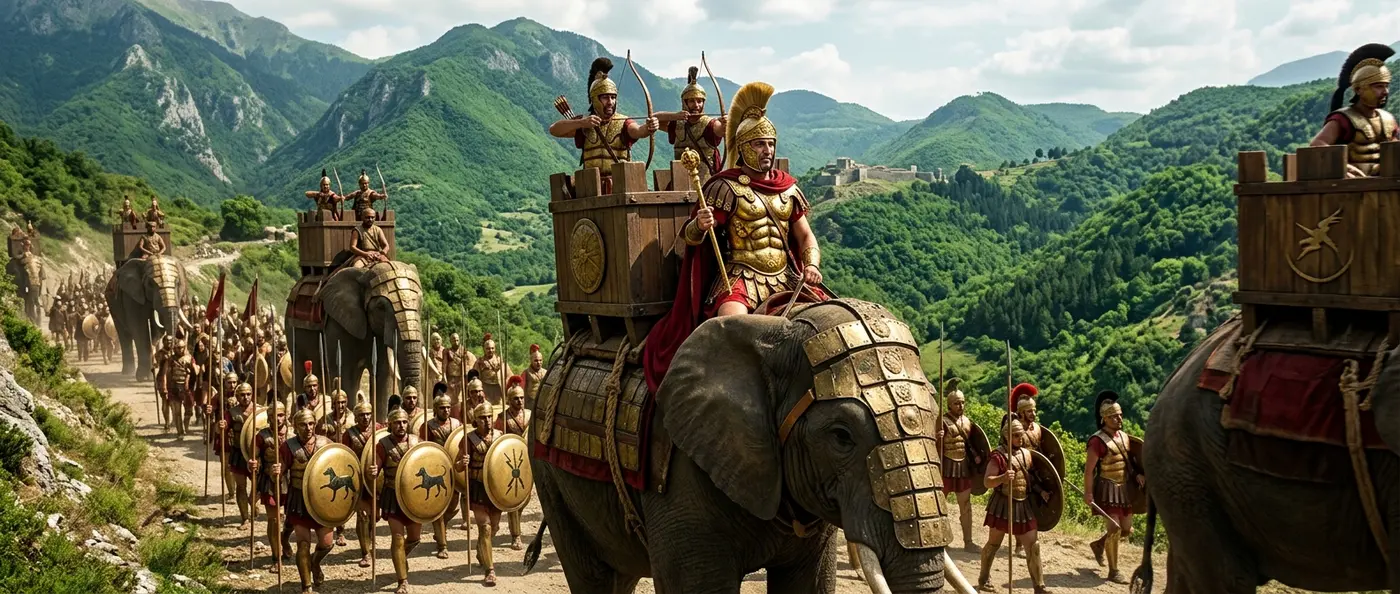
On the steep slopes of the Pindus Mountains, where ancient Greeks believed the Dodonaean Zeus dwelled, one of antiquity's most distinctive civilizations flourished. Epirus, with its legendary Molossians and the renowned King Pyrrhus, carved out a distinct place among Mediterranean powers.
🏔️ The Geography That Forged a People
Ancient Epirus stretched from the Ambracian Gulf to present-day Albania's borders, covering a landscape filled with mountains, gorges, and rivers. This wild geography wasn't merely the backdrop of Epirote life. It was the catalyst that shaped their character.
The Molossians, the region's most powerful tribe, inhabited central Epirus. Their name connects to the mythical Molossus, son of Neoptolemus and grandson of Achilles. This lineage wasn't a random choice. Molossian kings used their mythical genealogy to legitimize their power and enhance their prestige in the Greek world.
The isolation imposed by the mountains had a dual effect. On one hand, it preserved archaic elements in Epirote language and customs. On the other, it forged them into hardened warriors, capable of surviving harsh conditions and confronting any invader.
🗿 The Oracle of Dodona
In Epirus's heart, the Oracle of Dodona stood as the oldest oracle in the Greek world. Here, priests interpreted Zeus's will through the rustling of leaves from the sacred oak tree and the sound of bronze cauldrons hanging around the sanctuary.
The oracle wasn't merely a religious center. It functioned as a cultural hub uniting Epirus's scattered tribes. Every four years, the Naia were held—pan-Epirote games honoring Zeus that rivaled the Olympics in fame.
Archaeological excavations have uncovered thousands of lead tablets containing questions to the oracle. From simple daily concerns to major political decisions, everything passed through the judgment of Dodona's priests.
👑 The Rise of the Molossian Kingdom
The Molossian kingdom began emerging as a significant power in the 5th century BC. Their kings, who claimed descent from Neoptolemus, gradually managed to unite most Epirote tribes under their rule.
The Molossian state blended old and new: tribal assemblies still elected kings, but the army adopted Greek military innovations. The result was a unique political system combining monarchical and democratic elements.
Royal Authority
The king was elected by the Molossian assembly and sworn to respect the laws. His power wasn't absolute but limited by institutions.
Popular Assembly
The Molossian ecclesia held significant powers, from electing the king to making decisions about war and peace.
Military Organization
Every free Molossian was required to serve in the army. Their infantry phalanx was considered among the era's finest.
⚔️ Pyrrhus: The Eagle of Epirus
In 319 BC was born the man who would make Epirus known throughout the Mediterranean. Pyrrhus, nephew of Alexander the Great through his mother Olympias, grew up in turbulent times. At just two years old, he lost his throne and was forced to seek refuge at the Illyrian king's court.
His youth passed through adventures and exiles. At 17, he returned to Epirus with help from Glaucias of the Illyrians, but was soon expelled again. He found refuge at Demetrius Poliorcetes' court, where he received military training from one of the era's greatest generals.
In 297 BC, at age 22, Pyrrhus finally reclaimed the Epirote throne. From the first moment, he showed he wasn't an ordinary king. He reformed the army, strengthened the economy, and expanded his kingdom's borders.
💡 Pyrrhus's Military Genius
Hannibal ranked Pyrrhus second only to Alexander the Great, Plutarch wrote. Pyrrhus's edge came from pairing Macedonian phalanxes with war elephants—a combination that terrified enemies who had never seen the massive beasts.
🏛️ The Western Campaigns
In 280 BC, Pyrrhus accepted Tarentum's invitation to help the Greeks of Southern Italy against rising Rome. With an army of 25,000 men and 20 war elephants, he crossed the Adriatic and began one of antiquity's most famous campaigns.
The first clash with the Romans occurred at Heraclea. The legions, having never faced elephants, retreated in panic. Pyrrhus won, but his losses were so heavy he exclaimed: "Another such victory and I shall be ruined." From this comes the term "Pyrrhic victory."
The Battle of Asculum followed in 279 BC, where Pyrrhus again won with devastating losses. The Romans had begun adapting to his tactics and developing countermeasures for the elephants.
⚔️ Pyrrhus vs Rome: The Great Battles
🌊 The Sicilian Adventure
In 278 BC, Pyrrhus accepted an invitation from Sicily's Greek cities to help them against the Carthaginians. He temporarily abandoned Italy and crossed to the island with a large portion of his army.
In Sicily, Pyrrhus achieved spectacular successes. He captured almost all Carthaginian positions except Lilybaeum. For a moment, it seemed he might unite all Western Greeks under his leadership.
However, his authoritarian behavior and excessive demands for money and soldiers displeased the Sicilians. When he returned to Italy in 275 BC, he had lost many allies' trust.
🏺 The Cultural Legacy
Between campaigns, Pyrrhus transformed Epirus into a cultural center. He established libraries, invited scholars and artists, and commissioned the writing of his campaigns' history.
Architecture of the era flourished. New public buildings, temples, and theaters were built throughout Epirus. The Theater of Dodona, reconstructed under Pyrrhus, is among ancient Greece's largest with a capacity of 17,000 spectators.
Pyrrhus's monetary policy reflected his ambitions. His coins, depicting Dodonaean Zeus and Dione, circulated throughout the Mediterranean and symbolized Epirus's power.
Theater of Dodona
Capacity of 17,000 spectators, among antiquity's largest. It hosted dramatic and musical contests during the Naia games.
Coinage
Epirus's silver staters featuring Zeus and Dione circulated widely and served as stable currency in transactions.
💀 The Tragic End
After returning from Italy, Pyrrhus turned toward Greece. In 274 BC, he invaded Macedonia and briefly occupied it. However, he couldn't maintain control.
In 272 BC, he was called to intervene in the Peloponnese. He besieged Sparta but failed to capture it. He then moved toward Argos, where he met his tragic death. During street fighting in the city, a woman from a rooftop threw a roof tile at his head. Pyrrhus fell unconscious and was beheaded by an enemy soldier.
Thus ended, at just 46 years old, one of antiquity's greatest generals. His death marked the end of Epirus's great era.
🌅 Decline and Legacy
After Pyrrhus's death, the Epirote kingdom gradually lost its power. His successors lacked both his talent and prestige. Internal conflicts and external pressures led to the kingdom's fragmentation.
In 232 BC, the last queen of the Aeacid dynasty was murdered and the monarchy abolished. The "Epirote League" was created, a federation attempting to maintain the region's independence.
In 167 BC, the Romans conquered Epirus. Revenge for Pyrrhus was harsh: 70 cities were destroyed and 150,000 Epirotes sold into slavery. Epirus never recovered from this blow.
Despite the destruction, ancient Epirus's legacy survived. The Oracle of Dodona continued operating until the 4th century AD. Molossian dogs, famous for their strength and loyalty, were exported throughout the Roman Empire.
Pyrrhus remained in history as a symbol of military genius but also of excessive ambitions' futility. His "Pyrrhic victories" became proverbial, reminding us that some successes cost so dearly they equal defeats.
Today, Epirus's archaeological sites—Dodona, Nicopolis, the Necromanteion of Acheron—testify to the greatness of a civilization that flourished on the Pindus's steep slopes. A civilization that gave the world one of history's greatest generals and proved that even the most remote regions can play leading roles in world history.