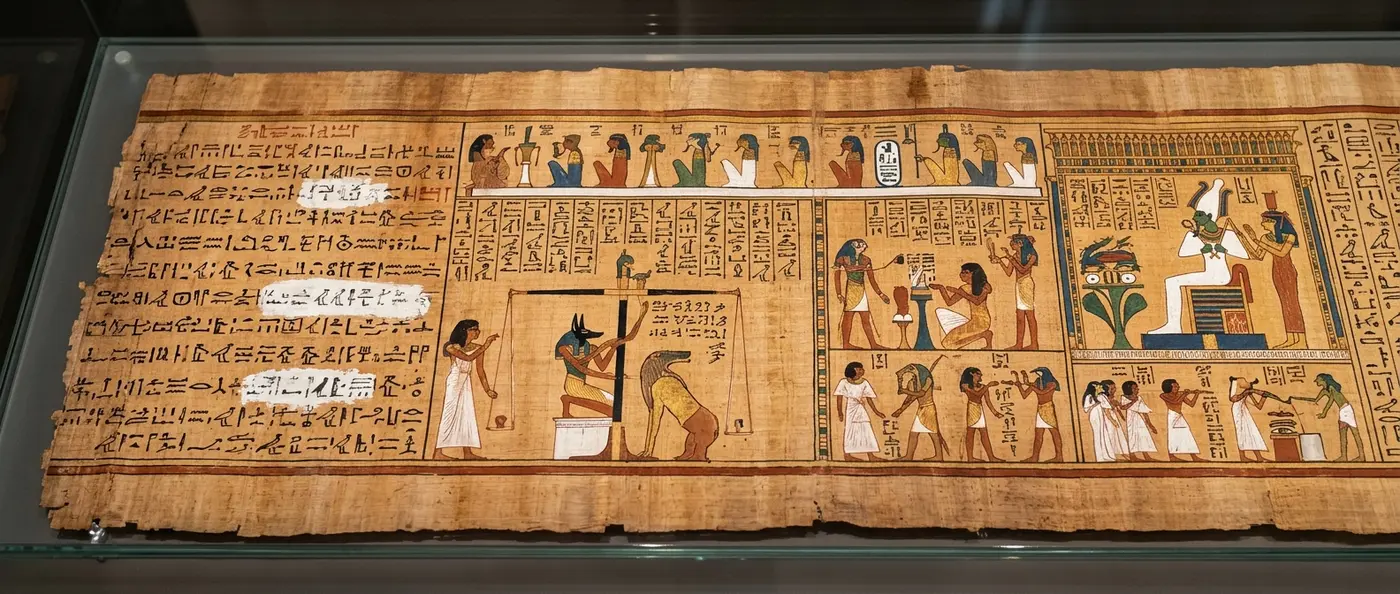
📜 The Book of the Dead: Your Afterlife GPS
The Book of the Dead wasn't actually a book. Ancient Egyptians called it "The Chapters of Coming Forth by Day" — essentially a survival guide for the soul's journey through the underworld. Picture a GPS for the afterlife, complete with over 200 chapters of spells and magical formulas designed to protect the dead from the horrors waiting below.
These texts started as "Pyramid Texts" around 2300 BCE, carved into royal burial chambers for pharaohs only. By the Middle Kingdom, death had gone commercial. Anyone with enough gold could commission their own copy. The first known example appeared in Queen Mentuhotep's sarcophagus during the 13th Dynasty (1633-1552 BCE).
During the New Kingdom (1539-1075 BCE), the Book of the Dead went mainstream. Luxury editions featured stunning illustrations painted by master artists. Budget versions came with blank spaces where scribes would fill in the deceased's name — ancient Egypt's version of mail merge. Some copies were clearly mass-produced, while others took months to complete with intricate artwork rivaling medieval illuminated manuscripts.
🔬 The Discovery of Ancient White-Out
Chemical analysis uncovered a practical innovation in Egyptian scribal work. Scattered across Book of the Dead papyri, researchers found corrections made with a special substance that functioned exactly like modern correction fluid. This ancient white-out allowed scribes to cover mistakes and rewrite the correct text on top.
The formula required precise mixing. Ancient Egyptian correction fluid consisted of lime and gypsum mixed with animal-based glue. When dried, it created a white surface perfect for overwriting. The technique was crucial for sacred texts where accuracy meant the difference between eternal paradise and becoming demon food.
Mistakes in Book of the Dead spells could be catastrophic. A misspelled incantation or forgotten god's name might leave the deceased defenseless against the terrors lurking in the underworld. Scribes couldn't afford errors, and when they happened, they needed to fix them flawlessly. Throwing away an entire expensive papyrus sheet over one mistake wasn't economically viable — papyrus cost roughly a month's wages per sheet.
⚔️ The Deadly Journey Through the Underworld
Egyptian afterlife beliefs centered on a terrifying underground journey following the sun god Ra's nightly path. After sunset in the west, Ra traveled beneath the world in a solar boat to return to his starting point in the east. The deceased, riding Ra's boat, faced monstrous creatures blocking the path to new life.
The most terrifying was Apep, a colossal serpent that tried to stop Ra's boat and plunge the world into chaos. Every night Apep threatened Ra, and if the deceased encountered this nightmare creature, Chapter 7 of the Book of the Dead offered protection: "I will not be inert for you, I will not be weak for you, your poison will not enter my limbs, for my limbs are the limbs of Atum."
After surviving Apep, the dead reached a labyrinth protected by a series of gates. Each gate required a specific text recitation and the correct gate name. If the proper prayer was offered, the gate would respond: "Pass, you are pure." Get it wrong, and the journey ended in eternal darkness.
💡 The Importance of Precision
Every word, every syllable in Book of the Dead spells carried critical importance. A single error could destroy the spell's effectiveness and leave the deceased defenseless. The discovery of correction fluid shows how seriously ancient Egyptians took the accuracy of their sacred texts.
⚖️ The Heart Trial: Final Judgment
After the labyrinth came the Hall of Two Truths, where the deceased faced judgment by a committee of 42 judges led by Osiris, god of the underworld. The "defendant" had to swear innocence from a long list of potential sins. Chapter 125 of the Book of the Dead includes many examples: "I have not killed people... I have not stolen the property of the gods... I have not made anyone cry... I have not profiteered with grain... I have not committed sinful intercourse... I have not caused terror... I have not killed sacred cattle."
After confession came the trial's climax: the weighing of the heart. Anubis, the jackal-headed god of mummification, held a scale. On one side sat an ostrich feather, symbol of the justice goddess Maat and truth itself. On the other side was the deceased's heart, containing all their life's deeds.
If the feather and heart balanced perfectly, the deceased passed. Those whose hearts weighed too much were deemed impure and condemned to horrible fates. Chapter 53 of the Book of the Dead summarizes ancient Egyptian deepest fears: "I detest what is detestable. I will not eat excrement, I will not drink urine, I will not walk upside down."
Maat's Feather
The ostrich feather symbolized truth and justice. It was the measuring stick for the purity of the deceased's heart.
Heart Scarab
Special scarab-shaped amulets were placed over the heart before mummification, inscribed with Chapter 30 for protection.
The 42 Judges
Each judge represented an Egyptian nome and examined specific sins related to their region.
🏺 The Papyrus of Ani: The Ultimate Example
At nearly 78 feet long, the Papyrus of Ani is the most complete surviving version of the Book of the Dead. Created around 1275 BCE for Ani, the royal scribe of Thebes, and his wife Tutu, priestess of Amun. Wallis Budge acquired it in Luxor in 1888 and published a translation in 1895.
This papyrus represents exceptional quality, with detailed illustrations and calligraphic text. Researchers found correction marks made with ancient white-out even in this luxury copy, indicating the care scribes took even with the most expensive manuscripts. The Papyrus of Ani remains in the British Museum and provides invaluable insight into Egyptian beliefs about the afterlife.
🎨 The Art of Egyptian Writing
Ancient Egyptian scribes were highly trained professionals who spent years mastering their craft. Their education included not only learning hieroglyphic and hieratic scripts but also manufacturing their tools. They made their own reed pens from rushes, prepared ink from soot and gum, and learned to prepare papyrus.
The correction fluid discovery reveals how scribes solved a costly problem. Scribes created practical solutions for expensive mistakes — papyrus cost a month's wages per sheet. Instead of discarding an entire sheet due to one mistake, they could correct it and continue.
Writing a Book of the Dead was laborious and time-consuming. Scribes had to copy hundreds of spells with absolute accuracy, often adding complex illustrations. A complete copy could take months or even years to finish, depending on size and complexity.
📊 Writing Technique Comparison
🔍 The Discovery's Significance for Egyptology
The discovery of correction fluid in Book of the Dead papyri provides new insights into ancient Egyptian scribal practices. It shows that even in sacred texts, mistakes were inevitable and that they had developed practical solutions to address them.
Chemical analysis of the correction fluid also reveals information about ancient Egyptian technical knowledge. Their ability to create an effective correction medium that dried quickly and provided a good surface for rewriting demonstrates advanced knowledge of chemistry and materials.
Studying these corrections can also reveal information about text evolution. By comparing original errors with corrections, researchers can better understand how these sacred texts were transmitted and copied from generation to generation. Sometimes corrections reveal older spell versions or different traditions that merged over time.
Finally, the discovery highlights the human dimension of these ancient texts. Behind every papyrus was a scribe working diligently, making mistakes, correcting them, and continuing. This simple human act of fixing an error connects us to ancient Egyptians in an unexpectedly familiar way.