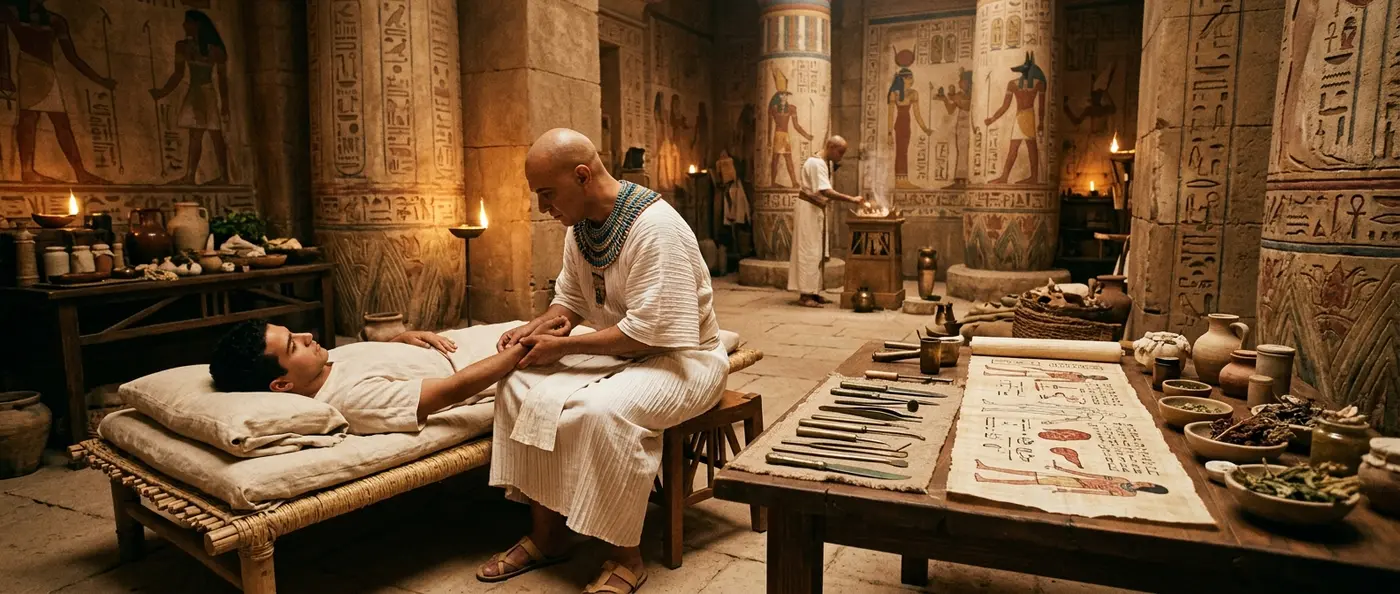
📜 The Papyri That Changed History
Our knowledge of ancient Egyptian medicine comes primarily from medical papyri preserved in the desert's dry sand. The Edwin Smith Papyrus, discovered in 1862, is the world's oldest known surgical manual. It contains systematic descriptions of injuries from head to spine, with instructions for examination, diagnosis, and treatment.
The Ebers Papyrus, dating to approximately 1550 BCE, is one of the largest and most complete medical papyri. Over 20 meters long, it contains more than 700 magical formulas and folk remedies, alongside practical medical advice for treating diseases. It references treatments for asthma, cancer, diabetes, and arthritis, showing that Egyptian physicians recognized and attempted to treat ailments that plague humanity to this day.
Other significant papyri include the Kahun Papyrus for gynecological conditions, the Hearst Papyrus with medical prescriptions, and the London Papyrus with magical healing incantations. Together, these papyri reveal how Egyptian doctors approached everything from childbirth to supernatural healing.
⚕️ The Organization of the Medical Profession
In ancient Egypt, medicine was a highly organized profession with clear hierarchy and specializations. Physicians trained in the "Houses of Life" (Per Ankh), which functioned as medical schools attached to temples. There they studied sacred papyri and learned healing techniques from experienced masters.
Different categories of physicians existed: the swnw (general doctors), the wabw (priest-physicians who dealt with ritual purity), and the saw (magician-healers who used incantations). Each category had its role in the therapeutic process. Specialization was common—there were ophthalmologists, surgeons, dentists, and even "guardians of the anus" who dealt with gastrointestinal problems.
Royal court physicians enjoyed high prestige and privileges. Imhotep, who lived around 2600 BCE, was architect, high priest, and physician to Pharaoh Djoser. After his death, he was deified as the god of medicine, and the Greeks later identified him with Asclepius. Other famous physicians include Hesy-Ra, the first recorded dentist, and Peseshet, who was possibly the first female physician in history.
The practice of mummification gave Egyptians unique access to human anatomy. During the embalming process, specialists removed internal organs through a small incision on the left side of the abdomen. The brain was extracted through the nose with a long metal instrument. This procedure gave them detailed knowledge of organ position and size.
Egyptians recognized the heart as the center of the circulatory system, though they believed it was also the seat of intelligence and emotions. They knew arteries and veins carried blood, but believed they also transported air, water, and semen. They had identified the liver, spleen, kidneys, and bladder, but didn't fully understand their functions.
Working without modern understanding of how organs functioned, Egyptian physicians still diagnosed injuries with startling precision. They could diagnose fractures, dislocations, and other injuries with impressive accuracy. The Edwin Smith Papyrus describes 48 trauma cases with such detail that modern doctors can recognize the conditions being described.
💡 They Knew the Pulse
Ancient Egyptians were the first to record pulse measurement as a diagnostic tool. The Ebers Papyrus states: "There are vessels in every limb of the body. If the physician places his fingers on the head, neck, hands, heart... everywhere he will encounter the heart, because its vessels lead to every limb."
🗡️ Surgical Techniques and Tools
Ancient Egyptian surgeons used an impressive variety of tools, many resembling modern surgical instruments. Scalpels made from obsidian and copper, forceps, cauterizers, bone saws, and suturing needles have been found in physicians' tombs. These tools reveal that Egyptian metalworkers had mastered techniques that produced instruments nearly as sharp as modern scalpels.
Surgical procedures included tumor removal, fracture treatment, abscess drainage, and even trepanation—drilling holes in the skull to relieve pressure. Skulls with healed edges around the holes show that many patients survived these operations. Egyptians used honey as an antiseptic and discovered that moldy bread (containing penicillin) helped heal wounds.
Wound suturing was done with linen threads or animal tendons. For large wounds, they used a technique similar to modern butterfly sutures—bringing wound edges together and holding them with strips of linen fabric. Bandages were soaked in resin that hardened to create a primitive cast.
Scalpels & Knives
Made from obsidian, copper, and later bronze. Obsidian created blades sharper than modern steel.
Cauterization
They used heated metal tools to stop bleeding and destroy infected tissue.
Enemas & Catheters
They developed devices for enemas and reed catheters for treating urological problems.
🌿 Pharmacology and Therapeutic Substances
Egyptian pharmacopoeia was extensive, including hundreds of substances from plant, animal, and mineral kingdoms. The Ebers Papyrus records over 700 prescriptions using approximately 500 different ingredients. Modern analysis confirms that dozens of these ancient remedies actually work.
Opium from poppies was used as a painkiller, castor oil as a laxative, and garlic as an antiseptic. Willow bark, containing salicylic acid (aspirin's active ingredient), was used for pain and fever. Honey was applied to wounds for its antibacterial properties. Even animal dung was used in certain treatments, possibly due to antibiotics produced by bacteria.
Egyptians developed various drug forms: pills, ointments, eye drops, inhalants, suppositories, and pessaries. They understood dosage importance, and their prescriptions included precise preparation and administration instructions. They used scales to measure ingredients and had standardized measurement units.
Ophthalmic conditions were common in ancient Egypt due to sand, sun, and infections. Egyptian ophthalmologists were renowned throughout the Mediterranean. They treated cataracts, glaucoma, and trachoma with various methods. They used eye drops made from malachite (green copper) which had antimicrobial properties. The kohl used for cosmetic purposes also protected eyes from infections.
Dentistry was also advanced. Hesy-Ra, who lived around 2600 BCE, is the first recorded dentist in history. Egyptians performed tooth extractions, treated abscesses, and even tried to stabilize loose teeth with gold wires. Skeletal findings show that tooth decay and periodontitis were common, possibly due to sand in food that wore down enamel.
There's evidence of primitive dental prosthetics. In one case, a human tooth was bound with gold wire to neighboring teeth to replace a missing one. While it's unclear whether these "bridges" were used in life or placed post-mortem for aesthetic reasons, they show understanding of dental alignment importance.
🏥 Comparison with Other Ancient Civilizations
🔮 Magic and Science: An Inseparable Relationship
In ancient Egyptian medicine, magic and science were inseparable. Every illness was considered to have both natural and supernatural causes. Physicians combined practical treatments with incantations, amulets, and rituals. They believed demons and evil spirits could enter the body and cause diseases.
Healing incantations often addressed gods, particularly goddess Sekhmet (goddess of diseases) and god Thoth (god of wisdom and medicine). Amulets bearing the image of god Bes protected pregnant women and children. The Eye of Horus (wadjet) was a powerful symbol of protection and healing.
While this blend of magic and medicine might look backwards to us, it actually helped patients heal. Belief in healing power and medicine's ritualistic aspect helped relieve anxiety and enhanced the placebo effect. Additionally, many "magical" practices had practical foundations—for example, cleansing and ritual washing helped prevent infections.
🌍 The Legacy of Egyptian Medicine
Ancient Egyptian medicine's influence extends far beyond Egypt's borders. Greek physicians, including Hippocrates, studied in Egypt and incorporated Egyptian practices into their own medicine. Herodotus wrote admiringly about Egyptian physicians' specialization. The Alexandrian medical school, established by the Ptolemies, became the premier center of medical education in the ancient world.
Many Egyptian medical practices survived through Arabic and European medicine. The use of honey as an antiseptic, the importance of hygiene, and systematic approaches to diagnosis are principles that began in ancient Egypt. Even today, researchers study ancient Egyptian treatments for potential applications in modern medicine.
The bizarre European practice of consuming mummies for medical purposes, which lasted from the 11th to 19th centuries, was based on a misunderstanding of Egyptian medicine. Europeans mistakenly believed mummies contained therapeutic substances and consumed them in powder form for various ailments. The practice reveals how Egyptian medicine retained an almost supernatural reputation centuries after the pharaohs fell.
🏺 Modern Discoveries
In 2021, archaeologists discovered a burial complex at Saqqara containing mummification tools and medical instruments. Among the finds were bronze scalpels, forceps, and a rare surgical saw. The discovery provides new information about surgical techniques from the Late Period (664-332 BCE).
📚 Lessons for Modern Medicine
Studying ancient Egyptian medicine offers valuable lessons for modern medical practice. The Egyptians' holistic approach, treating the patient as a whole rather than just symptoms, foreshadows modern trends in holistic medicine. Their emphasis on prevention, hygiene, and diet as health foundations remains relevant.
Systematic documentation of medical cases in papyri created the first medical records. This practice allowed knowledge accumulation and transmission to future generations of physicians. Modern medicine relies on similar documentation and case study systems.
Egyptian medicine reveals a fundamental truth: medical breakthroughs don't happen overnight—they build on centuries of trial, error, and careful observation. Ancient Egyptians laid foundations for many medical practices that evolved and were perfected in subsequent centuries. The Egyptian approach—combining precise surgical techniques with genuine concern for the patient's fears and beliefs—set a standard that modern doctors still struggle to meet.