🐊 The Discovery That Changed Everything
A team of researchers from the University of Manchester has uncovered details about the final hours of a crocodile that was mummified 3,000 years ago. Using a CT scanner at the Royal Manchester Children's Hospital, scientists managed to see inside the mummy without destroying it.
Inside the crocodile: a metal fishing hook, still embedded alongside a fish. This discovery confirms ancient descriptions by Herodotus from the 5th century BCE, who wrote about how Egyptians would beat pigs on the banks of the Nile to attract crocodiles and catch them with baited hooks.
The crocodile mummy, measuring 2.23 meters in length, is housed in the Birmingham Museum and Art Gallery collection. X-rays and CT scans revealed that the animal's digestive system was filled with small stones, known as "gastroliths," which crocodiles swallow to aid digestion and regulate their buoyancy.
🏺 Millions of Sacred Animals
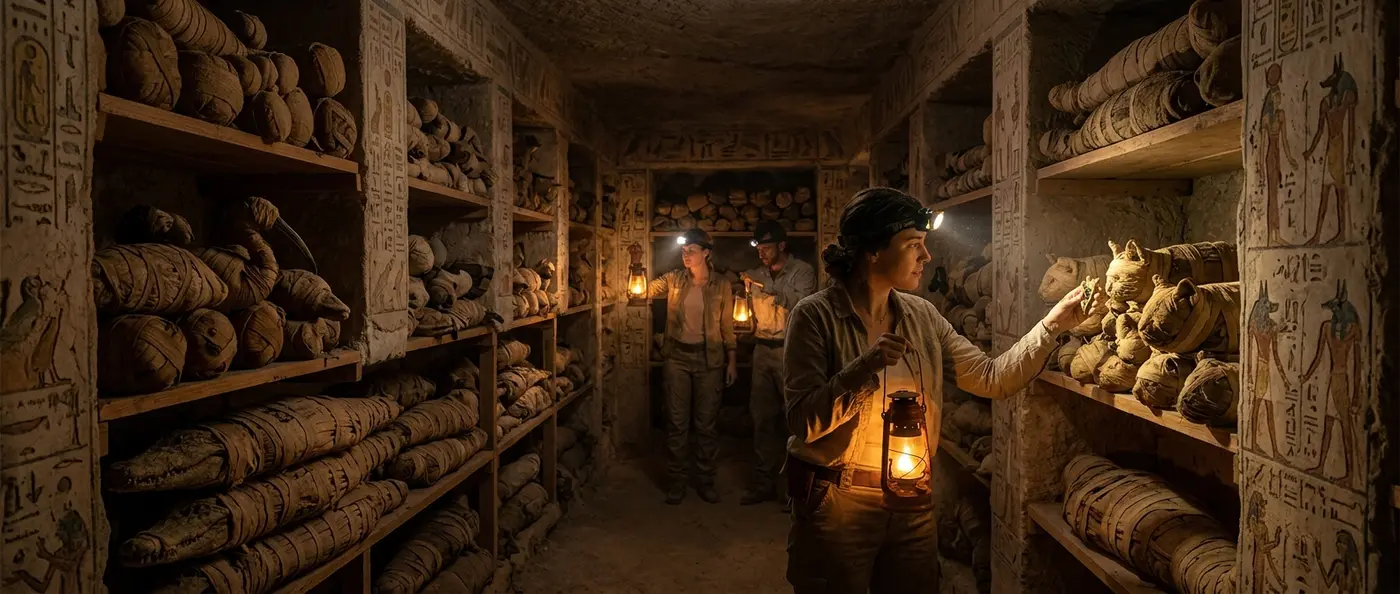
The ancient Egyptians didn't just mummify humans. Millions of animals underwent the same process, becoming sacred offerings to the gods. Each species served a specific deity as a bridge between earth and the divine.
Hawks were associated with the sun god Horus because they flew high in the sky, closer to the sun. Cats were dedicated to the goddess Bastet, a fierce and wild protective maternal figure. Crocodiles were linked to Sobek, the Lord of the Nile and god whose presence signaled the river's annual flood.
The period from 750 BCE to 250 CE was the golden age of animal mummies. Most were created as votive offerings or gifts to the gods, with worshippers purchasing mummified animals from specialized priests and offering them at temples.
🦅 Sacred Ibises and Climate Change
One of the most striking examples of mass mummification involves sacred ibises. These long-legged, curved-beak birds were mummified by the millions as offerings to Thoth, the god of wisdom and writing.
Something few people know: ibises no longer exist in Egypt. Climate change and desertification forced them to migrate south to Ethiopia. In antiquity, however, Egyptians saw them daily along the banks of the Nile.
Ibises for Thoth
Millions of ibises were mummified as offerings to the god of wisdom. These birds were considered the earthly incarnation of the deity.
Cats for Bastet
Cats were sacred to the goddess Bastet. Entire cat cemeteries have been discovered, containing thousands of mummified felines.
Crocodiles for Sobek
Crocodiles symbolized the power of the Nile. They were used as amulets and hung above house doors for protection.
🔬 Science Reveals the Secrets
Modern medical imaging techniques allow researchers to study ancient mummies without destroying them. Before CT scans, researchers had to unwrap and destroy mummies to study them.
In the case of the Birmingham crocodile, CT scans revealed that the embalmers did not remove the animal's internal organs, a process known as evisceration that was typically applied to human mummies to delay decomposition. This suggests different mummification practices for animals.
The Birmingham School of Jewellery team created a replica of the ancient hook in bronze, the metal likely used for the original. The replica is now displayed alongside the crocodile mummy.
💡 Did You Know?
The ancient Egyptians had specialized facilities for hatching crocodile eggs and raising the young. Archaeological evidence shows that some crocodiles lived as sacred animals in temples and died from natural causes, while others were killed specifically for mummification.
⚔️ The Industry of Religion
Animal mummification wasn't simply a religious practice. It evolved into a massive industry that employed thousands of people. There were animal breeding facilities, specialized embalmers, merchants who sold mummies to pilgrims, and priests who managed the offerings.
Most crocodile mummies are of small animals, suggesting that Egyptians had the means to hatch and keep the young alive until needed. As crocodiles grew larger, the danger to caretakers increased, so larger specimens were likely captured from the wild and killed quickly.
Research on mummified remains of larger animals has revealed evidence of cranial trauma inflicted by humans, possibly as an attempt to immobilize and kill the animal.
🏺 Mummification Comparison: Humans vs Animals
🗺️ Geography of Sacred Cemeteries
Sacred animal cemeteries were found throughout Egypt, but certain locations stood out. Saqqara, near Memphis, hosted millions of mummified ibises and baboons. At Tuna el-Gebel there are underground galleries filled with ibis and baboon mummies dedicated to Thoth.
Bubastis in the Nile Delta was the center of Bastet worship, with massive cat cemeteries. At Kom Ombo and Crocodilopolis (modern Fayyum) there were specialized cemeteries for crocodiles.
The Aswan Dam, completed in 1970, prevented crocodiles from moving north toward the Lower Egypt delta, forever changing the Nile's ecology.
📜 Testimonies of Ancient Writers
Classical writers who traveled to Egypt remain some of our best sources of information about animal worship and mummification. Herodotus, who visited Egypt in the 5th century BCE, described in detail how priests caught crocodiles for temples.
According to Herodotus, Egyptians would beat pigs on the riverbanks. The animals' cries attracted crocodiles, which were then trapped with baited hooks placed in the Nile. The hook inside the Birmingham mummy confirms this ancient description.
«The Egyptians consider crocodiles sacred. They adorn them with gold earrings and bracelets and feed them special meals. When they die, they mummify them with great care.»
🔱 The Theological Significance
Mummified animals weren't simply offerings. They represented a deep theological belief about the relationship between the natural and supernatural worlds. Each animal was considered the living incarnation or messenger of a specific deity.
Worshippers believed that by offering a mummified animal, they were sending a message directly to the god. It was like having a personal messenger who would carry their prayers and wishes to the divine world.
This practice reached its peak during a turbulent period of Egyptian history, when common people sought more direct ways to communicate with the gods, bypassing the traditional priestly hierarchy.
Religious Democratization
Animal mummification allowed ordinary people to have direct access to the gods, something that was traditionally a privilege of the elite.
Economic Impact
The animal mummy industry created thousands of jobs and was a significant source of income for temples.
🌍 The Legacy of Sacred Animals
Animal mummies provide a unique snapshot of the natural world of ancient Egypt. Some of the mummified species no longer exist in the region, offering valuable information about climate evolution and ecosystem changes.
The study of these mummies continues to reveal new information. Each scan, DNA analysis, and chemical examination reveals more about this ancient practice.
As Dr. Lidija McKnight from the University of Manchester notes: "Modern technology helps us learn more and more about our ancient past. I can only imagine what secrets technology will be able to reveal in the future."
💀 The Future of Research
Technological advances promise even more exciting discoveries. DNA analysis from mummified tissues can reveal information about species evolution and ancient diseases. Isotopic analysis can show what animals ate and where they came from.
New imaging methods, such as spectroscopy and microtomography, allow examination of mummies at the molecular level. 3D printing of objects found inside mummies, like the hook in the Birmingham crocodile, enables more detailed study without disturbing the mummy.
As more museums digitize their collections and share data, researchers can compare mummies from around the world, creating a more comprehensive picture of this ancient practice. The Ancient Egyptian Animal Bio Bank, directed by Dr. McKnight, collects data from mummified animals in museums worldwide.
🔬 Future Technologies
Artificial intelligence and machine learning promise to accelerate the analysis of thousands of mummies that remain unexamined in museums and storage facilities. Algorithms can recognize patterns and make connections that would be impossible for human researchers.
Ancient Egypt's mummified animals reveal a civilization where boundaries between animals, humans, and gods blurred.
Every mummy we examine, every hook we discover, every gastrolith we count, brings us closer to understanding this extraordinary civilization. And as the crocodile mummy with its last meal still in its stomach showed, even after 3,000 years, the ancient Egyptians still have secrets to reveal to us.