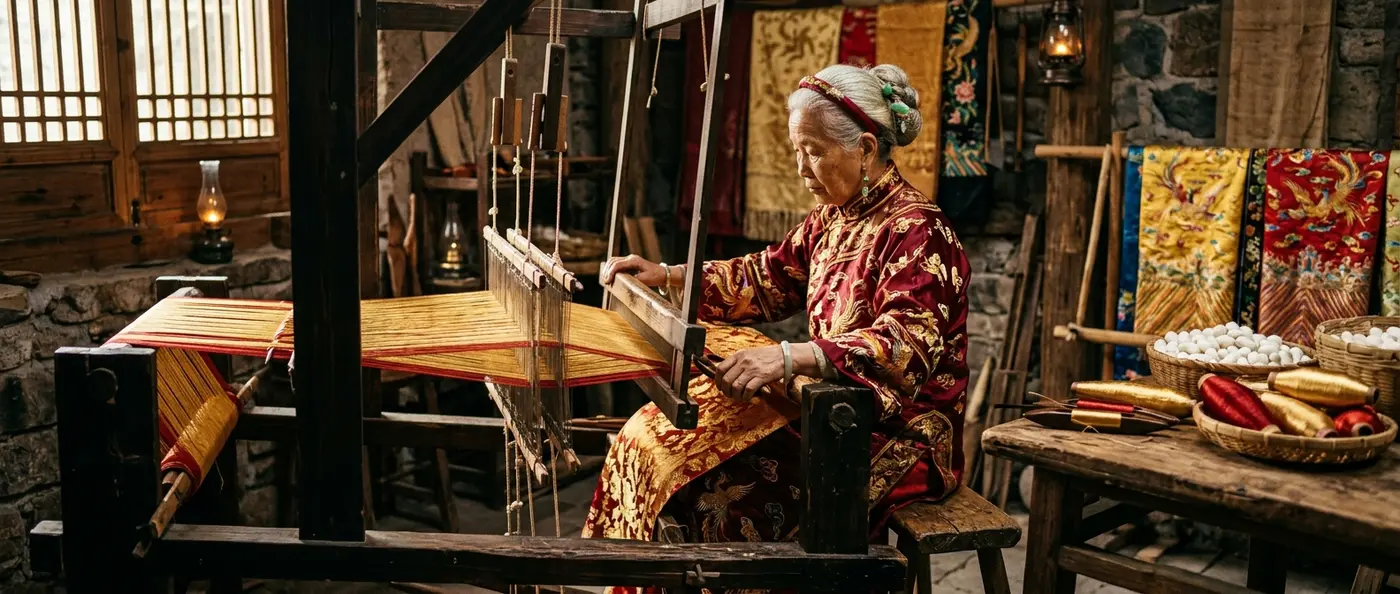
🐛 The Accidental Discovery That Started a Revolution
According to Chinese tradition, silk's discovery is attributed to Empress Leizu, wife of the legendary Yellow Emperor, around 2700 BCE. Legend tells that while drinking tea beneath a mulberry tree, a silkworm cocoon fell into her cup. As she tried to remove it, the hot water dissolved the sericin holding the cocoon together, and a fine thread began to unravel.
Leizu wound the thread around her finger and unraveled it completely, marveling at its strength and luster. A single cocoon yielded one continuous thread up to 1,000 meters long. This moment marked the beginning of sericulture, an art the Chinese would perfect and keep secret for millennia.
Archaeological evidence tells a different story. Archaeological findings from the Yellow River valley show silk production began at least 5,000 years ago during the Neolithic period. The oldest silk fabrics discovered date to around 3630 BCE, proving ancient Chinese had already developed sophisticated weaving techniques.
🏺 The Empire's Closely Guarded Secret
For over 3,000 years, China managed to maintain its silk production monopoly. The secret of sericulture was guarded so strictly that revealing it was punishable by death. Imperial laws forbade the export of silkworms, eggs, or even mulberry seeds beyond the empire's borders.
The production process was extraordinarily complex and required precision. Silkworms had to be fed exclusively on fresh mulberry leaves, in controlled temperature and humidity. After 35 days of continuous feeding, the worms began spinning their cocoons. The cocoons then had to be carefully collected and boiled to kill the chrysalis while preserving the intact thread.
Each step demanded expertise passed down through generations. Water temperature had to be exactly right — too hot and the thread would be destroyed, too cold and it wouldn't unravel properly. It took approximately 2,000 to 3,000 cocoons to produce just half a kilogram of silk thread.
Silk wasn't merely a luxury fabric — it was ancient China's currency. During the Han Dynasty (206 BCE - 220 CE), silk was used to pay taxes, soldier wages, and as diplomatic gifts. A piece of silk of specific length and width had fixed value, like banknotes today.
Silk's value was so immense it often outweighed gold. In the Roman Empire, one kilogram of silk cost as much as one kilogram of gold. Roman historian Pliny the Elder complained that Rome spent 100 million sestertii annually importing silk from China — an amount that could maintain entire legions.
Currency & Taxes
Silk functioned as official currency in ancient China. Farmers paid taxes in silk, and government officials received part of their salaries in silk fabrics.
Diplomatic Tool
Chinese emperors used silk as a diplomatic weapon, offering thousands of rolls to foreign rulers to secure peace and alliances.
Trade Monopoly
China's silk monopoly created massive trade surpluses, bringing gold and silver from across the world into the empire.
🗺️ The Silk Road: The First Global Trade Network
The Silk Road wasn't a single road but a complex network of trade routes spanning over 7,000 kilometers, connecting China to the Mediterranean. Its official beginning is placed at 130 BCE, when Emperor Wu of the Han Dynasty sent Zhang Qian on a diplomatic mission to Central Asia.
Caravans traversing the Silk Road faced incredible challenges. They had to cross the Taklamakan Desert, known as "the desert of death," traverse the Himalayas and Pamir Plateau, and confront bandits, extreme weather, and political upheavals. A journey from China to Rome could take up to two years.
The profits made the dangers worthwhile. Silk purchased in China could be sold in Rome for 100 times its original price. This massive profit margin justified the risks and difficulties of the journey.
🐪 The Secret of Success
Camels were the "ships of the desert" that made the Silk Road possible. A camel could carry 200-300 kilograms of cargo and travel 25-30 kilometers daily without water for weeks. Without camels, the Silk Road would have been impossible.
🌏 Cultural Revolution: Beyond Trade
The Silk Road didn't just transport goods — it carried ideas, religions, technologies, and cultures. Along this route, Buddhism traveled from India to China, transforming East Asian religious life. Christianity and Islam also spread through trade networks.
Technology exchange was equally significant. China exported not only silk but also paper, gunpowder, compass, and printing. Conversely, it imported glass, wine, woolen textiles, and new agricultural techniques from the West. Plants and animals also traveled the road — grapes, carrots, and cucumbers came to China from the West, while peaches, apricots, and tea traveled in the opposite direction.
Cities along the Silk Road became cosmopolitan centers where merchants from dozens of different cultures met. Samarkand, Bukhara, Kashgar, and Dunhuang evolved into multicultural metropolises where dozens of languages were spoken and many religions practiced.
Recent archaeological discoveries continue revealing new aspects of silk history. According to a 2025 study, ancient DNA analysis from cat bones found at archaeological sites in China revealed that domestic cats arrived in the country via the Silk Road around 600 CE, several hundred years later than previously believed.
The discovery shows the Silk Road carried living creatures that transformed everyday life, not just luxury goods. Cats, initially considered exotic pets for the elite, were transported in small cages by merchants and diplomats as gifts for Chinese officials.
📊 The Silk Road in Numbers
⚔️ The End of Monopoly: How the Secret Leaked
Despite strict security measures, the silk production secret eventually leaked. According to legend, in 552 CE, two Nestorian monks managed to hide silkworm eggs inside hollow bamboo canes and transport them to Constantinople for Emperor Justinian.
Another story tells of a Chinese princess who married the king of Khotan (in present-day Xinjiang) and hid silkworm eggs in her elaborate hairstyle, knowing guards wouldn't dare search a princess's hair. Thus, silk technology gradually spread to Central Asia.
By the 6th century CE, the Byzantine Empire had established its own silk industry, and gradually the technology spread to the Islamic world and later to Europe. However, China maintained its superiority in quality and innovation for centuries more.
🏛️ The Continuing Legacy
Silk changed more than fashion — it reshaped civilization. It didn't just change how we dress — it changed how we think about trade, diplomacy, and cultural exchange. The Silk Road laid foundations for globalization, showing that people from different cultures could cooperate for mutual benefit.
Today, China remains the world's largest silk producer, generating about 70% of global production. The ancient art of sericulture continues with traditional methods in many rural areas, while modern technology has improved efficiency and quality.
In 2013, Chinese President Xi Jinping announced the "One Belt, One Road" initiative, an ambitious infrastructure plan aimed at reviving the ancient Silk Road for the 21st century. This modern network of railways, roads, and maritime routes connects China with Europe, Africa, and all of Asia, proving that silk's legacy continues shaping our world.
The story of silk teaches us that great innovations can emerge from the simplest observations — a cocoon falling into a tea cup. It also shows us that no secret can be kept forever, and that true power lies not in monopolizing knowledge, but in the ability to continuously innovate and adapt. Silk wasn't just a fabric — it was the catalyst that united East and West and forever changed the course of human history.