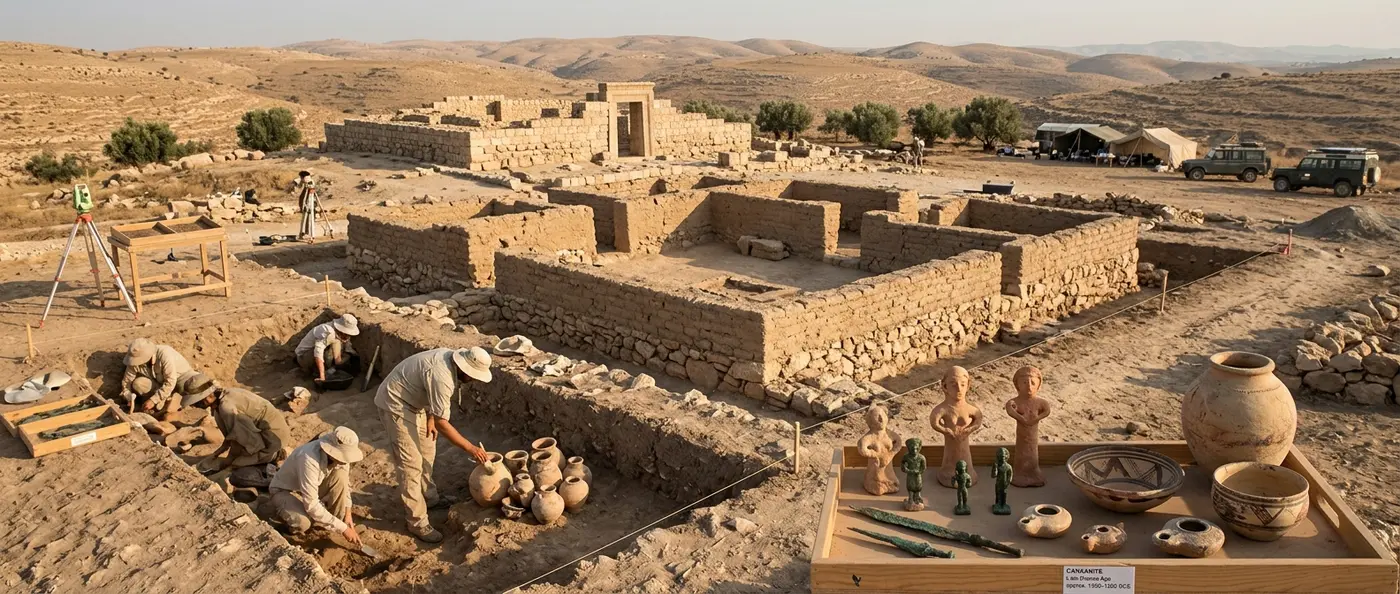
Long before the Philistines settled on the eastern Mediterranean shores and became the legendary adversaries of the Israelites, the region we now know as Palestine already had a long and rich history. Ancient Canaan, as this land was called, sat at the intersection of Egyptian and Mesopotamian trade routes, its cities growing wealthy from the constant flow of merchants and armies.
🏛️ The Land of Canaan: From Paleolithic to Bronze Age
Canaan's history begins in the Paleolithic era, with the region's coastal civilization dating back thousands of years. Archaeological excavations have revealed that the first cities began developing during the Neolithic period, around 7000-4000 BCE. This long period of development laid the foundation for one of the most significant civilizations of the ancient Near East.
The name "Canaan" first appears in written texts from the 15th century BCE, though the region already had a long history behind it. Canaan's borders were never fixed, but its center always remained the area that would later be called Palestine. Its strategic position, between the great empires of Egypt and Mesopotamia, made it a natural crossroads of trade and civilizations.
The Canaanites developed an advanced civilization with organized city-states, sophisticated architecture, and a complex system of religious beliefs. Each city had its own king and functioned as an independent political entity, though there were common cultural elements that united the entire region.
🔱 The Religion and Gods of Canaan
The Canaanites' religious system was complex and polytheistic. Baal, whose name means "lord" or "owner" in Semitic languages, was one of the most important gods in their pantheon. He was considered the god of fertility and rain, vital for an agricultural society. Alongside him was worshipped Astarte (Ashteroth), goddess of love and war, as well as Dagon, an ancient god of grain.
These deities weren't merely abstract concepts. For the Canaanites, their gods were living presences that influenced every aspect of daily life. From harvest to war, from birth to death, the gods were everywhere. Temples and shrines rose in every city, with ceremonies and sacrifices conducted regularly to ensure divine favor.
Interestingly, many of these deities were later adopted by the Philistines when they settled in the region. Dagon, for example, became one of the main gods of the Philistines, showing how the newcomers absorbed elements of local culture. Even Beelzebub, mentioned in the Bible as a god of the Philistines in Ekron, likely had Canaanite origins.
⚔️ The Arrival of the Sea Peoples
Around 1200 BCE, the eastern Mediterranean was shaken by a series of catastrophic events. The mysterious "Sea Peoples" appeared, destroying cities and empires in their path. Among them were the Philistines, referred to in Egyptian inscriptions as "prst".
According to inscriptions at Ramesses III's mortuary temple at Medinet Habu, the Philistines were part of an alliance of peoples who attacked Egypt around 1190 BCE. They had already plundered Anatolia, Cyprus, and Syria before reaching Egypt's borders. Ramesses III's forces defeated the Sea Peoples in a naval battle depicted on temple walls at Medinet Habu.
After their defeat by the Egyptians, the Philistines settled - possibly with Egypt's permission - in the coastal plain of Palestine. The area they occupied extended from Joppa (modern Tel Aviv-Jaffa) south to Gaza. Here they established their famous Pentapolis: five cities that would dominate the region for centuries.
Aegean Origins
The Philistines are believed to have originated from the Aegean, possibly from Crete (Caphtor in the Bible), though there's no archaeological evidence for their occupation of the island.
Iron Technology
They brought iron-working technology, likely acquired in Anatolia. This gave them a significant military advantage over their Bronze Age neighbors.
The Pentapolis
They established five powerful cities: Gaza, Ashkelon, Ashdod, Gath, and Ekron, which functioned as a confederation under joint leadership.
🏺 Cultural Fusion and Transformation
The Philistines' settlement in Canaan wasn't simply a military conquest. It was a complex process of cultural interaction and transformation. The newcomers brought elements of Aegean culture, as evidenced by their pottery - a variation of 13th-century BCE Mycenaean styles.
However, the Philistines also adopted many elements from the local Canaanite culture. Their language, for which no written texts have been found, was probably gradually replaced by Canaanite, and later by Aramaic and Greek. Their gods, as we've seen, acquired Semitic names and characteristics.
This fusion process created a unique culture that combined elements from East and West. The temples and shrines excavated at Ashdod, Ekron, and Tel Qasile show this mixture, with architectural elements reminiscent of the Aegean but also local traditions.
💡 The Mystery of the Philistine Language
Despite their power and wealth, the Philistines left behind no written texts in their own language. This linguistic mystery continues to puzzle archaeologists. How could such a powerful civilization leave no written testimony? Did they use materials that weren't preserved, or did they adopt local writing so quickly that they abandoned their own?
🗿 The Legacy of Pre-Philistine Canaan
Canaan before the Philistines wasn't simply an empty space waiting to be filled. It was a land with deep roots, with civilizations that had flourished for millennia. The Canaanites had developed advanced agricultural techniques, created extensive trade networks, and built cities that withstood the test of time.
Their influence extended far beyond Canaan's borders. Their alphabet, developed by the Phoenicians (who were essentially northern Canaanites), became the basis for most alphabetic writing systems in the world. Their maritime skills and trade network laid the foundation for later Phoenician dominance in the Mediterranean.
Even after the arrival of the Philistines and later conquest by the Israelites under King David (10th century BCE), Canaan's cultural legacy continued to influence the region. Many Canaanite traditions, practices, and beliefs were incorporated into the cultures that followed.
📜 From Canaan to Palestine
The transition from Canaan to the land of the Philistines and eventually to Palestine is a story of continuous transformations. After the Philistines' defeat by David, the region became part of the United Kingdom of Israel. However, the Philistine cities maintained their identity and regained independence after the kingdom's division (10th century BCE).
In the centuries that followed, the region passed from hand to hand. Assyrians, Babylonians, Persians, Greeks, and Romans ruled successively. Each conqueror left their mark, but the basic cultural infrastructure established by the Canaanites and enriched by the Philistines remained.
It's ironic that the name "Palestine" derives from the Philistines - a people who weren't indigenous to the region but invaders. The Greeks used the term "Palestine" to describe the entire region, even though the Philistines only occupied the coastal strip. This naming survived through the centuries, reminding us of the lasting impact a civilization can have on history.
🏛️ Canaan vs Philistia: Cultural Comparison
🔬 Modern Archaeological Discoveries
Modern excavations continue to shed light on the region's complex history. At Ashdod, Ekron, and Tel Qasile, archaeologists have discovered temples and shrines showing the mixture of Aegean and local elements. The pottery found at these sites reveals a gradual transition from Mycenaean styles to local traditions.
Particularly revealing are excavations in layers dating before the Philistines' arrival. Here we see the wealth and complexity of Canaanite civilization - sophisticated architecture, artistic objects, and evidence of extensive trade. These findings remind us that the region's history didn't begin with the Philistines or Israelites, but has roots lost in the depths of time.
DNA studies of ancient skeletons also offer new information. They show that the Philistines indeed had genetic roots from the Aegean, confirming biblical and Egyptian sources. However, they also show that they quickly mixed with the local population, creating a new, hybrid culture.
DNA analysis of Philistine skeletons confirms their Aegean origins while showing rapid intermarriage with local populations within just a few generations.