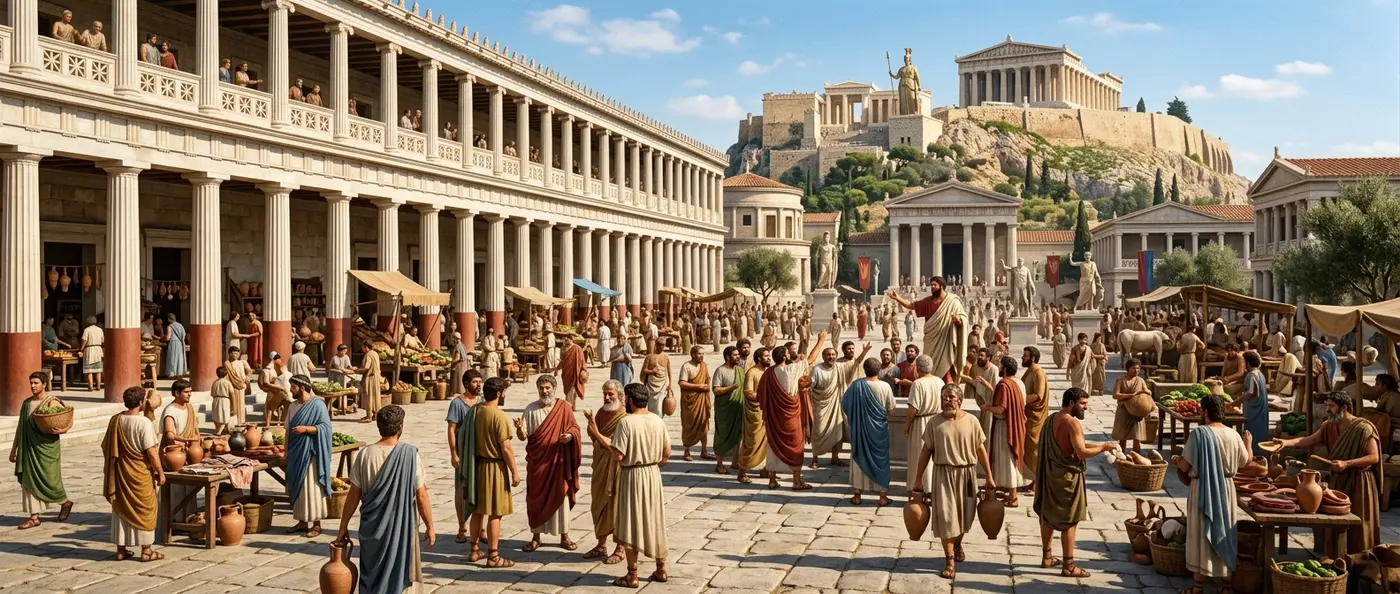
Every morning, thousands of Athenians hurry past the ruins of the Ancient Agora on their way to work. Few pause to consider they're walking beside the birthplace of democracy, where Socrates debated with his students and where decisions were made that shaped Western civilization. The Ancient Agora of Athens wasn't just a marketplace — it was the beating heart of the world's first democracy.
🏛️ The Center of Ancient Life
The Ancient Agora of Athens sprawled across approximately 30 acres at the foot of the Acropolis. From the 6th century BC to the 6th century AD, this space served as the nerve center of the city. Here, thousands of citizens gathered daily to shop, discuss political matters, attend trials, and participate in religious ceremonies.
The word "agora" originally meant "gathering" and only later took on the meaning of commercial marketplace. In reality, the Agora was much more than a trading space. It was where Athens' public life unfolded in all its glory — from morning commerce to evening philosophical discussions.
Archaeologists have discovered the site was used as early as the Neolithic period, around 3000 BC, but the organized Agora began taking shape in the 6th century BC when Solon and later Peisistratos initiated major development projects. Its golden age came in the 5th century BC during Pericles' leadership.
🏺 Architectural Marvels and Public Buildings
The Agora wasn't simply an open space. It was surrounded by impressive buildings serving various functions of the democratic state. The most iconic was the Stoa of Attalos, a two-story building stretching 377 feet, built in the 2nd century BC by King Attalos II of Pergamon. Today, the reconstructed stoa houses the Museum of the Ancient Agora.
On the western side stood the Temple of Hephaestus, one of the best-preserved ancient Greek temples. Constructed from Pentelic marble between 449-415 BC, the temple was dedicated to the god of fire and metalworking, as well as Athena Ergane, protector of craftsmen.
Another significant building was the Bouleuterion, where the Council of 500 met. Here, bills were prepared for presentation to the Assembly of the People. The original Bouleuterion was built in the late 6th century BC and replaced by a new one around 415 BC.
⚖️ The Birth of Democracy
The Agora was where Athenian democracy came to life. Here, citizens gathered to vote, discuss laws, and elect their leaders. The unique democratic process of ostracism was also conducted in the Agora. Once a year, Athenians could vote to exile someone they considered a threat to democracy by writing their name on ostraka (pottery shards).
Archaeologists have discovered thousands of ostraka bearing the names of famous politicians of the era, including Themistocles and Aristides. These finds give us a direct connection to the democratic process practiced 2,500 years ago.
The Agora also housed the Heliaia, Athens' largest court, where up to 1,500 jurors could sit simultaneously. Here some of antiquity's most famous trials took place, including Socrates' trial in 399 BC.
Judicial Power
The Heliaia and other courts operated daily with hundreds of citizens serving as jurors. Trials were public and formed an important part of political life.
Assembly of the People
While major assemblies took place on the Pnyx, many preliminary discussions and smaller gatherings occurred in the Agora.
Ostracism
A unique democratic process allowing citizens to exile for 10 years anyone they deemed a threat to democracy.
📜 Philosophers and Intellectuals
The Agora wasn't just a center of politics and commerce. It was also where antiquity's greatest philosophers met their students and developed their ideas. Socrates spent his days wandering the Agora, discussing virtue, justice, and knowledge with anyone willing to listen.
The Painted Stoa, decorated with murals depicting famous battles, gave its name to Stoic philosophy. Here Zeno of Citium taught around 300 BC, founding a philosophical school that would influence Western thought for centuries.
Archaeologists have located the foundations of many of these stoas, though most have been destroyed by centuries and invasions. Nevertheless, the atmosphere of intellectual life that flourished here is still palpable to anyone walking among the ruins.
💡 Did You Know?
The word "stoic" comes from the Painted Stoa of the Ancient Agora, where Zeno taught his philosophy. His students were called "Stoics" because they met in the stoa!
🏪 Commerce and Daily Life
Despite its importance as a political and intellectual center, the Agora remained primarily a place of commerce. Every morning, merchants from throughout Attica brought their goods: oil, wine, grain, ceramics, textiles, and metals. Bankers had their tables under the stoas, while craftsmen sold their works.
The organization of commerce was strict. Special inspectors, the agoranomoi, checked weights and measures, product quality, and prices. The metronomoi supervised weights and measures, while the sitophylakes ensured adequate grain supply for the city.
The Agora also housed barbershops, taverns, and workshops. Barbershops were particularly popular as meeting places for gossip. Here Athenians learned the latest news and commented on the day's political events.
🗿 Monuments and Statues
The Agora was filled with statues and monuments honoring gods, heroes, and distinguished citizens. The most famous was the Altar of the Twelve Gods, considered the center of Athens from which all distances to other cities were measured.
Near the Stoa of Attalos stood the Odeon of Agrippa, a large enclosed theater seating about 1,000 spectators. Built around 15 BC by Marcus Vipsanius Agrippa, Augustus' son-in-law, it was used for musical performances and lectures.
The statues of the Tyrannicides, Harmodius and Aristogeiton, who killed the tyrant Hipparchus in 514 BC, were among the Agora's most important monuments. They symbolized liberation from tyranny and the beginning of the democratic era.
🏛️ Major Agora Buildings
⚔️ Destruction and Discovery
The Agora suffered serious destruction throughout its long history. In 480 BC, the Persians destroyed much of it during their invasion. After victory at Salamis, the Athenians rebuilt it more magnificently than before. In 86 BC, Roman general Sulla sacked Athens and destroyed many Agora buildings.
The greatest destruction came in 267 AD when the Heruli, a Germanic tribe, invaded and almost completely destroyed the Agora. After this devastation, the area never fully recovered. During the Byzantine period, new buildings were constructed over the ruins, and gradually the ancient Agora was buried under centuries of sediment.
Systematic excavations began in 1931 by the American School of Classical Studies. To uncover the ancient Agora, approximately 400 modern houses were demolished. Excavations continue today, constantly revealing new evidence about life in ancient Athens.
🔬 Modern Athens and Ancient Legacy
Today, Athens' relationship with its ancient heritage is complex and fascinating. As National Geographic reports, beneath every modern building lie ancient ruins. The law requires all ancient finds to remain visible and accessible, even on private property.
A striking example is the Zara store on Stadiou Street, where shoppers walk over a 2,000-year-old Roman tomb visible through a glass floor. At Monastiraki Metro station, passengers can see archaeological finds from the 8th century BC to the 19th century AD, including remains of the ancient Eridanos River.
This coexistence of old and new isn't accidental. It's a conscious choice reflecting modern Athenians' respect for their history. Every new construction must consider ancient foundations, creating a dialogue between eras that makes Athens unique worldwide.
💧 Hadrian's Aqueduct: Ancient Technology Serving Today
One of the most impressive examples of ancient works' timelessness is Hadrian's Aqueduct. Built in the 2nd century AD by order of the Roman emperor, the 15-mile aqueduct carried water from Mount Parnitha's springs to Athens for over 1,300 years.
In 2025, after five years of preparation, Athens begins a groundbreaking program: reactivating the ancient aqueduct to address the modern water crisis. As Giorgos Sachinis from EYDAP states, "the miracle is that it still works." The water, currently lost to the sewage system, will be channeled to 80 homes in Chalandri for irrigation and cleaning.
This experiment doesn't just aim to save water — it seeks to create a new "water culture." With Athens' water levels at decade lows, utilizing ancient infrastructure offers sustainability lessons from the past.
«It's very exciting that something built 2,000 years ago will be used by modern Greeks for such an important reason»
🌅 The Agora Today: A Living Archaeological Site
The Ancient Agora of Athens today is one of Greece's most visited archaeological sites. Thousands of tourists and students walk daily on the same paths trodden by Socrates, Plato, and Pericles. The reconstructed Stoa of Attalos houses an excellent museum with excavation finds.
The Temple of Hephaestus remains one of the world's best-preserved ancient temples. The foundations of the Bouleuterion, Tholos, and other buildings allow visitors to imagine life in the ancient democracy. Every stone, every column, every inscription tells a story.
But the Agora isn't simply an outdoor museum. It's a space that continues to inspire. Concerts, theatrical performances, and educational programs breathe new life into the ancient space. The Odeon of Herodes Atticus, though technically outside the Agora, continues the tradition of cultural events that began 2,000 years ago.
Visitor Numbers
Over 1 million visitors annually explore the site, discovering the history of democracy and ancient civilization.
Educational Programs
Thousands of students participate in educational activities that bring history to life through experiential learning.
🏛️ Lessons from the Past for the Future
The Ancient Agora of Athens shows how democratic institutions can survive millennia. The democracy born here, despite its imperfections, laid the foundation for modern political systems. The philosophical discussions conducted in the stoas continue to influence our thinking.
Athens has found a way to integrate the past into the present. The city maintains a working relationship with its ancient infrastructure. Hadrian's Aqueduct being reactivated, ancient tombs beneath modern stores, ongoing excavations — all show a city drawing strength from its roots.
As Athens faces 21st-century challenges — climate change, overtourism, urbanization — it turns to ancient wisdom for solutions. The Agora draws over one million visitors each year to the site where democracy began.
🌟 The Future of Ancient Heritage
With new technologies like 3D scanning and virtual reality, archaeologists can now digitally reconstruct the Agora as it was in its prime. These technologies promise to bring the past even closer to the present, allowing future generations to "walk" through ancient Athens.
The Ancient Agora of Athens remains a place of inspiration and reflection. From Socrates' philosophical discussions to modern educational programs, from ancient temples to digital reconstructions, the Agora continues to be a space where past meets future. It's proof that great ideas — like democracy, philosophy, and the pursuit of knowledge — aren't limited by time.
Next time you walk Athens' streets, remember that beneath your feet lies an entire city that changed the world. And that the Ancient Agora's legacy isn't just history — it's a living organism that continues shaping the present and inspiring the future.