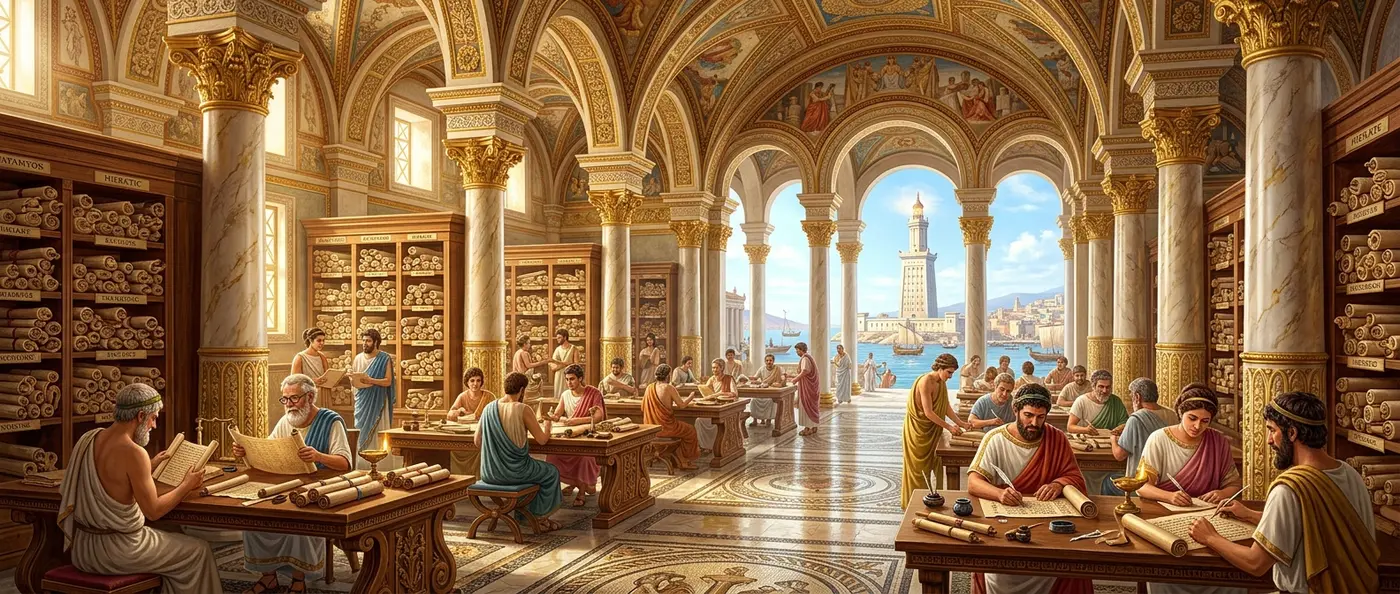
Picture this: 700,000 scrolls. Every piece of human knowledge from across the known world, rolled up and shelved in one colossal building. Where the Nile meets the Mediterranean, ancient Alexandria housed humanity's first attempt at collecting everything — and I mean everything — worth knowing. The Great Library wasn't just a building full of papyrus. It was the world's first research university, where scholars dissected cadavers, mapped the stars, and calculated Earth's circumference.
🏛️ One Man's Impossible Dream
The story starts with Ptolemy I Soter, a Macedonian general who served under Alexander the Great and became pharaoh of Egypt in 323 BCE. Historical sources paint Ptolemy as wildly ambitious for Alexandria, the Mediterranean port city he helped establish and made his capital in 305 BCE.
Around 295 BCE, Ptolemy handed his advisor Demetrius of Phalerum an impossible task: create the world's largest collection of written works. This project would transform Alexandria into the center of Greek civilization and make it a gateway for literature, art, philosophy, and trade.
Ptolemy I died in 283 BCE without seeing his vision completed. But historians agree the Library officially opened during his son's reign — Ptolemy II Philadelphus — between 284 and 246 BCE. The Ptolemaic dynasty poured massive resources into the project and Alexandria's expansion.
The Collection
Pharaoh's agents scoured the world hunting manuscripts. They acquired or copied treasures like Aristotle's personal library and original works by Aeschylus, Euripides, and Sophocles.
Global Reach
Beyond Greek literature, the library housed works from Syria, Persia, and India, making it a truly international knowledge hub.
📜 The Mouseion: Temple of the Muses
The Library lived inside the Mouseion — the Temple of the Muses. This complex wasn't just reading rooms and gardens. It functioned as an early university. Contemporary accounts describe its architecture and contents with awe — everything paid tribute to Greek civilization thanks to the three-century reign of the Ptolemaic dynasty in Egypt.
The Mouseion attracted scholars from across the world, drawn by both its massive collections and the chance to advance knowledge in science, mathematics, and the arts. The complex grew so large it spawned a branch library, the Serapeum, at another nearby temple.
In 48 BCE, at least part of the library fell victim to Egypt's civil war. That year, Roman general Julius Caesar and his men traveled to Alexandria to defend Caesar's ally Cleopatra in a war against her brother, Ptolemy XIV. During the fighting, Romans tried to prevent Ptolemy's fleet from escaping Alexandria's docks by setting fire to ships and piers.
The fires spread to the Mouseion. Historical sources disagree about the damage. Some early historians like Plutarch claim the entire library burned, while philosopher Seneca the Younger later cited a lost work claiming 40,000 papyrus scrolls were destroyed.
⚔️ Slow Death and Final Blows
The library's remnants and its associated scholars experienced slow decline alongside Alexandria itself. Over time, the Great Library withered from neglect. Once the seat of Greek learning, Alexandria now lived under Roman rule, and Roman leaders largely ignored the repository.
Evidence suggests the sister institution, the Serapeum, survived — only to burn twice. As Christianity spread throughout Rome, Christian leaders like Theodosius I began fighting what they considered idolatry. In 391 CE, a group of Serapeum scholars angered by Roman attacks on their gods and muses attacked some Christians in Alexandria. In response, Christians vandalized and demolished the Serapeum.
In 642 CE, Arab forces under Amr ibn al-As captured Alexandria. According to a 13th-century text that survives, the Arab invaders were ordered by Caliph Umar to destroy the great library, supposedly using its books as fuel for fires. However, modern historians consider this a myth likely created and spread by medieval Christians suspicious of Islam.
🏺 Hellenistic Alexandria's Legacy
Despite its destruction, the Library of Alexandria's impact on the ancient world was enormous. As historian Frank William Walbank notes, perhaps its greatest contribution to the history of science is that it existed at all. It was the Ptolemies' greatest gift to the ancient world.
💡 Did You Know?
Alexandria was described as "nurse of the world, a city in which every human race has settled" and Strabo called it "the world's reservoir." It was a truly cosmopolitan city where cultures from across the globe met.
The city of Alexandria was designed with the typical Hellenistic grid plan along a narrow strip between Lake Mareotis and the sea. The Canopic Way crossed the city's length, beautifully paved and almost 30 meters wide, with seven or more main streets running parallel to it.
Alexandria's great buildings included the palace, Alexander's tomb, the temple of the Muses, the academy and library, zoological gardens, the temple of Serapis, the magnificent gymnasium, the stadium and hippodrome, the theater, and an artificial hill, the shrine of Pan, which one climbed via a spiral road.
There were two harbors and the famous lighthouse stood on an offshore island. A canal to the Nile helped ensure water supply, while there were also rainwater cisterns. The city wall stretched about 16 kilometers.
🏛️ Comparison with Other Hellenistic Cities
📚 The Mystery of Destruction
For years, debates raged about who destroyed the library and why. Classical historian Roger S. Bagnall describes it as "a murder mystery with a number of suspects," noting that "passions continue to run high on this subject." Some scholars blamed the Christian teachers of 391 CE for destroying the remnants of classical learning, while others attributed the final destruction to the Islamic Caliphate.
The truth is probably more complex. The Library suffered multiple destructions and periods of neglect over the centuries. Each era left its mark on this great institution's decline, from civil wars and invasions to religious conflicts and simple governmental indifference.
Today, the loss of the Library of Alexandria continues to be mourned as one of cultural history's greatest tragedies. With the flames went the vast collection of works from the ancient world, including literature, philosophy, science, and history from various civilizations like Greece, Egypt, Persia, and Mesopotamia.