Summer, 323 BCE. Babylon. Alexander the Great collapses in his palace, burning with fever. Thirteen years of conquest from the Balkans to India. An empire spanning three continents. And at 32, he's dying with no clear heir. What happened next created the cultural foundation that would determine whether Christianity survived its first century.
🏛️ The Empire That Lost Its Emperor
When Alexander died in June 323 BCE, he left behind the largest empire the world had ever seen. Ancient historians Plutarch and Arrian describe his final days: a night of heavy drinking followed by escalating fever. Diodorus Siculus reports that the illness struck after consuming wine and worsened rapidly.
Here's the weird part. Curtius Rufus, writing in the 1st century CE, claims Alexander's body showed no signs of decomposition seven days after death. This detail has sparked modern theories about what actually killed Alexander.
The empire he left behind stretched 5.2 million square kilometers. No succession plan. No designated heir. Just a power vacuum that would reshape civilization. His generals—the Diadochi (Successors)—faced a problem no one had solved before: how do you divide the undividable?
⚔️ The Successors: When Generals Become Kings
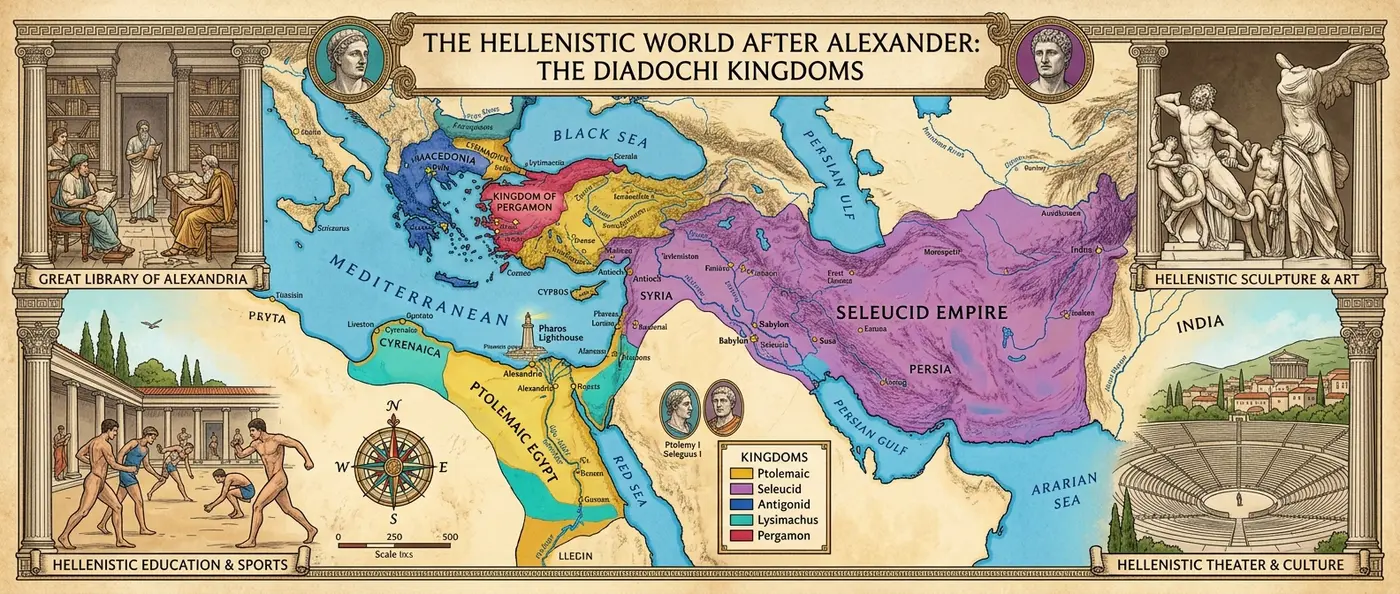
The meeting in Babylon became known as the "Partition of Babylon." Alexander's top generals carved up his empire like a Thanksgiving turkey. Ptolemy I Soter grabbed Egypt and founded a dynasty that lasted three centuries. Seleucus I Nicator took Mesopotamia and the eastern territories. Antigonus I Monophthalmus tried to reunite the whole empire under his rule. Lysimachus claimed Thrace and Asia Minor. Cassander seized Macedonia and Greece.
What followed was 40 years of brutal warfare. The Wars of the Diadochi weren't just about territory—they were about legitimacy. Each general claimed to be Alexander's true heir. None succeeded in reuniting the empire.
Instead, they created a network of Hellenistic kingdoms that maintained Greek culture while adapting to local conditions. This wasn't conquest anymore—this was cultural fusion spanning three continents.
🌍 The Birth of the Hellenistic World
The period following Alexander's death became known as the Hellenistic era. Greek culture didn't just spread—it evolved. It mixed with Egyptian, Persian, and Indian traditions to create something entirely new.
Koine Greek changed everything. This simplified form of Greek became the lingua franca from Spain to India. Merchants in Alexandria could talk to traders in Bactria. Scholars in Pergamon could read texts from Babylon. For the first time in history, a single language connected three continents.
New cities sprouted everywhere. Alexandria in Egypt became the intellectual capital of the ancient world. Antioch in Syria and Pergamon in Asia Minor emerged as major cultural centers. In these cities, Greek settlers lived alongside native populations, creating a unique cultural synthesis that would influence everything from art to religion to science.
Library of Alexandria
The ancient world's greatest center of learning, housing hundreds of thousands of scrolls and scholars from across the known world.
Koine Greek
The language that united peoples from the Mediterranean to Central Asia, enabling unprecedented cultural exchange.
Art & Science
The fusion of Greek and Eastern elements that birthed new art forms and scientific discoveries.
💀 The Mystery That Still Haunts Historians
Alexander's death remains one of history's great unsolved mysteries. In 2019, Katherine Hall from the University of Otago proposed that Alexander died from Guillain-Barré syndrome, a neurological disorder where the immune system attacks the peripheral nervous system.
This condition could have left him in a deep coma that ancient physicians mistook for death. That might explain why his body didn't decompose for days. Plutarch and Arrian report that Alexander was giving orders until just before losing consciousness—typical for patients with this disorder.
Other researchers argue for typhoid fever. Ernesto Damiani from the University of Padua notes that the illness described by ancient sources matches typhoid symptoms. Historical accounts mention Alexander falling into lethargy, a condition often observed in typhoid patients.
🔍 The Poison Theory
Adrienne Mayor from Stanford believes Alexander was poisoned with strychnine. The symptoms described—high fever, inability to speak due to jaw spasms, and intense pain—match strychnine poisoning from a plant that grows in the highlands of India and Pakistan.
🗺️ What If Alexander Had Lost?
Consider this historical what-if. At the Battle of the Granicus River in Turkey, a Persian satrap named Spithridates nearly struck Alexander in the head. If he had succeeded?
Nikolaus Overtoom from Washington State University argues the world would be unrecognizable. No Alexander means no Hellenistic period. Koine Greek never becomes the international language. Christianity might never have spread.
Why? Because the earliest Christian texts were written in Koine Greek. Without this language as a common medium of communication, the Christian message couldn't have spread so quickly and widely across the Roman Empire. It might not have survived the competitive spiritual landscape of the early centuries.
🏰 The Hellenistic Kingdoms and Their Legacy
The kingdoms created after Alexander's empire fractured each developed their own unique character. The Ptolemaic Kingdom of Egypt became the wealthiest and most stable. The Ptolemaic dynasty lasted nearly 300 years, with Cleopatra VII being its last descendant.
The Seleucid Empire, stretching from Syria to Iran, was the largest in territory but the hardest to govern. The diversity of peoples and cultures it encompassed made it inherently unstable. It gradually lost territory, especially in the east where new powers like the Parthians emerged.
In Macedonia and Greece, the Antigonid dynasty tried to maintain the tradition of Philip and Alexander. But constant wars with Greek city-states and later with Rome weakened the kingdom. The Romans systematically dismantled the Hellenistic world, but they couldn't destroy its cultural impact.
⚖️ The Great Hellenistic Kingdoms
🔬 The Scientific Revolution Nobody Talks About
The Hellenistic period wasn't just about wars and politics. It was a golden age for science and philosophy. In Alexandria, Eratosthenes calculated the Earth's circumference with stunning accuracy. Archimedes in Syracuse made revolutionary discoveries in mathematics and physics.
Medicine advanced with Herophilus and Erasistratus conducting the first systematic dissections. Astronomy flourished with Hipparchus discovering the precession of the equinoxes. Ctesibius invented the first hydraulic pump and the hydraulic organ.
Hellenistic kings funded these scientific breakthroughs. The Ptolemies generously funded the Museum and Library of Alexandria. The kings of Pergamon created the ancient world's second-largest library.
🌅 The End of an Era and Its Eternal Legacy
The Hellenistic era began to fade with Rome's rise. Macedonia fell to the Romans in 168 BCE. Greece became a Roman province in 146 BCE. The Seleucid kingdom was abolished in 64 BCE. In 30 BCE, with Cleopatra's suicide, Ptolemaic Egypt fell too.
But political dominance ending didn't mean Hellenism died. Romans adopted Greek culture enthusiastically. Greek education became essential for every educated Roman. Koine Greek remained the language of commerce and diplomacy in the Eastern Mediterranean for centuries.
The Hellenistic legacy shaped Western civilization. From the spread of the Greek alphabet to scientific discoveries, from art to philosophy, the world created by Alexander's successors laid the foundations of Western civilization. Even today, when we talk about democracy, science, or philosophy, we use concepts that were shaped and spread during the Hellenistic period.
Alexander dreamed of a unified world empire but achieved something different. The fragmentation of his empire created a world where Greek culture merged with local traditions, producing a cultural synthesis that outlasted any military conquest.