📖 Read more: 5,000-Year-Old Skull Masks Reveal China's Dark Ritual Past
🏺 The Discovery That Sat in Plain Sight
At the Museu Arqueológico de Sambaqui de Joinville in southern Brazil's Babitonga Bay, 15 bone artifacts had been mislabeled for generations. Construction workers discovered them while mining ancient shell heaps called sambaquis for lime to make concrete. Nobody recognized what they were looking at.
📖 Read more: Paleo-Inuit Crossed 33 Miles of Arctic Ocean 4,500 Years Ago
André Carlo Colonese from the Autonomous University of Barcelona spotted them immediately. These weren't random bone fragments. They had hollow centers for wooden handles and carved points — unmistakable harpoon heads. Radiocarbon dating revealed their true age: between 4,710 and 4,970 years old, making them over 1,000 years older than Arctic whale hunting tools.
Molecular analysis cracked the code. The harpoons came from two whale species: southern right whales and humpback whales. Out of 118 whale bones examined at the museum, most belonged to these species, with 37 transformed into tools and ornaments. The Sambaqui people weren't just opportunistic scavengers — they were active whale hunters with sophisticated technology.
🗿 The Sambaqui: Masters of Tropical Seas
The Sambaqui people built monuments from dinner scraps. Over thousands of years, they piled shells, bones, and refuse into massive mounds — sambaquis — that tower 30 meters high and stretch 500 meters across. These aren't just garbage dumps. They're archaeological goldmines that preserve an entire maritime civilization.
Archaeologists had written off the Sambaqui as simple shellfish gatherers and fishermen. The conventional wisdom said they lacked the technology to hunt large marine mammals. These harpoons shatter that assumption. The Sambaqui developed whale hunting techniques as sophisticated as their Arctic counterparts, but adapted for warm tropical waters.
Babitonga Bay was perfect whale hunting territory. Protected waters and numerous coves created ideal calving grounds where whales came to give birth. The Sambaqui exploited this natural concentration, developing specialized tools and techniques to hunt these massive mammals in their most vulnerable moments.
⚓ The Hunt: Technology Meets Courage
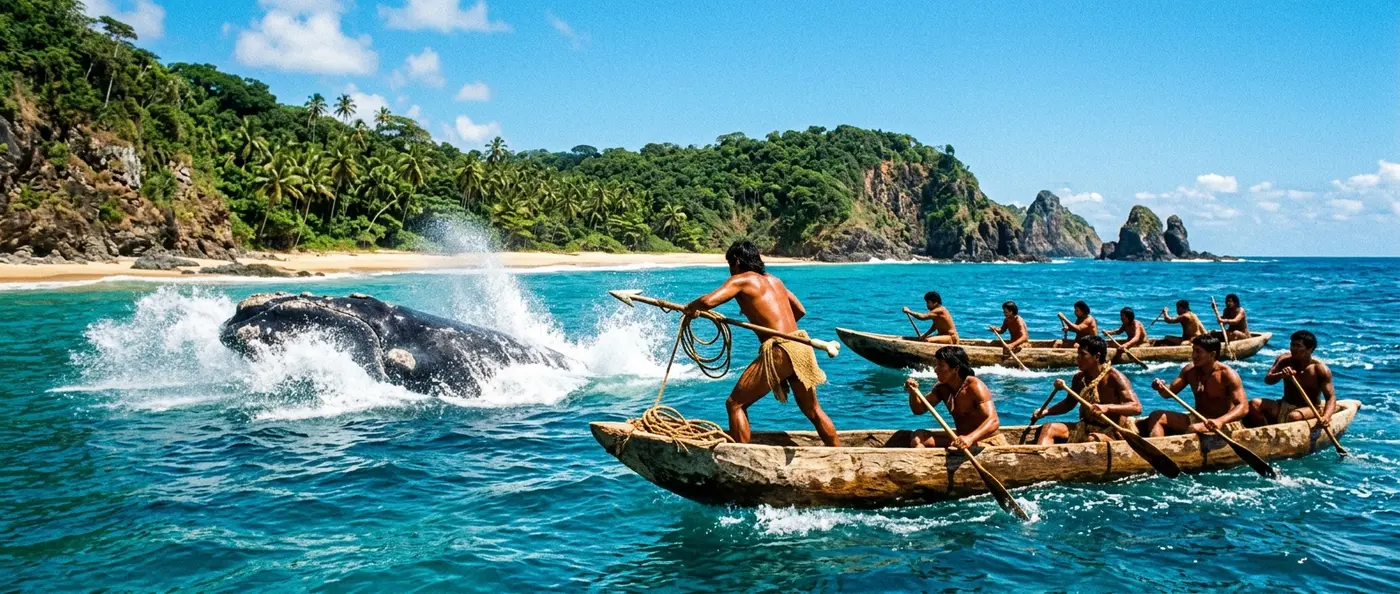
Sambaqui harpoons were complex weapons with multiple components. The barbed bone point attached to rope and a float — either an inflated bladder or a piece of buoyant wood. The point sat loosely in the wooden shaft, designed to detach after impact.
When the harpoon struck a whale, the point stayed embedded while the shaft broke away. The rope and float prevented the whale from diving deep, forcing it back to the surface where hunters could strike again. Similar techniques were later used by whale hunters worldwide — but the Sambaqui were doing it 5,000 years ago.
The hunt launched from dugout canoes carved from massive tree trunks. Krista McGrath, who led the research, notes it "would have been dangerous, but a whale represented a lot of food." Entire communities gathered to consume as much meat as possible while preserving the rest with oil from the whale itself or by drying.
Dugout Canoes
Boats carved from hollowed tree trunks required specialized knowledge and tools, demonstrating advanced woodworking skills.
Barbed Points
Harpoon heads featured backward-facing barbs that prevented the weapon from pulling free once embedded in the whale.
Float Systems
Inflated bladders or wooden floats kept wounded whales near the surface, making follow-up strikes possible.
🔬 Rewriting Prehistoric Maritime History
Until now, archaeologists believed prehistoric whale hunting was limited to cold northern waters. The oldest known evidence came from South Korea (6,000 years ago) and the Arctic (3,500 to 2,500 years ago). The Brazilian discovery completely changes this picture.
Jean-Marc Pétillon, an archaeologist at the University of Toulouse, calls the discovery "spectacular and informative." He emphasizes that it contradicts assumptions about whale hunting being exclusively a Northern Hemisphere practice and transforms our perspective on maritime exploitation systems.
Tropical whale hunters used the same sophisticated techniques as their Arctic counterparts — but they invented them independently. The Sambaqui weren't simple coastal foragers but specialized marine hunters with deep environmental knowledge.
💡 Why Hunt Whales?
A single whale provided massive quantities of meat, fat for fuel and food preservation, bones for tools and construction, and hide for various uses. Colonese explains: "You can store the oil for a very long time, use it as fuel, and then you have all the bones... a whale is very valuable."
🏺 Sambaquis: Archaeological Treasures
Sambaquis are artificial hills created by accumulating shells, animal bones, ash, and other human activity remains. Some reach 30 meters high and 500 meters in diameter, representing thousands of years of continuous habitation.
Inside sambaquis, archaeologists have found thousands of artifacts: bone and stone tools, jewelry, figurines, and human burials. The finds reveal a complex society with specialized techniques, artistic expression, and religious practices.
Unfortunately, many sambaquis were destroyed in the 20th century for lime extraction. This destruction paradoxically led to the preservation of thousands of objects that would otherwise have remained buried. Today, remaining sambaquis are protected as Brazilian national heritage.
🌊 Life in Babitonga Bay
Babitonga Bay, where the discovery was made, is a unique ecosystem with mangrove forests, islands, and protected waters. 5,000 years ago, the area was ideal for developing a maritime culture. Whales came there to calve, fish were abundant, and mollusks thrived in shallow waters.
The Sambaqui exploited all available resources. Besides whale hunting, they fished with nets and hooks, gathered shellfish, and hunted smaller marine mammals like seals. Their diet was supplemented with plant foods from the adjacent tropical forest.
Sambaqui social organization remains partly mysterious. Burials in sambaquis show differences in grave goods wealth, suggesting some form of social stratification. Whale hunting, which required coordination of many individuals, also implies organized social structure.
⚔️ Comparison with Other Whale Hunters
🔱 Legacy of Ancient Hunters
The Brazilian harpoon discovery reminds us that human ingenuity and adaptability aren't limited to specific geographic regions or climates. The Sambaqui developed technologies comparable to Arctic hunters, adapted to their own environment.
Today, descendants of the Sambaqui and other indigenous Brazilian populations continue fighting for recognition of their rights and preservation of their cultural heritage. This discovery strengthens our understanding of their rich past and technological evolution.
As research continues, scientists hope to find more evidence about hunting techniques and daily life of the Sambaqui. Each new finding adds a piece to the puzzle of prehistoric human history and helps us better understand how our ancestors managed to survive and thrive in different environments worldwide.