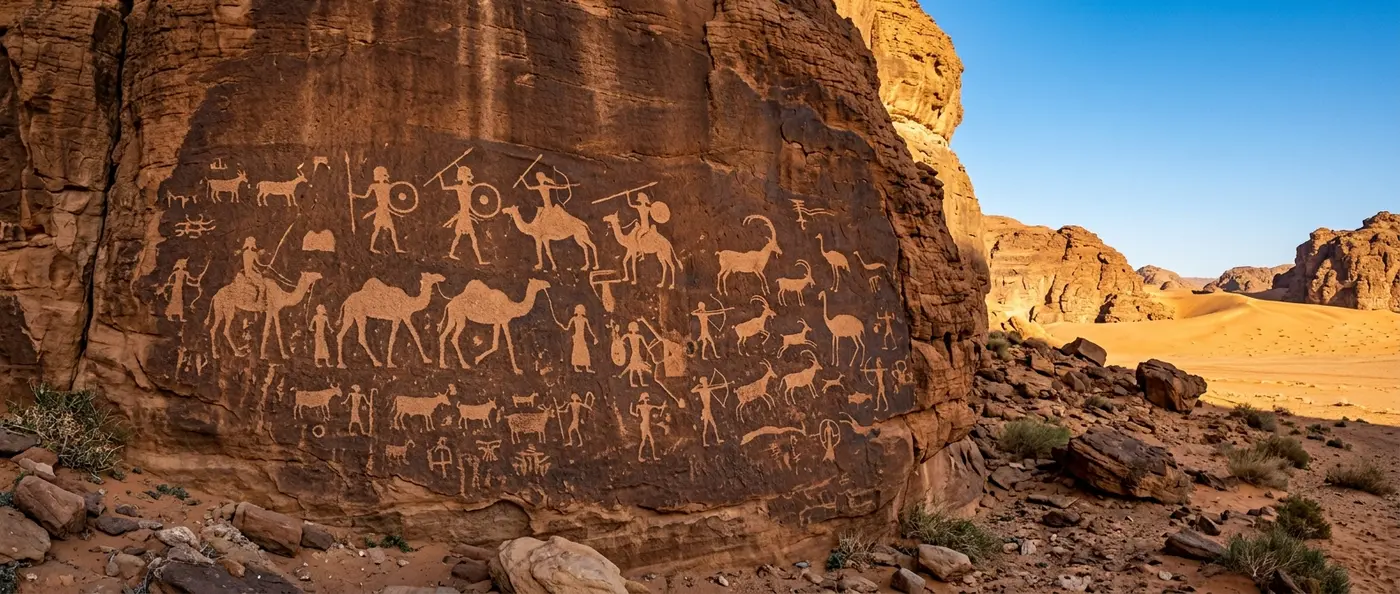
A team member wandered off to explore. What he found upended decades of assumptions about human survival in the Arabian desert. Hundreds of life-size rock carvings, etched 12,800 years ago in Saudi Arabia's Nafud desert, prove humans endured conditions far harsher than we imagined — and did it 2,000 years earlier than we thought possible.
🏜️ The Discovery That Rewrites History
It started with a tip from local amateur archaeologists. When the Max Planck Institute of Geoanthropology team arrived at the coordinates, one researcher decided to scout ahead. He stumbled onto a rocky outcrop covered in ancient art surrounding a water pool. On the mountain's far side lay the remains of an ancient lake.
The archaeologists mapped 62 rock art panels containing 176 individual carvings across three sites. Some were etched into massive boulders towering 39 meters high. The images were mostly life-size animals, with camels dominating the gallery.
The dating results defied expectations: these petroglyphs date between 12,800 and 11,400 years ago. That's over 2,000 years before we thought humans could survive in this region. Maria Guagnin, co-author of the study, put it bluntly: "This shows that people could survive in the desert much earlier than we thought and in much harsher conditions than we believed."
🐪 Camels as Symbols of Endurance
The camel depictions weren't random. Ancient artists carved specific details: male camels with the characteristic neck swellings that form during mating season and their thick winter coats. This suggests the ancient water sources formed during winter months.
Researchers believe camels symbolized resilience and survival ability in this brutal environment. The hunter-gatherers who created them invested these images with meaning beyond mere decoration.
⚒️ The Tools That Tell the Story
Beneath four camel carvings, archaeologists excavated over 1,200 stone artifacts, 16 animal bone fragments, and three fire hearths. Using luminescence dating and radiocarbon analysis, they pinpointed the finds' ages with precision.
At one dig site, the camels' feet were buried under sediment layers. When they dug deeper, they found the stone tool likely used to create the carvings, dated around 12,200 years ago.
🔍 Breakthrough Find
The stone tool found beneath the carvings provides "indirect dating for the engraving," the study authors wrote. It's rare to find the actual creation tool alongside the artwork.
🏹 Connection to Natufian Culture
Archaeologists also uncovered arrowheads, blades, and stone beads. These finds show an entire community lived here, crafting tools and jewelry typical of Natufian culture from the Levant, hundreds of kilometers away around the eastern Mediterranean.
Guagnin explained they "were in contact with the Levant somehow, crossing hundreds of kilometers" and learning about the latest tools and accessories. Michael Petraglia, study co-author, added that "some things are imported but some are unique," indicating these people also developed their own culture.
Ancient Oases
When the region turned wetter between 16,000 and 13,000 years ago, the rock art likely marked waypoints to newly formed oases.
Ancient Routes
The carvings possibly marked travel routes, territorial boundaries, or served as memory markers passed between generations.
Cultural Meaning
The realistic animal depictions held cultural significance for hunter-gatherers, symbolizing resilience in harsh environments.
🗿 Arabia's Stone Circles
Parallel to the rock art discovery, another major find emerged in northwestern Saudi Arabia near AlUla city. Archaeologists excavated eight ancient "standing stone circles" used as dwellings 7,000 years ago.
Aerial photography identified 345 such structures across Harrat 'Uwayrid, a volcanic field. The circles measure 4 to 8 meters in diameter with at least one upright stone at the center. They featured stone walls, at least one entrance, and roofs of stone or organic materials.
📊 Archaeological Finds Comparison
🌊 Trade Networks and Seashells
Inside the stone circles, researchers found numerous shells from the Red Sea, located 120 kilometers west. Their presence "suggests developing networks of trade and exchange, alongside mobility," according to the research team.
Jane McMahon, lead study author, explained that "globally, early domestic architecture was always circular, and rectangular houses only appear in the later Neolithic period." This explains why the structures had circular shapes.
🌿 The Environment That Changed
Seven thousand years ago, northern Saudi Arabia's environment was much wetter than today. Though agriculture hadn't yet arrived, inhabitants gathered wild plants and possibly managed the landscape to increase wild species' likelihood and yield.
Sediment analysis from dried water sources revealed the region became wetter starting 16,000 to 13,000 years ago, forming seasonal lakes. This discovery represents the earliest evidence of increased moisture in northern Arabia after the Last Glacial Maximum.
🔬 Archaeological Significance
Hugh Thomas, a University of Sydney archaeologist specializing in Saudi Arabia, called the study "very exciting," revealing a part of Saudi history that wasn't visible until now. The results show "the whole region was inhabited and that even then, it was an interconnected landscape."
Gary Rollefson, emeritus anthropology professor, believes the people who built the stone circles and mustatils (rectangular stone structures with ritual purpose) descended from humans living in Jordan and Syria about 500 years earlier. Migration may have been triggered by population increases due to new hunting technologies.
🏛️ Arabia: Crossroads of Civilizations
At the crossroads between Africa and Asia, Arabia was a key migration route for early humans. The region experienced various "wet episodes" that enabled these movements, as recent research confirms.
📜 The Future of Research
These Saudi Arabian sites force archaeologists to reconsider early human history in the Middle East. The rock art and stone circles show the region supported complex societies with their own culture, art, and trade networks — not just passing migrants.
Future excavations and improved dating methods will likely reveal more about these ancient communities. The supposedly barren Arabian desert was actually a hub of human activity and cultural expression.