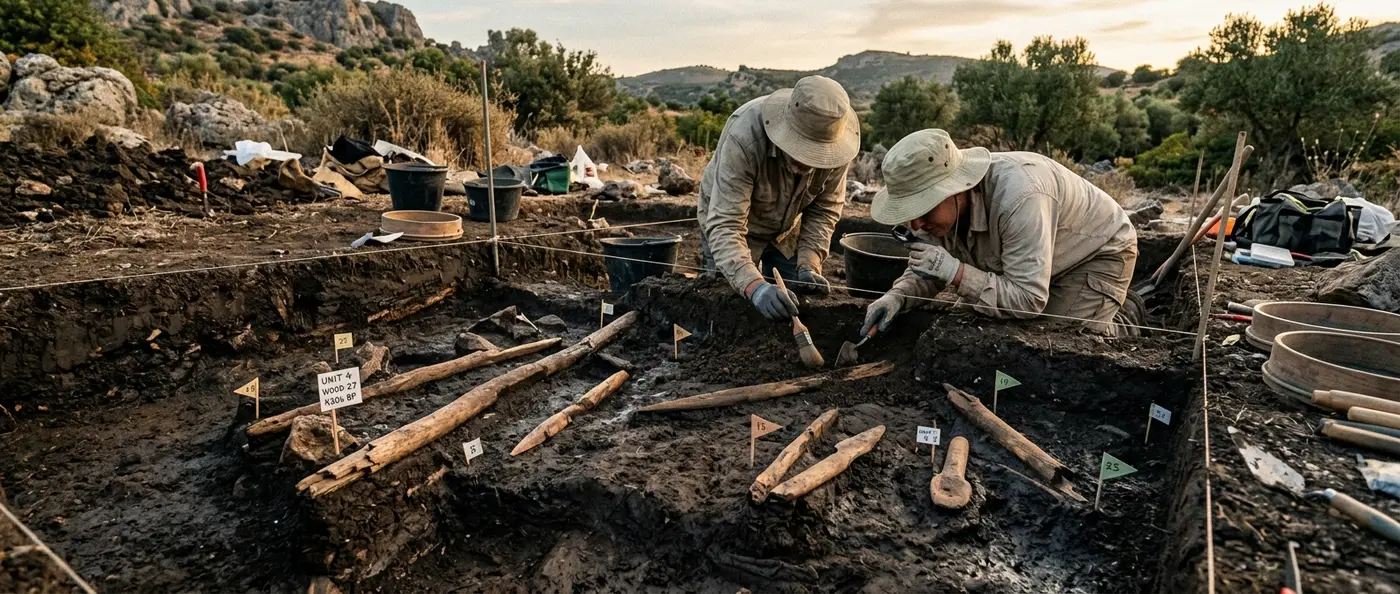
A team of archaeologists in Greece has uncovered something that could fundamentally change our understanding of early human presence in Europe. Wooden tools dating back 430,000 years have been found at a Paleolithic site, revealing that our ancestors in the region were far more technologically advanced than previously believed.
🔬 The Discovery That's Shaking Archaeology
The discovery was made during systematic excavations at a Paleolithic site in Greece. The wooden tools, preserved under exceptionally rare conditions, date to 430,000 years ago. This represents one of the earliest evidence of wooden tool use in Europe.
The preservation of organic materials like wood for such an extended period is extraordinarily rare. Typically, wooden objects decompose completely within decades or centuries. The special soil conditions at this particular location, likely involving high moisture and oxygen-free environments, allowed these precious artifacts to survive.
🏺 Significance for the Paleolithic Era
This discovery has enormous implications for understanding the Paleolithic period in Europe. Until now, most evidence for tools from this era came from stone artifacts. These wooden tools give us a much more complete picture of our ancestors' technological capabilities.
The humans who crafted these tools 430,000 years ago were likely Homo heidelbergensis, a species considered the common ancestor of both Neanderthals and modern humans. Their ability to work wood with such precision indicates advanced cognitive abilities and complex social organization.
These tools were probably used for various activities, from hunting and food processing to shelter construction. The variety of shapes and sizes found suggests specialized use for specific tasks.
⚒️ Construction and Processing Techniques
Analysis of the tools revealed remarkable details about the techniques used by their makers. Cut marks and polishing traces show they used stone tools to shape the wood. The precision of the workmanship is impressive for the era.
Some of the tools appear to have undergone heat treatment. This technique, involving controlled burning of the wood surface, makes it harder and more durable. No other site worldwide has yielded evidence of heat-treated wood this old.
Cutting Tools
Sharp wooden implements used for cutting meat and processing hides. Their fine points were created through careful scraping and shaping.
Heat Treatment
Controlled use of fire to harden wood. This technique increases tool durability and lifespan significantly.
Weapon Handles
Wooden hafts that were likely fitted with stone points to create composite hunting weapons.
🗺️ Greece's Paleolithic Landscape
430,000 years ago, Greece's landscape was vastly different from today. The climate was cooler and wetter, with extensive forests covering much of the country. This environment provided abundant timber for tool construction.
The area where the tools were found was likely near a river or lake. Early humans chose such locations for their settlements due to easy water access and the abundance of game animals that came to drink.
Greece's geographic position as a bridge between Africa, Asia, and Europe made it an important passage for early human migrations. These findings strengthen the view that the region played a crucial role in the spread of human species into Europe.
💡 Why Are Wooden Artifacts So Rare?
Wood, unlike stone or bone, decomposes rapidly under normal conditions. Very specific conditions are needed - such as waterlogged, oxygen-free soil - for preservation over thousands of years. Most wooden tools from this period simply rotted away millennia ago.
🔍 Dating and Analysis Methods
Dating the artifacts involved combining various methods. Stratigraphic analysis, examining the position of finds within geological layers, provided initial age estimates. More advanced techniques were then used to confirm the dating.
Microscopic analysis of wood fibers revealed the tree species used. These were mainly hardwoods like oak and beech, ideal for creating durable tools. The selection of specific wood types shows deep knowledge of different materials' properties.
Researchers also used experimental archaeology to understand how these tools were made and used. They created replicas using only techniques and materials that would have been available in the Paleolithic era.
🌍 Comparisons with Other European Finds
The wooden tools from Greece aren't the only ones found in Europe, but they're among the oldest. Similar finds have been discovered at various sites, but most are much younger.
In Germany, the wooden spears of Schöningen, about 300,000 years old, caused a sensation when discovered. The Greek finds are even older, placing Greece at the center of early technological innovation in Europe.
📊 Paleolithic Artifact Comparison
👥 The People Behind the Tools
Who were the people who made these tools? Based on the dating, they likely belonged to the species Homo heidelbergensis. These ancestors had larger brains than their predecessors and were capable of more complex behaviors.
They lived in small groups, probably 20-30 individuals, and were nomadic hunter-gatherers. Their ability to create such sophisticated tools suggests they had developed ways to transmit knowledge from generation to generation. This requires some form of language or at least complex communication.
Their diet included large mammals like deer and wild boar, but also smaller animals, plants, roots, and fruits. Wooden tools would have been essential for processing both animal and plant foods.
🔮 Implications for Future Research
This discovery opens new avenues for Paleolithic research. It shows we need to revise many assumptions about early humans' technological capabilities. If they had such advanced wood-working technology 430,000 years ago, what else might we not know?
Archaeologists are now searching for similar sites with conditions that could preserve organic materials. Sites with similar soil conditions may hide caches of organic artifacts waiting to be discovered.
Analysis technology continues to improve. New methods like ancient DNA analysis from soil around finds may reveal even more information about the people who lived there and their environment.
New Technologies
Advanced analysis methods allow extraction of more information from finds, from microscopic use-wear traces to organic material residues.
Targeted Excavations
Knowledge of preservation conditions leads to more targeted searches in areas with similar geological conditions.
🏛️ Greece as a Cradle of Early Technology
This discovery adds another chapter to Greece's long history as a site of significant archaeological finds. From Paleolithic sites to classical civilizations, the country continues to reveal treasures that illuminate human history.
The 430,000-year-old wooden tools show the region was inhabited by humans with advanced technical skills much earlier than previously believed. This strengthens Greece's position as a crucial point on the map of human evolution and migration.
As research continues, more evidence about these early inhabitants' lives will likely emerge. The next excavation season may reveal whether these toolmakers left behind workshops, shelters, or evidence of the fires they used to harden their creations.