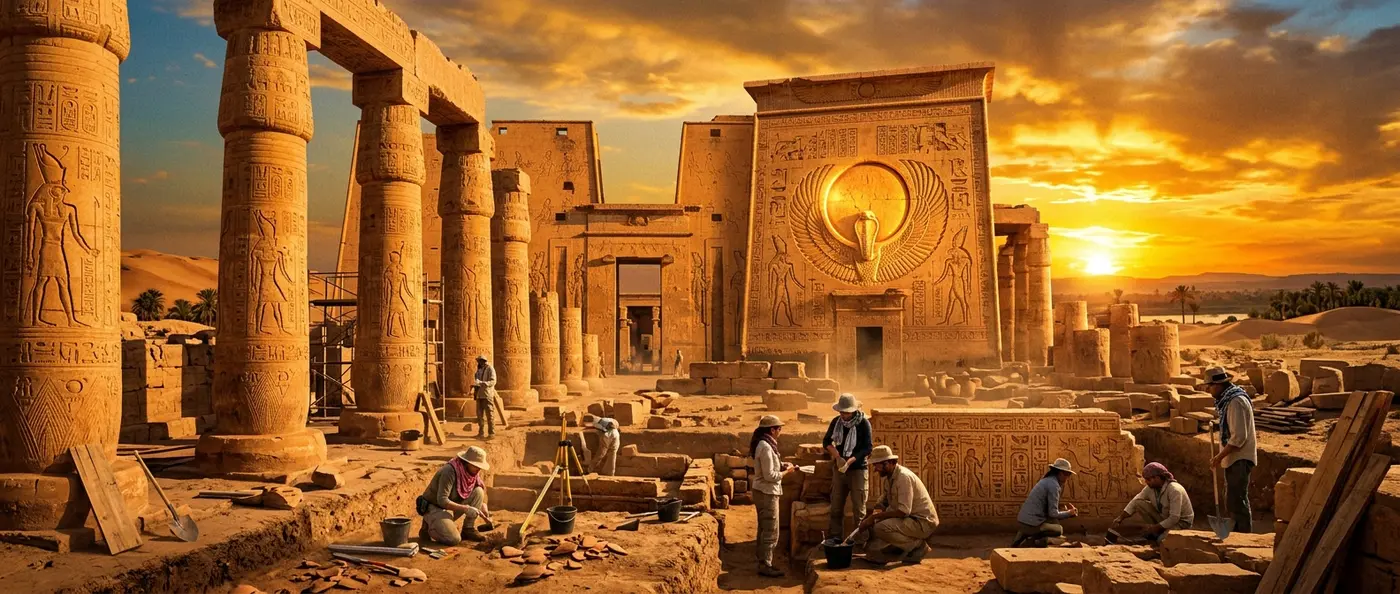
Forty feet down. That's where archaeologists hit the limestone pylon that changed everything. On March 15, 2026, a team digging at Saqqara broke through millennia of sand and debris to find hieroglyphs that read "House of Ra, where the sun rests." Hidden beneath tons of earth lay a temple that had been swallowing sunlight for 4,500 years, complete with a gold solar disk and astronomical records that predate known Egyptian star charts by centuries.
🌅 The Moment Everything Changed
The University of Cairo team, working with German archaeologists, wasn't even looking for a temple. They were doing routine conservation work on a nearby monument when ground-penetrating radar picked up something massive 40 feet down. The first clue came from an 8-meter limestone pylon carved with Ra's falcon head, clutching the ankh and was scepter.
But the real stunner was the inscription. Fifth Dynasty hieroglyphs naming Pharaoh Neferirkare Kakai as the temple's founder, dating the structure to around 2500-2350 BCE. This puts the temple's construction at the absolute peak of Ra worship, when the sun god's power rivaled that of the pharaohs themselves.
Even more striking was the location. Saqqara was supposed to be fully excavated. Decades of digs had combed through every square meter. Yet here was a temple complex the size of a city block, preserved in the kind of condition that makes archaeologists weep with joy. The dry sand had mummified everything — wood, papyrus, even organic pigments still bright enough to read by candlelight.
☀️ Architecture That Tracks the Cosmos
This isn't your typical Egyptian temple. The entire structure runs east-west with a 23.5-degree deviation — exactly matching Earth's axial tilt. That's not coincidence. Ancient Egyptian priests designed this temple to be a solar clock, with light shafts positioned to illuminate specific chambers at precise times of day and year.
The central sanctuary uses white Tura limestone walls inlaid with gold leaf. At the center sits a granite base from Aswan where Ra's statue once stood. The floor around it shows an intricate pattern mapping the sun's path across the sky — essentially a 4,500-year-old sundial built into the architecture.
The lighting system defies explanation. Tiny apertures in the roof and walls create light beams that hit different spots throughout the day. During summer solstice, one beam illuminates Ra's statue face for exactly 20 minutes. The precision required to calculate and build this system suggests astronomical knowledge that rivals modern understanding.
📜 Sacred Texts That Rewrite History
The walls tell stories. Thousands of hieroglyphs cover every surface — rituals, hymns to Ra, and astronomical observations spanning 200 years. Buried in these texts, archaeologists found an early version of the "Book of Ra," previously known only from much later sources. This version describes the sun god's nightly journey through the underworld in detail that makes modern scholars rethink everything they knew about Old Kingdom theology.
But the real treasure is the astronomical catalog. Priests systematically recorded positions of the sun, moon, and planets for two centuries. These observations show ancient Egyptians understood axial precession at least 2,000 years before Hipparchus supposedly "discovered" it. Egyptian astronomy was centuries ahead of what scholars thought possible.
One inscription stopped the translation team cold: detailed calculations predicting eclipses decades in advance. The math checks out. These priests were running astronomical calculations that wouldn't be matched in Europe for another 3,000 years.
Book of Ra
Early version of the sacred text describing the sun's nightly journey through the Duat, the Egyptian underworld, with unprecedented detail.
Astronomical Catalog
200 years of celestial observations proving ancient Egyptians possessed advanced astronomical knowledge millennia ahead of their time.
Ritual Texts
Detailed instructions for daily Ra worship, including offerings, prayers, and ceremonial procedures unknown from other sources.
🏺 Treasures Hidden in Secret Chambers
Ancient tomb robbers missed the good stuff. Hidden chambers behind false walls yielded ritual objects that make museum curators drool. The centerpiece: a solid gold solar disk 18 inches across, decorated with precious stones. At its center, a lapis lazuli eye represents the "Eye of Ra." The inscription around the rim reads: "Ra who shines on the horizon, lord of heaven and earth."
Twenty-three bronze sistrums — musical instruments used in religious ceremonies — lay exactly where priests left them 4,500 years ago. Chemical analysis of alabaster vessels revealed traces of sacred oils: myrrh, cinnamon, and frankincense. These weren't just random containers — they held the actual incense burned during daily rituals.
The preservation defies belief. Wooden ceremonial objects that should have rotted away millennia ago still show tool marks from their makers. Papyrus scrolls unroll to reveal prayers written in ink that looks fresh enough to have dried yesterday. The site feels frozen in time, as if the priests simply walked away mid-ceremony.
🔬 AI Reads Damaged Hieroglyphs
This dig marks the first time artificial intelligence has been used to decode damaged Egyptian texts. The AI system can "read" hieroglyphs that are 70% destroyed, suggesting probable meanings based on similar texts. It's already solved inscriptions that human experts couldn't crack.
Drones equipped with thermal sensors map the entire site while 3D scanners create digital copies of every artifact and inscription. Spectroscopy analyzes paint pigments without causing damage — revealing that ancient Egyptians used rare materials from across the known world. Afghan lapis lazuli, Spanish cinnabar, and other exotic pigments prove extensive trade networks.
The technology is revealing details invisible to the naked eye. Infrared imaging shows erased and rewritten texts, giving glimpses into how religious practices evolved over time. Some inscriptions were deliberately altered, suggesting political or theological changes that historical records never mentioned.
💡 Revolutionary Excavation Methods
For the first time in Egyptian archaeology, artificial intelligence analyzes and reconstructs damaged inscriptions. The system reads hieroglyphs that are 70% destroyed and suggests probable interpretations based on similar texts from the period.
🗿 Rewriting Ancient Egyptian Religion
The find upends decades of assumptions about Old Kingdom theology. The inscriptions reveal Ra wasn't just a sun god — he was protector of kingship and guarantor of cosmic order (Maat). The temple texts describe a complex theological system where Ra's daily journey maintains universal balance.
The astronomical records prove ancient Egyptians understood axial precession 2,000 years before it was "discovered" in Greece. The timeline of ancient scientific knowledge just got rewritten. Egyptian priests were tracking celestial mechanics with precision that wouldn't be matched until the Renaissance.
Temple archives list hundreds of priests, scribes, and craftsmen with their specific duties. The organizational structure resembles a modern corporation more than a simple religious institution. These weren't primitive sun worshippers — they were running a sophisticated operation that combined religion, science, and administration.
🌍 International Collaboration and Future Plans
This isn't just an Egyptian project. Teams from Germany, France, and the United States bring specialized expertise and cutting-edge technology. The collaboration model could reshape how major archaeological projects are conducted worldwide.
Full excavation will take at least five years. Plans include an on-site museum where visitors can see the temple as it appeared in ancient times through virtual reality technology. The goal: preserve the site while making it accessible to researchers and the public.
Digital reconstruction will allow virtual visits to the temple at different periods of its use. Visitors will experience daily rituals, seasonal ceremonies, and astronomical observations exactly as ancient priests performed them. The technology turns archaeology into a time machine.
📊 Comparison with Other Ra Temples
🔮 Mysteries That Remain
Why was this temple deliberately buried? Evidence suggests organized abandonment — sacred objects removed, entrances carefully sealed. Something made the priests close shop and hide their temple so thoroughly it stayed hidden for 4,500 years.
Ground-penetrating radar detected an underground chamber 65 feet below the temple floor, connected to a network of tunnels. The chamber remains unexcavated, but its size suggests it could be a crypt holding the temple's most sacred objects. What's down there could dwarf everything found so far.
Analysis of priest remains found unusual gold levels in their bones. This could indicate ritual consumption of gold-infused drinks — a practice never documented elsewhere in ancient Egypt. Were these priests ingesting gold for spiritual purposes? The discovery raises questions no one thought to ask.