🗿 The Foundation Stone That Changed History
Tomanec spotted the unusual rectangular stone in 2007. Twenty-three centimeters long, weighing 1.1 kilograms, it looked different from the typical rocks scattered around his property. But life got in the way. Twelve years passed before he decided to hand it over to the Moravian Museum for examination in 2019.
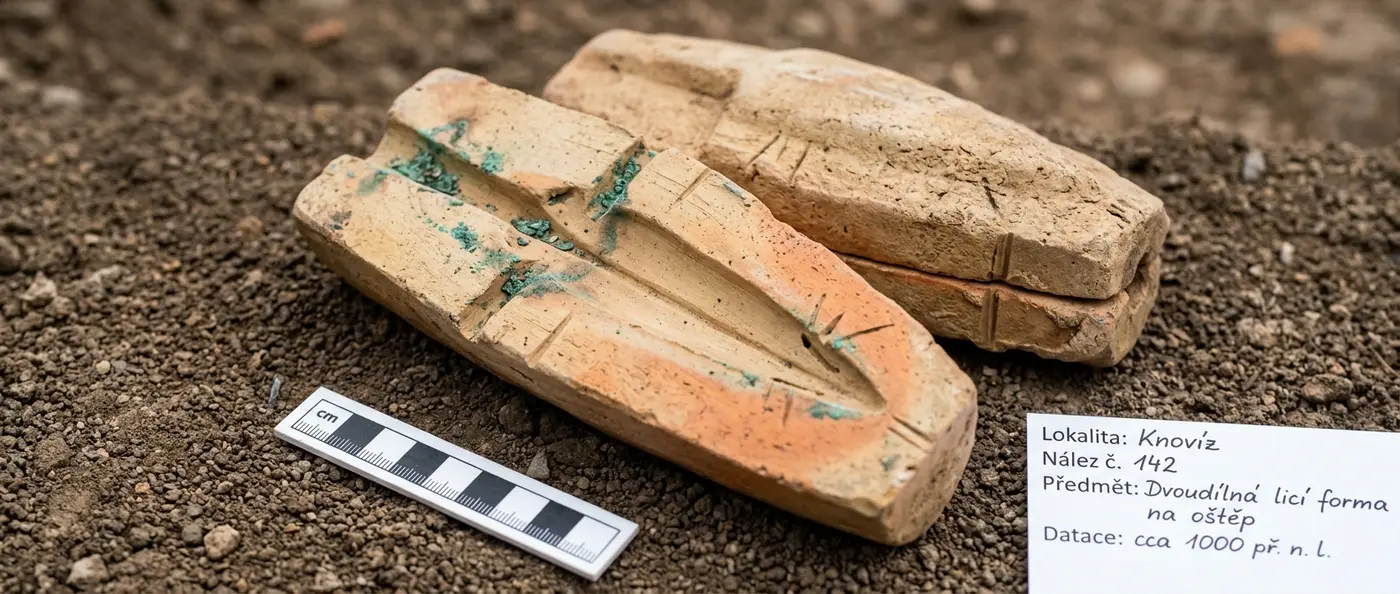
Museum archaeologists, led by Milan Salaš, subjected the stone to X-ray fluorescence spectroscopy. The results changed everything. This wasn't just any rock — it was half of an extraordinarily rare Bronze Age casting mold made from rhyolitic tuff, dating to around 1350 BCE during the Late Bronze Age.
"This is the best-preserved and most complete casting mold for a bronze spearhead in Central Europe," Salaš declared. The mold showed heavy use. Burn marks and heat damage covered its surface, clear evidence of repeated casting sessions that churned out weapons by the dozen. Someone had run an ancient arms factory with this thing.
🔬 Cracking the Ancient Manufacturing Code
The scientific analysis revealed Bronze Age technology that would impress modern manufacturers. X-ray fluorescence confirmed bronze had been cast in this mold. Even more fascinating: traces of copper showed the two mold halves had been bound together with copper wire during casting — ancient quality control at its finest.
Geology professor Antonín Přichystal from Masaryk University used X-ray diffraction to nail down the stone's exact composition. The mold was carved from rhyolitic tuff, a volcanic rock found mainly in Hungary's Bükk Mountains or around Salgótarján. The stone had traveled far from home.
Twenty million years ago, a massive volcano in the region "produced enormous quantities of tuff," Přichystal explained. While pinpointing the exact quarry is impossible, the mold clearly originated from northern Hungary or southeastern Slovakia — hundreds of kilometers from where Tomanec found it.
⚔️ Mass Production Meets Ancient Warfare
The mold belonged to the Urnfield culture, which emerged in the mid-second millennium BCE. These people transformed Bronze Age Europe, cremating their dead and burying ashes in urns in vast cemeteries. They transformed warfare too, through standardized weapon production.
Spearheads cast from molds like this featured distinctive ridges along the blade and sharp edges at the socket. "It was essentially mass production," Salaš noted. "As we can see, the mold was used very intensively. Probably dozens of spearheads were cast from it." The heavy burn marks and heat traces prove this mold cranked out weapons in serial production runs.
Casting Technique
The mold was heated and filled with molten bronze. Two halves were clamped tight with copper wire to ensure perfect alignment and prevent metal leakage.
Mass Production
Molds enabled uniform weapon production, making it easier to equip large armies with standardized gear that could be maintained and replaced efficiently.
Trade Networks
Importing the mold from Hungary proves extensive trade networks connected Central European regions, spreading technology and expertise across vast distances.
🏺 The Urnfield Revolution
The Urnfield culture, which produced this mold, marked a turning point in European prehistory. Stretching from modern France to Hungary, it introduced social and technological innovations that shaped the continent. Standardized weapon production through molds like this one changed more than just spearmaking.
Mass production enabled better-equipped armies and strengthened the commercial and political power of Carpathian Basin civilizations. Weapon standardization also simplified maintenance and replacement, making prolonged military campaigns more sustainable. When every spearhead was identical, logistics became manageable.
Typically, Urnfield casting molds are found in settlements. More rarely, they turn up in graves as burial goods. How an Urnfield spearhead mold ended up in Tomanec's Moravian yard remains unclear, but researchers suspect it "was probably moved in modern times from an Urnfield period site in the area."
💡 Why is this so rare?
Most Bronze Age molds were destroyed through use or melted down to recycle their metal content. Finding such a well-preserved mold with clear signs of intensive use happens maybe once in a generation.
🗺️ The Journey from Hungary to Moravia
The stone analysis revealed an impressive journey. This mold was carved from rhyolitic tuff sourced from northern Hungary's Bükk Mountains, hundreds of kilometers from its discovery site. This distance wasn't accidental — it demonstrates extensive trade networks connecting Central European regions during the Late Bronze Age.
Transporting such a valuable object across vast distances wasn't casual commerce. Specialized molds were precious tools that enabled high-quality weapon production. Importing them from regions with skilled craftsmen and suitable stone was part of a broader system exchanging expertise and products across cultural boundaries.
🔱 Echoes of the Trojan War Era
Dating the mold to around 1350 BCE places it in a turbulent period of European history. This was the era associated with the Trojan War and social collapse across the Mediterranean. During this time, bronze armor was worn by elite warriors, while common soldiers likely wore protective clothing made from organic materials that doesn't survive in the archaeological record.
Another recent Czech discovery reinforces this connection. In 2023, metal detectorists found fragments of 3,200-year-old bronze armor near Brno, along with a spearhead, sickle, and needle. The objects had been deliberately destroyed and buried together, possibly as part of a ritual. The armor dates to the Late Bronze Age (1600-1200 BCE) and represents only the second such find in the country.
⚔️ Contemporary Bronze Age Finds in Czech Republic
📜 The Long Road from Discovery to Publication
The timeline from initial discovery to scientific publication tells its own story. Tomanec found the stone in 2007, handed it to the museum in 2019, and the scientific study was published in Archeologické Rozhledy in 2025.
As Přichystal noted, "This interesting case shows how long the journey from the discovery of a unique archaeological object (2007) to its scientific evaluation in a professional journal (2025) can sometimes be." The 18-year delay underscores the patience and persistence required in archaeological research.
Moravian Museum director Zbyněk Šolc emphasized the importance of public-expert collaboration: "This finding confirms the importance of long-term cooperation between experts and the public, which is crucial for our museum. Thanks to this, we can discover and protect valuable objects that bring us closer to ancient times and bring new knowledge about our history."
🏛️ The Mold's Future
The Moravian Museum is preparing a new exhibition where the public can see the mold and learn about Bronze Age military culture in Central Europe. The display will feature not just the mold itself, but 3D reconstructions of the spearheads it produced, along with information about the extensive trade networks of the period.
This discovery reminds us that significant archaeological finds can hide in the most unlikely places. A simple stone in a backyard proved to be a window into a world of sophisticated technology and extensive trade networks from 3,000 years ago. As archaeological research continues, who knows what other secrets of the past await discovery in Europe's yards and gardens?