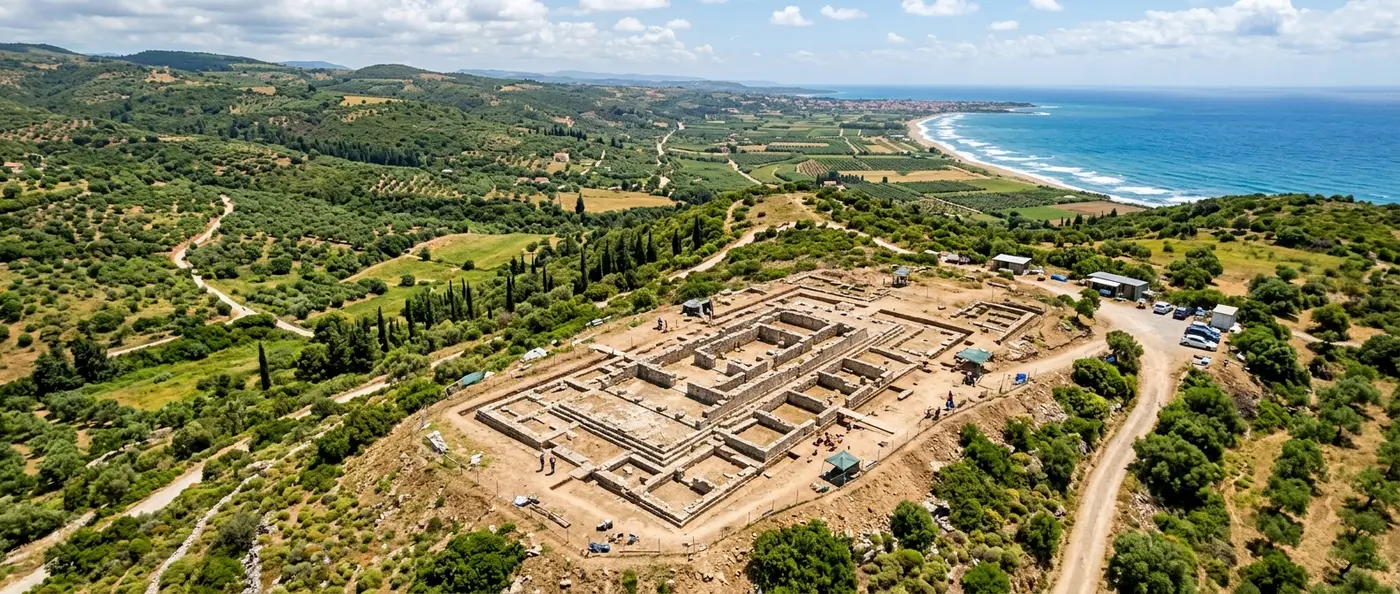
🏛️ The Sanctuary of Kleidi-Samiko
Ancient Samiko, located in the western Peloponnese, served as an important religious center during the archaic period. Initial excavations in the area in 2022 uncovered the foundations of a temple that archaeologists believe corresponds to the sanctuary of Samian Poseidon referenced in ancient texts.
According to preliminary findings, the temple dates to the 6th century BC and displays architectural elements indicating its monumental scale. Its position at the foothills of ancient Samiko's acropolis offered a strategic view toward the sea, reinforcing the hypothesis of its connection to Poseidon worship.
November 2024 excavations brought to light new evidence showing the sanctuary was much larger than initially estimated. Architectural remains indicate an extensive complex that included not only the main temple but also auxiliary buildings for worship needs.
⚡ The Significance of the 2026 Excavation
The planned 2026 excavation continues research that began in 2022. The international archaeological team aims to fully uncover the temple and understand the sacred space's function. Special emphasis will be placed on excavating layers dating from the archaic to the Hellenistic period.
When the new excavation season begins in March 2026, archaeologists plan to focus on three main areas: the main temple area, the sanctuary's perimeter, and buildings that likely housed votive offerings and sacred vessels. The use of modern technologies like geophysical surveying and 3D mapping will enable precise site documentation.
A bronze inscription from preliminary surveys awaits detailed study. The inscription, dating to the 6th century BC, contains text likely referring to dedications to the god or sanctuary operating regulations.
Equally significant is the discovery of evidence for an archive within the temple. If confirmed, this archive would reveal how the sanctuary managed its affairs and connected with other religious centers. Ancient Greek temple archives typically contained votive catalogs, financial records, and correspondence with other cities.
💡 Why This Discovery Matters
Identifying the temple with the sanctuary of Samian Poseidon referenced by Strabo would confirm the existence of one of the most important religious centers in the western Peloponnese. The sanctuary appears to have functioned as a meeting place for regional cities and played a significant role in the political and religious life of the archaic period.
🔱 Poseidon Worship in Ancient Greece
Poseidon, as god of the sea and earthquakes, held a prominent position in the Greek pantheon. His worship was particularly widespread in coastal areas and islands, where inhabitants depended on the sea for trade and survival. In the Peloponnese, besides Samiko, important Poseidon sanctuaries existed at Isthmia, Sounion, and Kalauria.
Poseidon's sanctuaries often functioned as amphictyonic centers—religious unions of cities that cooperated in managing and protecting the sanctuary. Multiple cities funded these temples, accounting for their massive size.
At Samiko, the sanctuary's geographical position, overlooking the Ionian Sea, made it ideal for worshipping the sea god. Sailors and merchants traveling along the western coast of the Peloponnese likely stopped here to offer sacrifices and seek the god's favor for safe journeys.
🏺 Architectural Features of the Temple
Based on current findings, the Kleidi-Samiko temple displays characteristics of archaic Doric architecture. The uncovered foundations indicate a peripteral building with six columns on the narrow sides, a typical design for 6th-century BC temples. The use of local limestone in construction shows exploitation of the region's natural resources.
Traces of polychromy found on architectural members are particularly interesting. Like all ancient Greek temples, the Samiko temple was painted with vivid colors—red, blue, and yellow—that emphasized architectural elements and sculptures.
Doric Order
The temple followed the austere Doric order with simple columns without bases and triglyphs in the frieze.
Polychromy
Traces of red and blue paint on architectural members attest to rich chromatic decoration.
Local Materials
Use of limestone from nearby quarries for temple and foundation construction.
🗺️ The Sanctuary's Strategic Position
The site selection for establishing the sanctuary wasn't random. Kleidi is located at a strategic point controlling the passage between Elis and Messenia, while offering easy access from the sea. This position made the sanctuary accessible to both inland inhabitants and seafarers.
The area's geomorphology, with the hill rising abruptly from the coastal plain, created an impressive natural setting for the sanctuary. Visitors arriving from the sea would see the temple dominating the slope, visible from great distances—a symbol of the god's power and regional prosperity.
Freshwater springs near the sanctuary served purification rituals and the daily needs of priests and pilgrims. Archaeologists expect to locate the hydraulic installations that served the sanctuary during the 2026 excavation.
The 2026 excavation will employ the most modern archaeological methods for studying the site. Geophysical surveying with magnetometers and ground-penetrating radar will enable detection of buried structures before excavation, minimizing the risk of damaging sensitive finds.
Photogrammetry and 3D laser scanning will be used for precise documentation of each excavation phase. This will enable creation of digital models of the temple and sacred space, usable for research and educational purposes.
Special attention will be given to micro-excavation of layers containing organic materials. Radiocarbon analysis will enable precise dating of various sanctuary use phases, while archaeobotanical study will reveal information about offerings and ritual practices.
📊 Comparison with Other Poseidon Sanctuaries
💎 Expected Finds and Challenges
Archaeologists expect the 2026 excavation to yield significant finds that will enrich our knowledge of the sanctuary. Among expected discoveries are votive statues, pottery from various Greek regions attesting to the sanctuary's broad influence, and perhaps more inscriptions clarifying the space's function and administration.
However, the excavation faces challenges. Erosion from torrents and the region's seismic activity have damaged ancient remains. Additionally, intensive agricultural use of the area in recent times may have disturbed upper archaeological layers.
The international team believes systematic digging will uncover more of the sanctuary's past. The collaboration between Greek and Austrian archaeologists, combining local knowledge with international experience, is expected to yield significant results.
🌊 Significance for Understanding the Ancient World
Complete excavation and study of the Kleidi-Samiko sanctuary will significantly contribute to understanding the religious and political organization of the western Peloponnese during the archaic period. The sanctuary appears to have been a communication hub between regional cities and a contact point with the broader Greek world.
Additionally, sanctuary study will illuminate maritime routes and period trade. Analysis of imported pottery and other objects will reveal the region's commercial relationships with other parts of the Greek world and beyond.
Finally, the excavation is expected to provide valuable information about ancient Greek religion's evolution. Study of votive offerings, sacrifices, and ritual practices will help understand how ancient Greeks perceived and honored their gods, particularly Poseidon, who was so important to a people closely connected to the sea.