🚢 The Discovery in Ancient Harbor
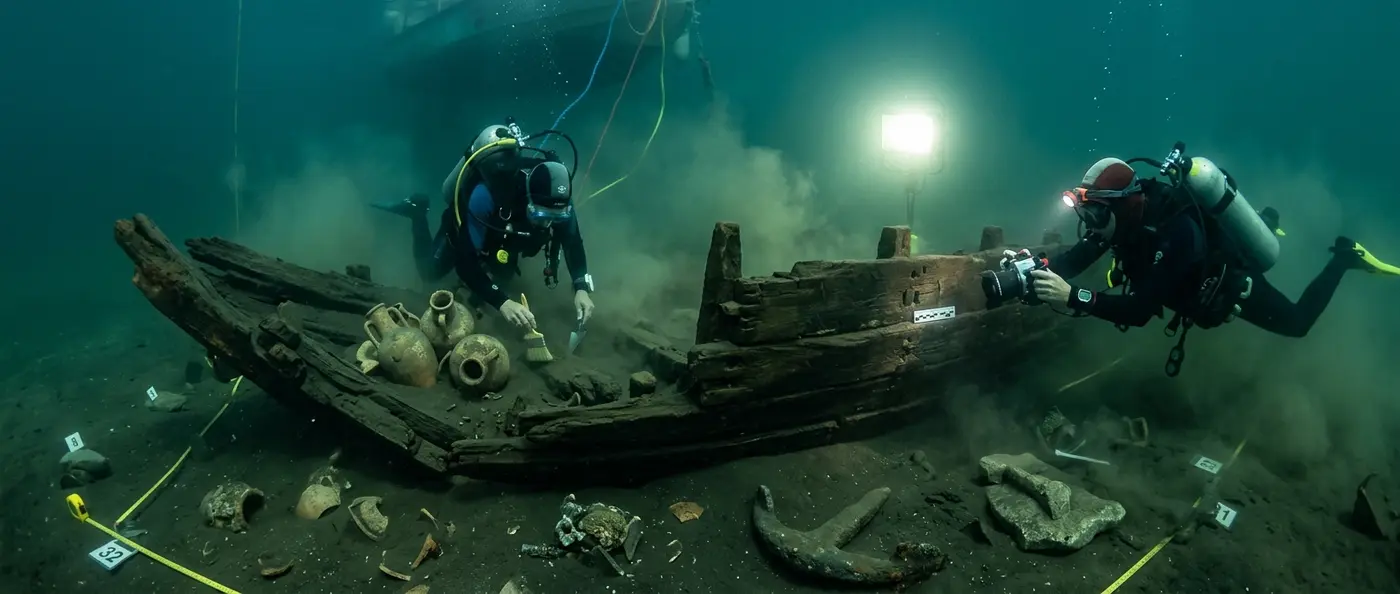
October 2024. The French-Egyptian archaeological team led by Franck Goddio was working the ancient harbor of Alexandria when they hit something extraordinary. At 16 feet down, divers found the remarkably preserved wooden remains of a ship stretching 115 feet long and 23 feet wide.
The vessel rested just yards from where the temple of Isis once stood on Antirhodos island, which disappeared beneath the waves sometime between the 4th and 8th centuries CE. This location sat in the Portus Magnus — the Great Harbor of Alexandria during the Ptolemaic period (304-30 BCE).
The ship's timbers, running 92 feet in length, remained intact in the underwater environment. On one of the planks, archaeologists discovered graffiti with Greek characters dating to the first half of the 1st century CE — a timestamp that places this wreck in the twilight of pharaonic Egypt.
🏛️ The Pharaoh's Floating Palace
According to Goddio, this ship was likely a "thalamegos" — a Greek word meaning literally "cabin bearer." These were the floating palaces of Ptolemaic Egypt. Luxury vessels with richly decorated central cabins, propelled by oars rather than sails.
The ancient Greek geographer Strabo, writing in the 1st century BCE, painted a vivid picture of these craft: "They organize festivals on ships with cabins, with which they enter the thick foliage of Egyptian lotuses and enjoy the shade of their leaves." His description reveals how the wealthy used these vessels to glide between select locations along Alexandria's canal network.
No similar ship had ever been found, despite extensive descriptions by ancient writers and frequent depictions in Egyptian art. This discovery represents the first archaeological proof that such floating palaces actually existed.
⚓ The Historic Significance of the Site
Alexandria during the Ptolemaic period was Egypt's capital and one of the ancient world's most important centers. After the Battle of Actium in 31 BCE, when Octavian's naval forces defeated the fleet of Cleopatra VII and Mark Antony, the city passed under direct Roman control.
The island of Antirhodos, where the wreck was found, hosted a major temple dedicated to the goddess Isis. The temple was likely destroyed by earthquake around 50 CE, while the island itself sank into the sea between the 4th and 8th centuries, along with large sections of the ancient harbor.
💡 Did You Know?
Alexandria featured an extensive network of canals connecting the Mediterranean to the Nile. Luxury vessels like the thalamegos could navigate both sea and inland waters, transporting the elite to various locations for recreation and worship.
🔱 Religious or Secular Use?
What was this ship actually doing when it sank? Goddio proposes two scenarios that don't exclude each other.
Perhaps it ferried wealthy passengers through Alexandria's canal network, as Strabo described — its massive size and elaborate construction certainly fit the bill.
The second scenario, strengthened by the wreck's proximity to the Isis temple, implies ceremonial use. The ship may have participated in the "navigatio iside," a naval ceremony conducted in Roman-era Alexandria. During this festival, a procession honoring Isis carried a richly decorated ship called the "Navigium" through the city streets.
Luxury Construction
The ship featured a lavishly decorated central cabin, suitable for transporting royal family members or high-ranking officials. Its 115-foot length provided ample space for luxurious amenities.
Religious Significance
The wreck's position near the Isis temple suggests possible participation in religious ceremonies. The ship may have performed annual ritual journeys from Alexandria to the shrine of Osiris at Canopus.
🗺️ Underwater Archaeology Technology
Discovering and studying this wreck required advanced underwater archaeological techniques. Goddio's team used digital photogrammetry to create a detailed three-dimensional model of the wreck. This technology allows researchers to study the find with precision without disturbing its position on the seabed.
Divers worked in challenging conditions, as the ancient harbor area is filled with sediments and debris from centuries of human activity. Yet the timbers survived because the seabed's oxygen-free environment prevented the wood from rotting away.
📜 Connections to the Last Dynasty
Dating the wreck to the 1st century CE places it in a critical period of Egyptian history. The Ptolemaic dynasty had just ended with Cleopatra's death in 30 BCE, and Egypt had become a Roman province.
However, many traditions and practices from the Ptolemaic period continued under Roman rule. Luxury vessels like the thalamegos were still used by the elite, while religious ceremonies honoring Egyptian deities were maintained and incorporated into the Roman religious system.
⚖️ Ptolemaic vs Roman Period
🔬 Future Research and Prospects
Research on the wreck is still in early stages. Timmy Gambin, a maritime archaeologist from the University of Malta who didn't participate in the discovery, emphasizes that it's too early to determine with certainty whether the ship is indeed a thalamegos. Further scientific analysis is required to confirm the identity and exact use.
Researchers plan to continue excavations in the area, hoping to find more evidence about the ship and its relationship to the Isis temple. Analysis of the timbers could reveal information about the origin of materials and construction techniques.
The study of Greek graffiti on the planks could offer valuable information about the ship's crew or passengers. While the text is difficult to read, paleographic analysis might reveal names or messages that would further illuminate the vessel's history.
🏺 The Legacy of Ancient Alexandria
The wreck offers a glimpse into ancient Alexandria, where Greek rulers governed Egyptian subjects and Hellenistic luxury met pharaonic tradition. From its founding by Alexander the Great in 331 BCE until the Arab conquest in 641 CE, Alexandria was one of the ancient world's most important centers of learning and culture.
The city's sunken harbor still hides many secrets. Besides the thalamegos wreck, archaeologists have discovered palaces, temples, statues, and other shipwrecks that testify to the grandeur and wealth of the ancient metropolis. Each artifact pulled from the harbor floor reveals more about how Alexandria's elite lived, worshipped, and traveled.
🌊 The Sunken Harbor
Much of Alexandria's ancient harbor sank due to earthquakes, tsunamis, and ground subsidence. Today, approximately 6,500 square meters of the ancient city lie beneath the sea surface, creating one of the world's richest underwater archaeological parks.
As underwater archaeological technology continues to evolve, we can expect even more exciting discoveries from the Mediterranean depths. The wreck of the probable thalamegos is just the beginning of what Goddio calls "a fascinating journey into life, religion, luxury, and pleasure on the waterways of early Roman Egypt."