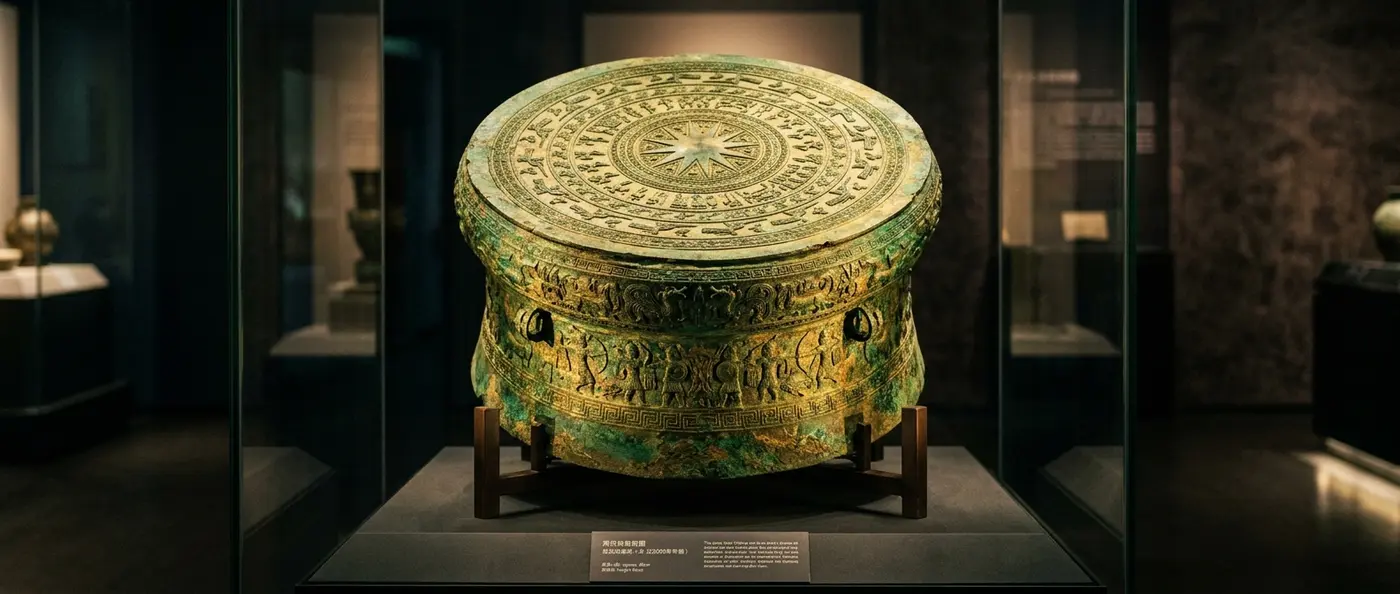
In China's Guangxi Province, archaeologists have uncovered a bronze drum dating back approximately 2,000 years to the Eastern Han dynasty (25-220 CE). The discovery, made during routine road construction near Nanning city, belongs to the renowned Dongson drum tradition and showcases the advanced metallurgical skills of Han dynasty craftsmen.
🥁 The Discovery That Stunned Archaeologists
The bronze drum was found by chance when construction workers building a road near Nanning struck something hard with their machinery. What they initially thought was a large rock turned out to be an archaeological treasure of immense value. The drum, measuring 68 centimeters in diameter and 42 centimeters in height, was buried just 1.5 meters below ground surface.
Archaeologists called to the site were amazed by the exceptional preservation of the find. Despite spending two millennia underground, the drum retained its intricate decoration, with geometric patterns and animal representations adorning its surface. The green patina covering the metal testifies to its age while simultaneously protecting the decorative details.
Evidence around the burial site points to ancient settlement patterns. Preliminary excavations around the drum revealed pottery fragments and bronze artifacts, suggesting this area was once part of a larger ceremonial or residential complex. The drum's placement suggests it was deliberately buried, possibly during a period of conflict or as part of a ritual offering.
🏺 Dongson Drums: Symbols of Power and Wealth
Dongson-type bronze drums represent one of the most distinctive artifacts of ancient Southeast Asian civilization. Named after the Dong Son region in northern Vietnam where they were first discovered in the early 20th century, their production began around 600 BCE and continued for over a thousand years.
These drums served purposes beyond making music. In ancient society, they functioned as symbols of prestige and power. Only the most powerful leaders and wealthy families could acquire such objects. Owning a bronze drum signified wealth, influence, and connection to the divine.
Their construction required specialized metallurgical techniques that few craftsmen possessed. Ancient masters used the lost-wax casting method, a complex process that allowed for the creation of detailed decorative motifs. The bronze alloy they used contained carefully measured amounts of tin and lead, giving the drum ideal acoustic quality and durability.
The drums served multiple functions beyond their ceremonial role. They were communication devices capable of transmitting messages across vast distances. Different rhythmic patterns conveyed specific meanings - warnings of danger, calls to assembly, or announcements of important events. This acoustic network connected scattered communities across the mountainous terrain of southern China and Southeast Asia.
🎨 The Art of Decoration: A World of Symbols
The surface of the drum discovered in Guangxi is a true canvas of ancient art. At the center of the upper surface, a sun with twelve rays dominates, surrounded by concentric circles of geometric designs. Each decorative zone has its own motif: triangles, rhombuses, spirals, and wave-like lines creating complex visual patterns.
Among the geometric designs, microscopic figures of animals and humans tell stories from daily life. We see warriors with spears, dancers in ritual poses, flying birds, and running deer. These representations are not random. Each symbol had specific meaning in the cosmology of the region's ancient inhabitants.
The four frogs sitting symmetrically on the drum's perimeter are perhaps the most characteristic element of Dongson drums. In ancient Southeast Asian mythology, frogs were associated with rain and fertility. Their presence on the drum indicates its use in rain-calling ceremonies, crucial for agricultural societies of the era.
Recent analysis has revealed that the decorative patterns follow mathematical principles. The spacing between motifs, the proportions of figures, and the arrangement of symbols all adhere to specific ratios that may have had astronomical or calendrical significance. This suggests the drums served as more than ritual objects - they may have been sophisticated timekeeping devices.
Solar Symbol
The central sun motif with 12 rays symbolizes divine power and the cycle of time
Four Frogs
Symbols of rain and fertility, positioned at the four cardinal directions
Human Figures
Dancers and warriors depicting rituals and social activities
🔊 The Power of Sound: Communication with Gods and Humans
Bronze drums were not merely decorative objects. Their sound could be heard for miles, making them ideal for communication between distant villages. During wartime, they were used to call warriors to battle or warn of approaching danger.
However, their most important use was in religious ceremonies. The ancients believed that the deep, resonant sound of the drum could reach the spirit world. During rituals for rain, healing illnesses, or honoring the dead, the drum played a central role, creating an acoustic bridge between the earthly and divine realms.
Studies of similar drums have shown that their acoustic design was extremely advanced. The shape and thickness of the metal were calculated to produce specific frequencies considered sacred. Some researchers argue that these frequencies could induce trance states in ceremony participants.
The acoustic properties of these drums were no accident. Modern analysis reveals that the bronze composition and structural design create a unique harmonic resonance. When struck, the drum produces not just a primary tone but a complex series of overtones that can last for several minutes. This sustained reverberation was likely interpreted as the voice of ancestors or spirits responding to the ritual calls.
💡 Did You Know?
The largest Dongson bronze drums ever found weigh over 100 kilograms and have diameters exceeding one meter. Their construction required the work of dozens of craftsmen for many months.
🏛️ Historical Context: The Eastern Han Dynasty
The Eastern Han period (25-220 CE) was an era of great cultural flourishing in China. Trade along the Silk Road brought new ideas and technologies from distant lands. The Guangxi region, where the drum was found, occupied a strategic position on trade routes connecting China with Southeast Asia.
During this period, the art of metallurgy had reached new heights. Chinese craftsmen had perfected bronze casting techniques, creating objects of stunning complexity and beauty. The discovered drum represents the pinnacle of this technology, combining technical excellence with artistic expression.
The discovery of this drum in Guangxi confirms the region's importance as a cultural crossroads. Here, Chinese traditions met the civilizations of Southeast Asia, creating a unique synthesis reflected in the art and objects of the era.
Archaeological evidence suggests that Guangxi Province was home to several bronze drum workshops during the Han period. The standardization of certain decorative elements across multiple finds indicates organized production and quality control. This industrial approach to sacred object creation reveals the sophisticated economic systems that supported these ancient societies.
🔬 Modern Analysis Techniques: Revealing Ancient Secrets
Archaeologists today use advanced technologies to study the drum without destroying it. X-ray spectroscopy revealed the precise alloy composition: 78% copper, 18% tin, and 4% lead. This ratio is not random. It gives the metal ideal hardness to withstand impacts while maintaining the elasticity required for good acoustic performance.
Computed tomography allowed researchers to see inside the drum without opening it. They discovered that the metal thickness varies at different points, from 3 to 8 millimeters. This variation is not accidental but designed to optimize the instrument's acoustic performance.
Traces of organic materials found on the drum's surface indicate it was once covered with animal hide, probably buffalo or deer. This would have significantly improved its sound and allowed for greater tonal variety during playing.
Chemical analysis of the patina has revealed the drum's burial environment. The specific minerals present in the corrosion layers tell a story of changing soil conditions over two millennia. This data helps archaeologists understand not just the drum itself, but the environmental history of the region where it was buried.
⚖️ Comparison with Other Finds
🌏 Significance for Understanding the Past
This drum provides new evidence about ancient East Asian civilizations. It confirms that the Guangxi region was an important center for bronze drum production and trade during the Han period. The high quality of construction indicates the existence of specialized workshops and organized production.
The drum reminds us that ancient civilizations were not isolated but connected through extensive networks of trade and cultural exchange. Dongson drum-making technology spread across a vast area, from southern Vietnam to Indonesia, and from southern China to Burma.
For modern researchers, each such find is a window into the past. It allows us to understand not only the technology and art of the ancients, but also their beliefs, social structures, and how they perceived the world around them. The Guangxi bronze drum carries two millennia of history in its bronze surface and decorative motifs.
This discovery also highlights the ongoing importance of rescue archaeology. Had the construction workers not been alert to their unusual find, this remarkable artifact might have been destroyed by modern development. The drum's preservation serves as a reminder that our past lies just beneath our feet, waiting to be discovered and understood.