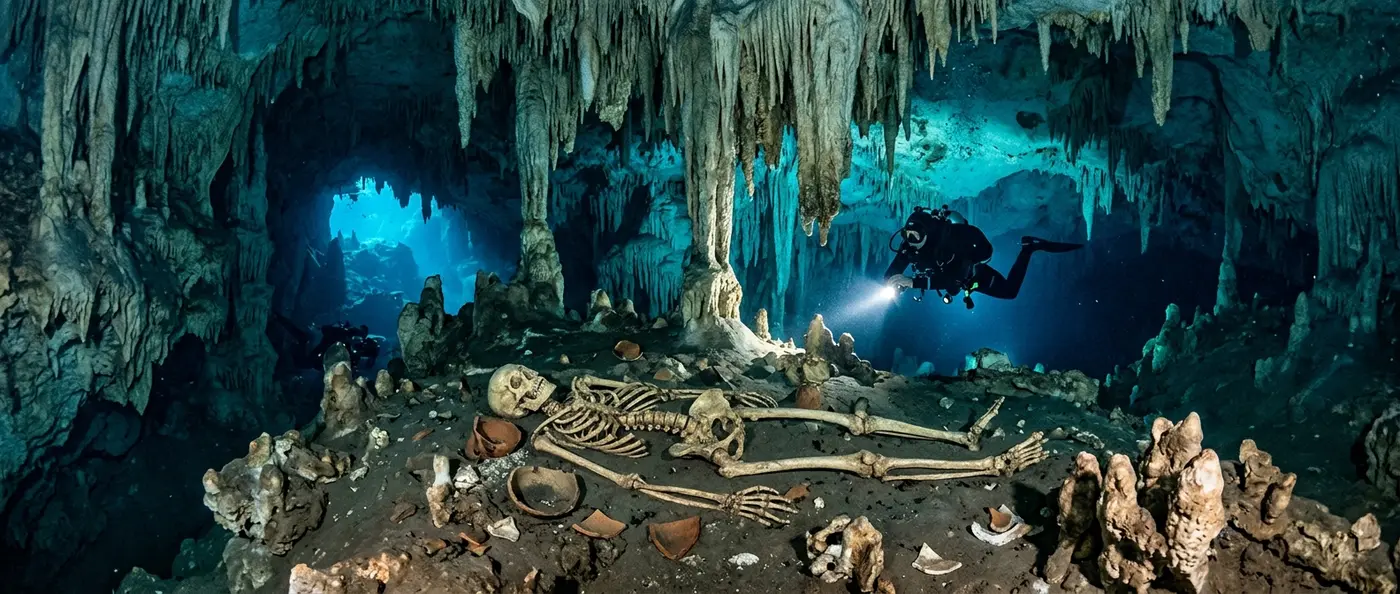
Sixty feet underwater in Mexico's Yucatan Peninsula, cave divers made a discovery that could flip our understanding of early American history. A human skeleton — possibly 13,700 years old — lay perfectly preserved on the floor of Sistema Ox Bel Ha, the world's largest underwater cave system. The woman, dubbed "Eve of Naharon," died when these caverns were bone-dry chambers. Now she's teaching us how the first Americans lived, and died, in ice age America.
🗿 Inside the World's Largest Underwater Labyrinth
Sistema Ox Bel Ha stretches for 326 miles beneath the jungle floor. That's "three paths of water" in Maya — a fitting name for what amounts to an underground ocean. Only Kentucky's Mammoth Cave system runs longer at 426 miles, but Mammoth stays dry. Ox Bel Ha drowns everything in crystal-clear water that preserves what would have rotted away millennia ago on the surface.
The Yucatan Peninsula sits on a foundation of limestone — soft rock that rainwater dissolves like sugar in coffee. This process, called karstification, carved out the cave system over millions of years. When fresh rainwater meets salty seawater pushing in from the ocean, the chemical reaction accelerates. The mixing zone, called a halocline, shifts between 33 feet near the coast and 66 feet inland, creating a shimmering underwater mirage that can disorient even experienced cave divers.
During the last ice age, sea levels dropped 400 feet. These caves were dry then — vast underground chambers where ancient peoples could shelter, hunt, and bury their dead. As glaciers melted and oceans rose, water gradually flooded the system, sealing it like a time capsule.
💀 Eve of Naharon: A 13,700-Year Mystery
The skeleton belonged to a woman between 25 and 30 years old. Her bones show she was deliberately placed on the cave floor — this wasn't an accidental death. Someone carried her body deep underground and laid her to rest in what may have been a sacred burial chamber. The dating hasn't been fully confirmed yet, but if the 13,700-year estimate holds, she predates most accepted timelines for human arrival in the Americas.
Cave archaeologists work like forensic investigators in reverse. Every bone position matters. Every artifact tells a story. The woman's placement suggests ritual burial practices among people we know almost nothing about — groups who lived in the Americas thousands of years before the Maya built their first temples.
The preservation is extraordinary. Bones that should have crumbled to dust survived because the cave environment lacks oxygen and maintains constant temperature. The woman's skeleton remains nearly complete, showing researchers what America's earliest inhabitants looked like and how they lived.
🔬 Rewriting the Story of Early Americans
Most theories place the first Americans crossing the Bering land bridge 15,000-20,000 years ago. If Eve of Naharon really lived 13,700 years ago, she represents one of the earliest confirmed human presences in the New World. That timing matters because it suggests these early populations spread across the continent faster than previously thought possible.
The Yucatan's underwater caves have become archaeology's new frontier. The stable water environment and oxygen-free zones create perfect preservation conditions. Besides human remains, divers have discovered bones from extinct Pleistocene megafauna — giant ground sloths, mastodons, and saber-toothed cats that roamed the Americas when Eve of Naharon was alive.
Each discovery raises new questions about America's first inhabitants. Who were these people? How did they live? What happened to them? The bones don't lie, but they don't tell the whole story either.
💡 Why Underwater Caves Preserve Everything
Water creates an anaerobic environment that slows decomposition to a crawl. Stable temperatures and complete darkness protect organic materials from the weathering they'd face on the surface. It's like nature's own deep freeze, preserving 13,000-year-old bones as if they were buried yesterday.
⚓ The Deadliest Archaeological Dig on Earth
Cave diving ranks among the most dangerous activities humans attempt. Add archaeological precision to technical diving, and you've got a recipe for disaster. Divers in Ox Bel Ha navigate narrow passages in total darkness, carrying heavy equipment while maintaining scientific protocols. One wrong turn in the labyrinth could mean death.
The halocline creates visual distortions that mess with depth perception. Disturb the sediment and visibility drops to zero. Equipment failure 200 feet from the nearest exit isn't just inconvenient — it's potentially fatal. Yet archaeologists keep diving because no other site preserves such ancient remains.
Modern cave archaeology relies on photogrammetry and 3D scanning to document finds without disturbing their underwater context. Teams can spend hours underwater creating detailed maps of bone positions, artifact locations, and cave geology. The data they collect builds virtual reconstructions that researchers worldwide can study.
Technical Diving
Cave divers use specialized techniques with twin tanks, guide ropes, and backup equipment to navigate the maze-like system safely during extended underwater expeditions.
Documentation
Photogrammetry and 3D scanning allow precise recording of finds without disturbing their position in the underwater environment for future study.
Mapping
CINDAQ has mapped hundreds of miles of passages, creating detailed charts of the underground network for both safety and scientific purposes.
🏺 Sacred Waters of the Ancient Maya
The Maya considered cenotes — natural sinkholes that form when cave roofs collapse — as gateways to Xibalba, their underworld. These weren't just water sources but sacred portals where priests performed rituals and offered sacrifices to appease the gods. Archaeologists have pulled countless ceramic vessels, jade jewelry, and human remains from cenote depths.
But Eve of Naharon predates Maya civilization by thousands of years. Her presence suggests the spiritual significance of these underground chambers runs deeper than Maya mythology. Perhaps the caves held sacred meaning for multiple cultures across millennia — a continuous thread of reverence for the underground realm.
The cave system supports a unique ecosystem that thrives without sunlight. In 2018, scientists discovered that the underground network feeds on methane produced beneath the jungle floor. Microbes consume the methane, becoming food for cave-dwelling crustaceans and various fish species, including a blind white cave fish that evolved in total darkness.
🔱 Racing Against Development
Sistema Ox Bel Ha faces serious threats from regional development. The Maya Train project and Tulum International Airport construction could compromise the system's integrity. The cave network already extends beneath several urban areas, making contamination from surface activities a constant concern.
Pollution seeps through porous limestone like water through a sponge. Agricultural chemicals, sewage, and industrial waste threaten both the unique ecosystem and the Maya Aquifer — the region's only source of fresh water. What took millions of years to create could be destroyed in decades through careless development.
CINDAQ researchers emphasize the critical importance of studying and mapping the system before it's too late. Every dive reveals new passages and more ancient remains. But time is running out as hotels and highways threaten the cave system.
🗺️ World's Largest Cave Systems
🌾 What Lies Beneath
Eve of Naharon's discovery opens new research avenues into early human presence in the Americas. As dating technologies improve and more cave sections get explored, researchers expect additional finds that will illuminate this crucial period of human history. Each skeleton, each artifact, each bone fragment adds detail to our understanding of how the Americas were first populated.
Scientists also work to understand the climate changes that led to cave flooding. By studying sediments and stalactite formations, they can reconstruct the region's paleoclimate and understand how environmental changes affected early inhabitants. The caves serve as both archaeological sites and climate records spanning thousands of years.
Preserving this unique archaeological and natural treasure requires cooperation between scientists, government authorities, and local communities. The underwater realm of Sistema Ox Bel Ha holds secrets we're only beginning to uncover. Rush to develop the surface, and we risk losing an irreplaceable window into humanity's deepest past.