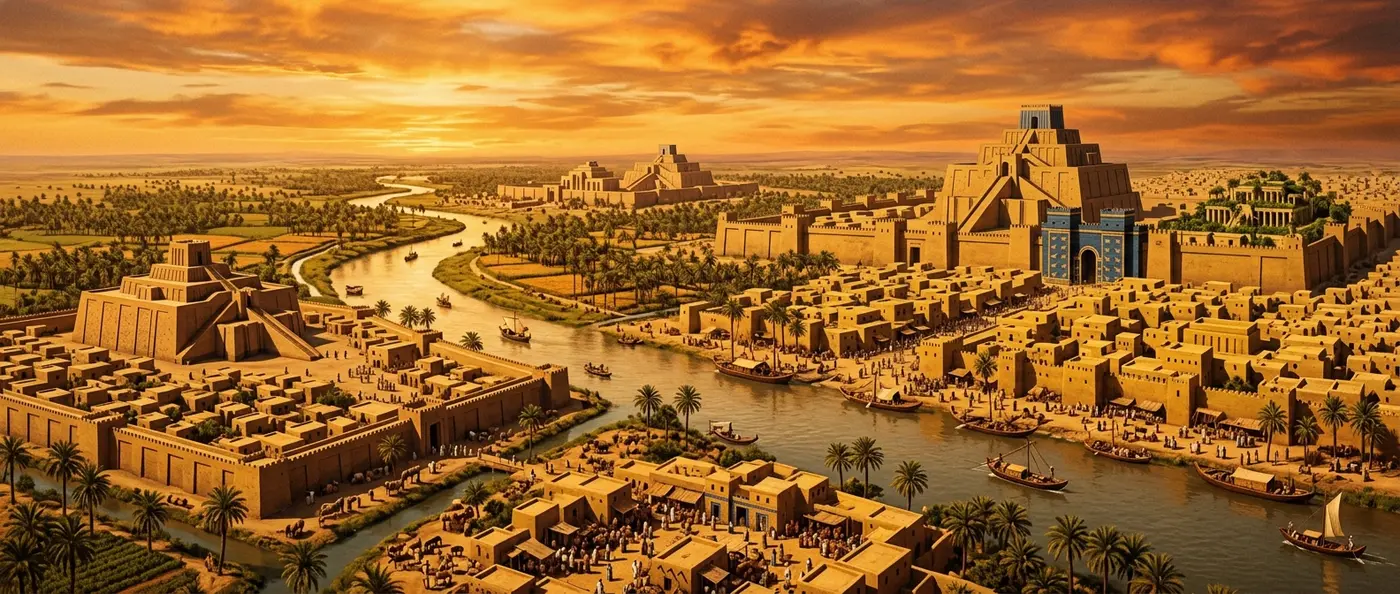
Imagine walking through streets built 6,000 years ago, past temples that touched the sky and palaces that housed humanity's first kings. Mesopotamia, the land between the Tigris and Euphrates rivers, gave birth to the world's first great cities — centers of civilization that forever changed the course of human history.
🏛️ The Birth of the First Cities
Mesopotamia wasn't just a geographical region. It was the cradle of urban civilization, where thousands of people first gathered in organized communities. The cities that emerged from the fertile plains between the two rivers became centers of trade, religion, administration, and innovation.
Each city had its own identity and patron deity. Their inhabitants developed complex irrigation systems, created the first written laws, and built monuments that inspire awe even today. From Uruk, considered the world's first city, to legendary Babylon with its hanging gardens, these ancient metropolises laid the foundation for all cities that followed.
🌾 Uruk: The First Megacity
On the banks of the Euphrates, around 4000 BC, Uruk became the first city to exceed 50,000 inhabitants. Here writing was born, as priests and merchants needed a way to record their transactions. The clay tablets with cuneiform script found in the city represent humanity's earliest written texts.
Uruk was also home to the legendary king Gilgamesh, hero of the world's oldest epic poem. The city's walls, which according to myth were built by Gilgamesh himself, had a perimeter of 9.5 kilometers and enclosed an area of 6 square kilometers. At the city's center rose the ziggurat of goddess Inanna, a massive tower symbolizing the connection between earth and heaven.
⚔️ Ur: The City of Abraham
Ur of the Chaldees, mentioned in the Bible as Abraham's birthplace, was one of southern Mesopotamia's most important cities. Founded around 3800 BC, it reached its peak during the Third Dynasty of Ur (2100-2000 BC), when it became capital of an imperial state spanning all of Mesopotamia.
The royal tombs of Ur, discovered in the 1920s, revealed wealth beyond imagination. Golden jewelry, musical instruments decorated with precious stones, and intricate vessels testify to the inhabitants' wealth and artistic skill. The most impressive find was Queen Puabi's tomb, where dozens of servants were sacrificed to accompany their queen into the afterlife.
🏺 Babylon: The Gate of the Gods
No ancient Mesopotamian city became as legendary as Babylon. Its name means "Gate of the Gods" and for centuries it was the center of the civilized world. Under Hammurabi (1792-1750 BC), Babylon became capital of the first Babylonian empire and here the famous Code of Hammurabi was compiled, the oldest surviving legal text.
The city reached its peak under Nebuchadnezzar II (605-562 BC), when it became the world's largest city with a population exceeding 200,000. Its double walls, with the famous Ishtar Gate decorated with blue tiles and relief lions, were considered impregnable. The legendary Hanging Gardens, one of the Seven Wonders of the Ancient World, were said to be built to remind Queen Amytis of her mountainous homeland.
Tower of Babel
The Etemenanki ziggurat, 91 meters high, inspired the biblical story of the Tower of Babel. It had seven floors and at its summit was a temple dedicated to god Marduk.
Library
The royal library contained thousands of clay tablets with texts on astronomy, mathematics, medicine, and literature, preserving centuries of knowledge.
Processional Way
The city's central avenue, 23 meters wide, was paved with stones and decorated with 120 lions. Here religious processions honored Marduk.
🔱 Nineveh: The Blood-Stained Capital
On the banks of the Tigris, Nineveh became the last and largest capital of the Assyrian Empire. Under Sennacherib (705-681 BC), the city transformed into a metropolis rivaling Babylon in size and magnificence. Its walls were 12 kilometers long and contained 15 gates, each guarded by colossal statues of winged bulls.
Nineveh remained in history for its violence as well. Assyrian kings boasted in their inscriptions about the massacres and tortures they inflicted on enemies. Paradoxically, the same city that spread terror also housed antiquity's greatest library. Ashurbanipal (668-627 BC) assembled over 30,000 clay tablets, preserving all of Mesopotamia's literary heritage, including the Epic of Gilgamesh.
🗿 Ashur: The Sacred City
Ashur, named after the eponymous god, was Assyria's first capital and religious center. Founded around 2500 BC in a strategic position above the Tigris, it remained the Assyrian state's spiritual center for over 1,500 years, even when the political capital moved elsewhere.
The city contained 34 temples and 3 ziggurats, with the temple of god Ashur being most important. Here kings were crowned and buried. The discovered royal tombs contained incredible treasures, including Queen Mullissu's sarcophagus with 440 golden objects. Even after the Assyrian Empire's fall in 612 BC, the city continued to be inhabited as a religious center.
💡 The Secret of Survival
Mesopotamian cities survived for millennia thanks to complex irrigation systems that transformed desert into fertile land. Canals thousands of kilometers long carried river water to fields, enabling the sustenance of massive populations. When these systems collapsed due to wars or neglect, the cities were abandoned.
📜 Mari: The Commercial Crossroads
In middle Mesopotamia, where the Euphrates meets trade routes to Syria and the Mediterranean, Mari emerged as a crucial commercial center. Founded around 2900 BC, it controlled trade between East and West for over 1,000 years. Mari's palace, with its 300 rooms, was one of the largest of its time.
In 1933, French archaeologists discovered over 25,000 clay tablets in the palace — the city's royal archive. These texts reveal details about diplomacy, trade, and daily life from 4,000 years ago. We learn about commercial missions reaching Crete and Cyprus, diplomatic marriages, and relations with Hammurabi of Babylon, who ultimately destroyed the city in 1761 BC.
⚓ Eridu: The World's First City?
According to Sumerian mythology, Eridu was the first city created in the world, when the gods brought kingship down from heaven. Archaeological evidence confirms the city was founded around 5400 BC, making it one of Mesopotamia's oldest settlements. It was dedicated to god Enki, lord of wisdom and sweet waters.
Excavations revealed 18 successive temple layers, built one atop another over 3,000 years. This shows the site's continuous sanctity. Though the city never became a great metropolis, its religious significance remained enormous. Sumerians believed that here Enki guarded the "me" — divine laws governing civilization.
🏰 Lagash: The City of Warriors
Lagash, consisting of three cities (Girsu, Lagash, and Nina), was one of Sumeria's most powerful city-states. It was ruled by a series of warlike rulers who left impressive monuments and inscriptions. The most famous was Gudea (2144-2124 BC), who elevated the city to a center of art and culture.
Dozens of Gudea's statues, carved in diorite transported from distant quarries, show a pious ruler in prayer position. His inscriptions describe in detail temple reconstruction and canal construction. Earlier, Eannatum's Stele of the Vultures depicts Lagash's victory over rival Umma, showing for the first time in history an organized military phalanx.
⚔️ Largest Cities by Population
🌾 Nippur: The Religious Center
Nippur was never a political capital, but its religious significance made it essential for any ruler wanting to legitimize their power. It was the city of Enlil, king of the gods, and only with the blessing of Nippur's priests could someone be considered legitimate king of Sumeria and later Babylonia.
The Ekur, Enlil's temple, was Mesopotamia's most important religious center for over 3,000 years. Here royal lists and chronicles were compiled. The city was also a center of learning — thousands of tablets with school exercises show that here scribes were trained who staffed all of Mesopotamia's administration. Among the finds is the oldest surviving city map, showing Nippur with amazing detail.
💀 Kish: The City of First Kings
After the flood, Sumerian king lists say, kingship first descended to Kish. The city, located where the Tigris and Euphrates came closest together, had a strategic position and controlled trade routes. For centuries, the title "King of Kish" meant hegemony over all Sumeria.
Excavations revealed two large palace complexes and a massive cemetery with thousands of graves. Among the finds was Queen Mullissu's tomb (different from Ur's) with stunning golden jewelry. Kish was also known for its warriors — here the oldest war chariots and first depictions of organized cavalry were found.
🐉 Sippar: The City of the Sun
Sippar, dedicated to sun-god Shamash, was located where the Euphrates branched into many canals. Its position made it an important commercial center, but its fame was mainly due to Shamash's great temple, the Ebabbar ("Bright House"). The temple also functioned as a bank and court, as Shamash was the god of justice.
Thousands of legal documents found in Sippar illuminate daily life in ancient Mesopotamia. Sales contracts, loans, wills, and court decisions show a complex society with a developed legal system. Remarkably, many documents concern women managing properties and businesses, showing they had more rights than commonly believed.
Scribal School
Sippar hosted one of the most important scribal schools, where students copied ancient texts and learned legal formulas.
Court of Shamash
The most important cases were tried in the sun-god's temple. Judges swore in Shamash's name to render justice.
🗺️ The Legacy of Mesopotamian Cities
The twelve great cities of Mesopotamia weren't just settlements. They were civilization workshops where the institutions that still govern our societies were born. Here writing was created, the first laws were written, mathematics and astronomy developed, trade and diplomacy organized.
Each city contributed in its own way to human progress. Uruk gave us writing, Babylon laws, Nineveh libraries, Ur art. Together they created a civilization that influenced all humanity. The ideas born on the banks of the Tigris and Euphrates traveled worldwide and became the foundation of Western civilization.
Today, most of these cities are piles of ruins in Iraq's desert. At Ur, tourists can still climb the ziggurat steps where priests once watched the stars. At Babylon, a lonely lion from the Ishtar Gate stares across empty fields. Mesopotamian cities continue to teach us, reminding us that civilization is fragile and must be protected.
The history of these cities is also a warning. Many were destroyed by wars, others abandoned when irrigation systems collapsed. Soil overexploitation and field salinization turned fertile plains into deserts. Mesopotamia's lessons about sustainability and resource management are more relevant than ever.