🏛️ The Discovery That Rewrites History
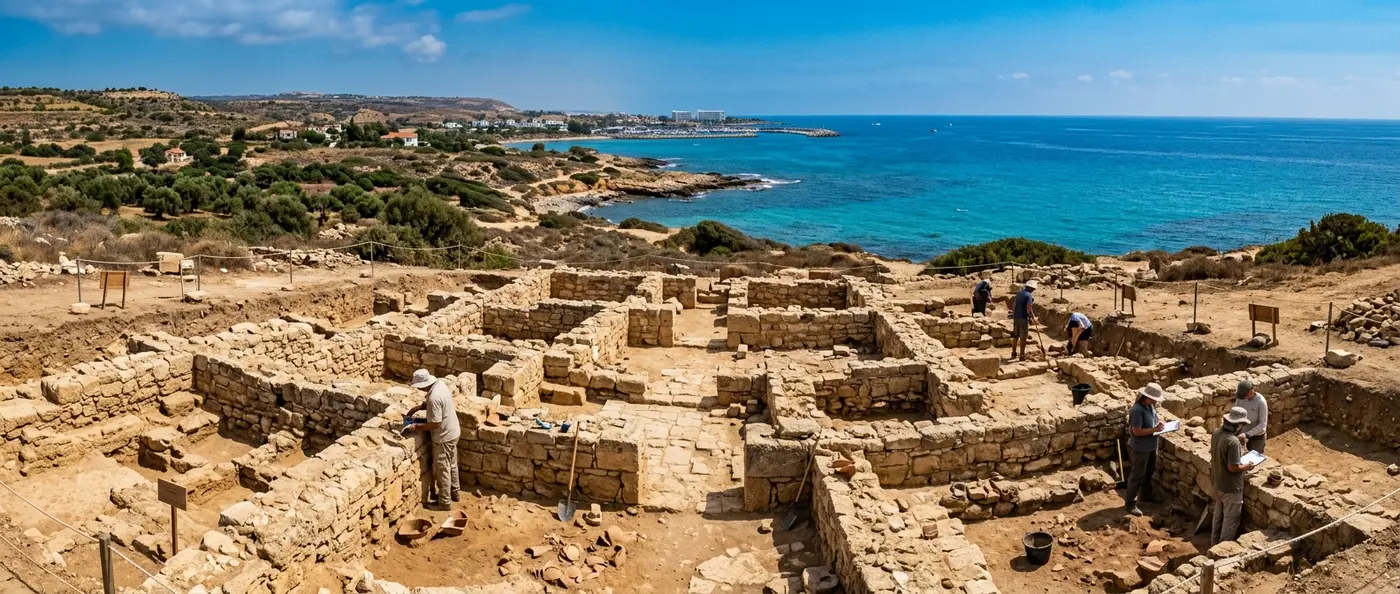
Excavations in the Ancient Paphos area have revealed building foundations dating to the Pre-Pottery Neolithic period, around 9,000 BCE. The finds include stone structures with sophisticated architecture, flint tools, and evidence of organized community life that predates the known civilizations of the Near East by millennia.
The location of the buildings, in a natural harbor of southwestern Cyprus, indicates that the first inhabitants strategically chose the site for their settlement. The geographical position provided protection from the elements and easy access to the sea, factors that proved crucial for the development of the settlement.
The buildings show unexpected engineering sophistication. The walls, constructed from local stone with careful placement, show engineering knowledge that was thought to have appeared much later. Some structures appear to have had multiple floors, something extremely rare for the period.
🗿 Architectural Wonders of Prehistory
The Ancient Paphos buildings show advanced technical skills. The structures are characterized by circular and rectangular shapes, with walls reaching 80 centimeters in thickness. The use of stone foundations and careful arrangement of spaces indicates advanced planning.
Of particular interest is a large building in the center of the settlement, which likely functioned as a communal space. Measuring 15x10 meters, it featured internal subdivisions and a central courtyard. The existence of such public buildings indicates organized social structure and collective decision-making.
Archaeologists also identified a sophisticated water drainage system, with stone conduits that led rainwater away from the buildings. This infrastructure, unique for its time, protected the settlement from floods and kept living spaces dry.
⚔️ Daily Life in Prehistoric Paphos
Finds from the excavations bring to life the daily routine of the first inhabitants. Flint tools, bone implements, and stone vessels testify to a society that had developed specialized material processing techniques. The variety of tools indicates different professional specializations within the community.
The inhabitants engaged in hunting, fishing, and food gathering. Bones from deer, wild boar, and marine shellfish were found in abundance. Interestingly, seeds from wild cereals were also discovered, showing early forms of cultivation, millennia before the official beginning of agriculture in the region.
The social organization appears to have been egalitarian, without signs of intense social stratification. All houses had similar size and equipment, indicating a community with shared resources and cooperative spirit.
Diet
Hunting deer and wild boar, fishing, gathering shellfish and wild fruits. Early cultivation of cereals.
Technology
Advanced flint tools, precision bone implements, stone vessels, and early construction techniques.
Society
Egalitarian social structure, collective decision-making, shared resources, and organized cooperation.
🔬 The Significance for Archaeology
The discovery of Ancient Paphos radically changes our understanding of early human settlement in the Mediterranean. Until recently, archaeologists believed Cyprus was permanently inhabited around 8,500 BCE. The new findings push this chronology back by at least 2,500 years.
The complex structures show that the first inhabitants were not simple nomads who arrived randomly on the island. Instead, they appear to have been an organized group with a clear settlement plan and the necessary knowledge to create a sustainable settlement.
Cyprus sits at the crossroads of three continents, amplifying the discovery's importance. The first inhabitants of Paphos may have played a crucial role in spreading ideas and technologies between East and West, much earlier than previously believed.
💡 Did you know?
Ancient Paphos is now the oldest known settlement with multi-story buildings in the eastern Mediterranean. This discovery places it chronologically before Turkey's Çatalhöyük and Palestine's Jericho.
🏺 The Mysteries That Remain
Despite the impressive discoveries, many questions remain unanswered. How did these people reach Cyprus? The distance from the nearest coast is about 70 kilometers, requiring advanced maritime skills for the time. The existence of an organized settlement indicates planned migration rather than accidental arrival.
Another mystery concerns the abrupt abandonment of the settlement around 7,000 BCE. There are no signs of violent destruction or natural disaster. The inhabitants appear to have left in an organized manner, taking most of their belongings with them.
Archaeologists continue their research, hoping to find answers. New technologies, such as DNA analysis from organic remains and isotopic analysis, may shed light on the origin and way of life of these early pioneers.
🗺️ Paphos in the Context of Ancient Civilizations
Prehistoric Paphos establishes Cyprus as a key center in early human development. While attention traditionally focused on Mesopotamia as the cradle of civilization, the new findings show that human innovation and progress occurred simultaneously in many places.
Comparing Paphos with other early settlements, we observe interesting similarities and differences. Like Turkey's Göbekli Tepe, there are indications of communal constructions that exceed simple survival needs. However, Paphos differs in its emphasis on residential architecture versus religious architecture.
Cyprus's geographical isolation may explain the unique evolution of Paphos civilization. Without pressure from neighboring populations, the inhabitants could develop their own solutions to challenges such as housing and community organization.
⚖️ Comparison with Other Early Settlements
🔱 Spiritual Life and Rituals
Although no large temples or monumental constructions were found, there are indications of spiritual life in prehistoric Paphos. Small figurines made of stone and clay, depicting human forms, suggest some form of worship or ritual practice. Most of these figurines are female forms, possibly connected to fertility.
Of particular interest is the discovery of a space that appears to have functioned as a ritual center. There, many of the figurines were found concentrated, along with food and tool offerings. The arrangement of the space and the findings indicate organized ceremonies that were probably related to seasons or earth's fertility.
Burial practices reveal respect for the dead. Graves contained grave goods such as tools, shell jewelry, and food for the journey to the afterlife. The careful placement of the dead in fetal position indicates belief in some form of rebirth.
🌾 The Transition to Agriculture
One of the most exciting findings is evidence of early agricultural activity. While the full transition to agriculture is thought to have occurred later, tools and installations found in Paphos indicate experimentation with plant cultivation.
Stone grinders and mortars, used for grinding seeds, were found in large quantities. Analysis of phytolithic remains revealed traces of wild cereals that were systematically collected. Some researchers argue that this systematic collection was the first step toward plant domestication.
The settlement's location near fertile plains and water sources facilitated these early experiments. The inhabitants appear to have understood plant cycles and carefully selected collection sites, preparing the ground for the future agricultural revolution.
Early Cultivation
Systematic collection of wild cereals, first steps toward plant domestication, soil preparation.
Processing Tools
Stone grinders and mortars for seed grinding, specialized collection and storage tools.
💀 The End of a Civilization
Around 7,000 BCE, the Ancient Paphos settlement was abandoned. Archaeological evidence shows no signs of violent destruction, epidemic, or natural disaster. The abandonment appears to have been gradual and organized.
One theory suggests that climate changes may have made the area less hospitable. Pollen analysis from the period shows decreased vegetation and possible drought. The inhabitants may have been forced to migrate to more fertile areas of the island.
Another hypothesis connects the abandonment to social changes. As the population increased, the old egalitarian social structure may have become unsustainable. The community may have split into smaller groups that scattered to various parts of Cyprus.
Regardless of the reasons, the legacy of Ancient Paphos survived. The construction techniques, environmental knowledge, and social structures developed there influenced later Cypriot civilizations. Millennia later, the area would become an important center again, this time as a place of Aphrodite worship.
🔍 Ongoing Research
Excavations at Ancient Paphos continue. Each year new findings are revealed that enrich our picture of this early civilization. New technologies like LiDAR and geophysical surveying promise to reveal even more secrets beneath Cyprus's soil.