📖 Read more: Graecopithecus: 7.2M-Year-Old Balkan Ancestor
🗿 The Birthday Discovery That Broke Science
Lordkipanidze still remembers the moment. "It was discovered on my birthday," he says, describing the day his team pulled the most complete early human skull from Georgian soil. But this wasn't just another fossil. The lower jaw had been sitting in storage since 2000, waiting five years for its missing partner to emerge from the dirt.
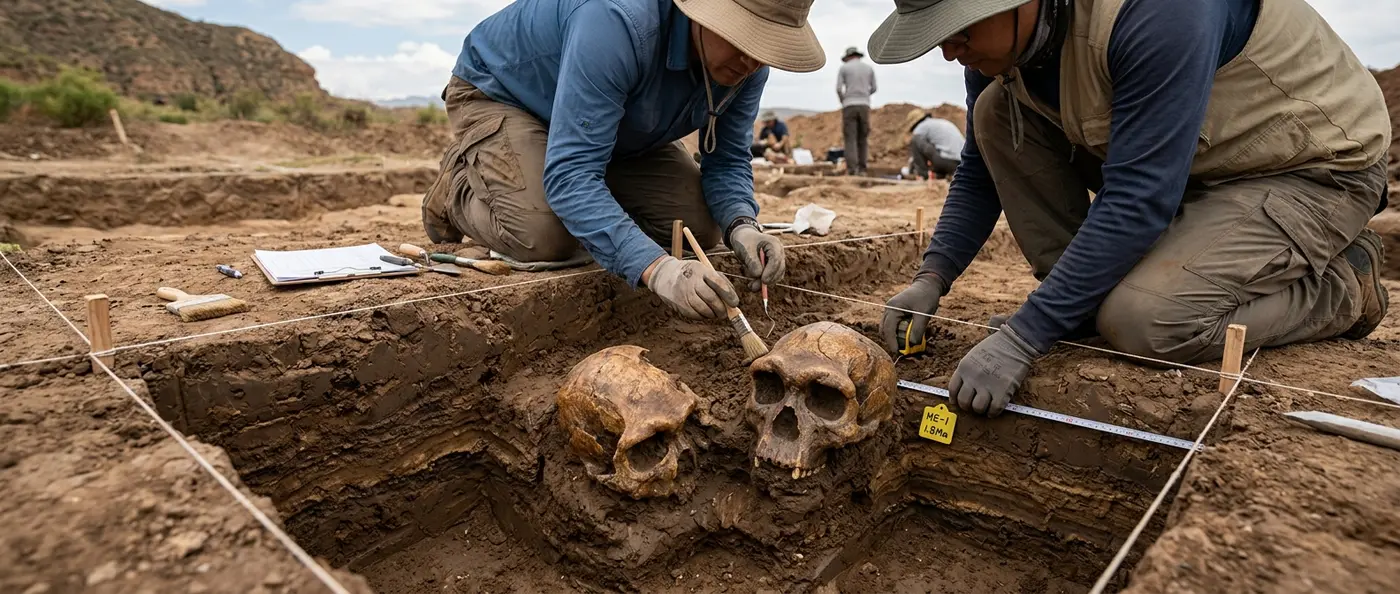
Dmanisi sits 96 miles southwest of Tbilisi, a windswept plateau that became humanity's first rest stop outside Africa. The site has yielded five relatively complete skulls dating back over 1.75 million years. Each one tells the same impossible story: early humans were far more variable than we ever imagined.
Skull 5 breaks every rule. Its face screams "primitive" - large teeth, small brain, heavy brow ridges that would make a gorilla proud. But the detailed cranial anatomy whispers "advanced," sharing key features with Homo erectus, a species that supposedly evolved much later. This skull is evolution caught in the act, a snapshot of our ancestors mid-transformation.
🔬 The Mosaic That Shouldn't Exist
Paleoanthropologists call Skull 5 a "mosaic" - a patchwork of features from different evolutionary stages stitched together in one individual. This unique combination has ignited a scientific war over the identity of Dmanisi's inhabitants.
Were they early Homo erectus? A separate species called Homo georgicus? Something else entirely? The answer rewrites the story of how our ancestors spread from Africa and adapted to new environments.
Lordkipanidze's team used morphometric analysis to measure each fossilized skull's shape. The results shocked them. The Dmanisi humans varied in facial features and brain size about as much as modern humans do today. Despite these differences, they all belonged to the same species.
This discovery suggests the human family tree might be simpler than we thought. Instead of multiple species evolving in parallel, the findings point to a single evolutionary line stretching from Homo habilis 2.4 million years ago to Homo erectus.
This "single lineage" theory has triggered fierce pushback from the scientific community. Bernard Wood of George Washington University calls Skull 5 "an interesting skull" but disagrees with the study's sweeping conclusions. "They assume that the only reason people have concluded there was more than one species of early Homo is based entirely on cranial shape, and that's not true," he argues.
Homo habilis
The first human species, appearing 2.4 million years ago in East Africa. Had relatively long arms adapted for climbing trees alongside upright walking.
Homo georgicus
Proposed species for the Dmanisi humans. Would represent an intermediate form between Homo habilis and Homo erectus during the first migration out of Africa.
Homo erectus
First human species to spread widely outside Africa. Characterized by larger brains and more modern anatomy than earlier human ancestors.
⚔️ The Scientific Battleground
Fred Spoor of the Max Planck Institute for Evolutionary Anthropology acknowledges that Skull 5 is "an absolutely gorgeous specimen" that will help researchers "understand what's going on with really early Homo erectus evolution." But he too rejects the study's "one big species" message.
📖 Read more: 480,000-Year-Old Bone Tool Made from European Elephant
The disagreement centers on methodology. Critics argue that focusing on skull shape alone might mask real differences between species. Important anatomical features - tiny openings in the skull for blood vessels or the fine bone anatomy of the brain - could be lost in such analysis.
The rest of the skeleton in other early human species carries distinctive features. There's no point, Wood argues, in "pretending that evidence doesn't exist" and "throwing out the whole house" by merging all early human fossils into one lineage.
💡 Evolution in Action
The combination of features seen in the Dmanisi skulls represents "evolution in action," according to Fred Spoor. The findings might place the Dmanisi humans somewhere after the split between Homo habilis and Homo erectus, sometime before 1.8 million years ago.
🏺 Dmanisi as a Time Capsule
Dmanisi sits at a crossroads in human history. The five relatively complete skulls found there over the past two decades might not have belonged to humans who lived simultaneously, but they appear to have inhabited the same space within a window of a few thousand years.
"Dmanisi is a snapshot in time, like a time capsule," Lordkipanidze explains. His team expects more early human fossils still lie buried there.
🔬 Skull Feature Comparison
🗺️ Humanity's First Migration
The Dmanisi findings reshape how we understand the first human migrations from Africa. If the Dmanisi inhabitants were indeed part of a single evolutionary lineage, it would mean the first humans to leave Africa were less differentiated than previously believed.
Dmanisi's geographic position, at the crossroads between Africa, Asia, and Europe, makes it an ideal spot for studying these early movements. The humans who lived there 1.8 million years ago might have been among the first to abandon humanity's African cradle.
The debate over who exactly the Dmanisi humans were and how they fit into our broader family history will undoubtedly continue. The arguments will depend on what's still being discovered. With each new find, the picture becomes clearer - or perhaps more complex.
What's certain is that Dmanisi has already changed how we think about early human evolution. Whether the skulls represent one species or many, they show us that our ancestors were more variable and adaptable than we had imagined.
As analysis technologies improve and new fossils come to light, the story of human evolution continues to be rewritten. Skull 5 and its companions from Dmanisi remind us that science is an ongoing process of discovery and reevaluation.