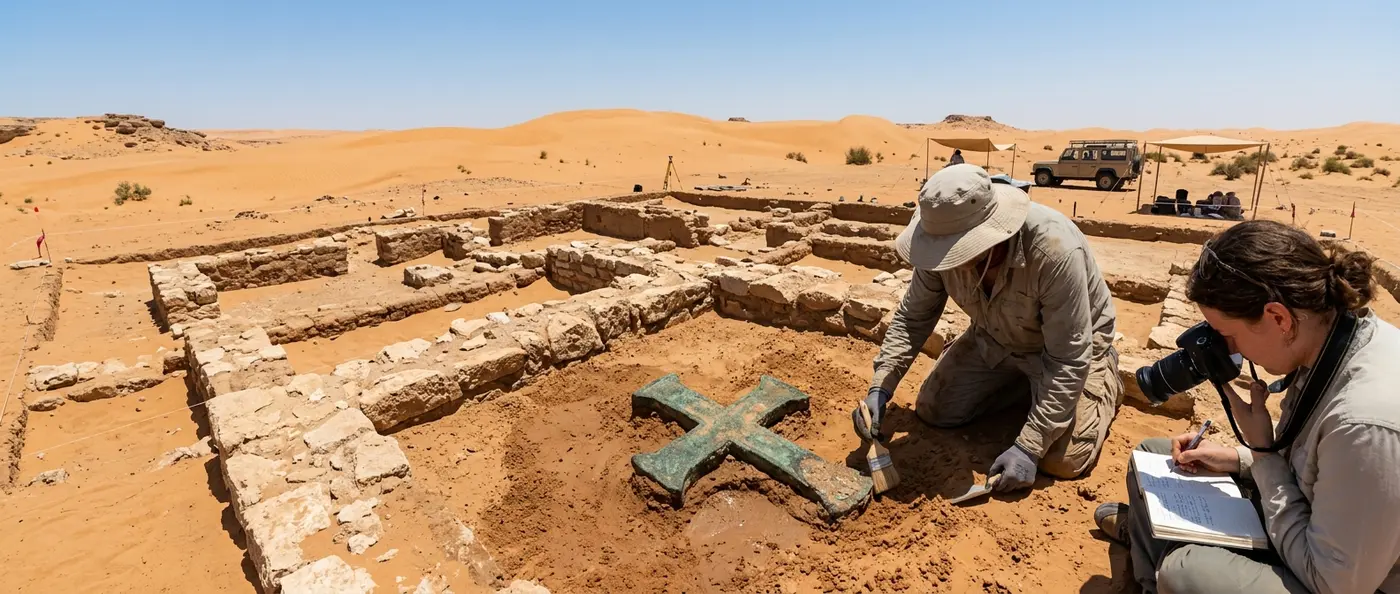
A bronze cross glints in the harsh desert sun. Fourteen centuries after monks last held it in prayer, archaeologists have pulled this Christian artifact from the sands of Abu Dhabi — along with an entire monastery that rewrites what we thought we knew about the Arabian Peninsula's religious past. Where skyscrapers now pierce the sky and luxury resorts sprawl across reclaimed coastlines, thriving Christian communities once gathered for worship, centuries before Islam arrived.
🏺 The Dig That Shattered Assumptions
The monastery surfaced during routine development work. What started as a construction project became one of the Gulf's most significant archaeological discoveries. Dating to the 7th century CE, this complex represents a crucial moment — the final flowering of Christianity in Arabia before the region's Islamic transformation.
The site sprawls across several acres. Church, monks' cells, kitchen, storage rooms — an entire spiritual community preserved under the desert. The architecture follows classic early Christian monastery design: central courtyard surrounded by functional buildings. But the details tell a uniquely Arabian story.
That bronze cross survived 1,400 years in conditions that destroy most organic materials within decades. Perfect preservation in the desert's brutal climate makes this discovery extraordinary. Archaeologists believe it served in liturgical ceremonies, passed from monk to monk through generations of worship.
The monastery wasn't abandoned violently — no scattered bones, no burned timbers, no signs of hasty flight. The community simply faded away as the religious landscape shifted, leaving their sacred objects behind like a time capsule waiting for rediscovery.
💡 Did You Know?
Before Islam's 7th-century expansion, the Arabian Peninsula hosted major Christian bishoprics. Dioceses operated in what are now the UAE, Qatar, and Bahrain — a forgotten chapter of Middle Eastern Christianity.
⛪ Monastery Life in the Desert
This wasn't just a place of worship. The excavation reveals a bustling spiritual hub that served the broader Christian community. Pottery shards, daily-use tools, even food remains paint a picture of monastic life that was both contemplative and practical.
Location mattered. The monastery sat near water sources and trade routes, serving as a waystation for travelers and merchants. This explains artifacts from across the region — evidence of extensive commercial and cultural networks that connected these desert Christians to the wider world.
The kitchen tells its own story. Large storage jars for food and water, bread ovens, grinding stones. This community was largely self-sufficient, supporting what appears to have been a substantial population of monks and lay workers.
🗺️ Christianity's Arabian Roots
Popular history often skips over pre-Islamic Christianity in Arabia. But historical sources and archaeological evidence confirm flourishing Christian communities throughout the Gulf region from the 4th through 7th centuries CE.
These Christians were primarily Nestorian, following the teachings of Nestorius that spread eastward after the Council of Ephesus in 431 CE. The Church of the East, as it was known, established bishoprics on islands and coastal areas throughout the Persian Gulf.
Trade drove Christianity's expansion here. Merchants from Mesopotamia and Persia, many of them Christian, settled in commercial centers along the Gulf coasts. They brought goods and faith in equal measure, creating communities that would endure for centuries.
The timing matters. This monastery flourished just as Islam began its expansion from the Arabian heartland. Rather than violent conquest, the transition appears to have been gradual — communities converting or migrating over decades rather than years.
🔍 What the Artifacts Reveal
Beyond the cross, archaeologists uncovered a treasure trove of religious and daily life objects. Ceramic vessels bearing Christian symbols, oil lamps for nighttime prayers, fragments of manuscripts in Syriac — the liturgical language of Eastern Christianity.
The church architecture speaks volumes. Three-nave basilica design, characteristic of early Christian worship spaces. Simple geometric floor patterns, wall fragments preserving traces of religious frescoes. This community invested in creating a proper sacred space, not a makeshift desert chapel.
Kitchen finds reveal surprising sophistication. Large storage vessels, specialized cooking equipment, evidence of diverse food sources. These monks ate well and lived comfortably — this was no austere hermitage but a thriving religious center.
Manuscript fragments offer tantalizing glimpses of intellectual life. Syriac texts suggest these monks maintained libraries and copied religious works, connecting them to the broader scholarly traditions of Eastern Christianity.
Manuscripts
Religious text fragments in Syriac, the liturgical language of Eastern Christians across the Middle East.
Ceramics
Vessels decorated with Christian symbols and inscriptions used in both liturgy and daily monastery life.
Frescoes
Wall painting remnants depicting biblical scenes and saints from the Eastern Christian tradition.
📜 Rewriting Religious History
The find upends assumptions about Middle Eastern religious history. Christianity wasn't a brief foreign intrusion into Arabia — it had deep roots and organized communities that lasted centuries.
The monastery's peaceful abandonment tells a story of gradual transition rather than violent conquest. No evidence of destruction suggests the shift from Christianity to Islam in this region happened through conversion and migration rather than force.
This find joins other recent Gulf discoveries. Monasteries and churches have emerged in Kuwait, Bahrain, and Saudi Arabia, creating a fuller picture of Arabian Christianity's extent and sophistication.
In a region often defined by religious conflict, the monastery tells a different story — one of gradual change rather than conquest.
🌍 Connections Across the Christian World
The monastery's artifacts reveal extensive connections beyond Arabia. Objects from Mesopotamia, Persia, Syria, and Egypt show this community wasn't isolated but part of a vast Christian network stretching from the Mediterranean to the Indian Ocean.
Architectural elements match patterns found in Mesopotamian and Syrian monasteries. This suggests a shared monastic tradition that transcended political boundaries, creating a common Christian culture across the Middle East.
The bronze cross itself bears decorative elements characteristic of Church of the East artistry. Its style combines Byzantine and Persian influences, reflecting the unique cultural synthesis that characterized Christianity in this borderland region.
Trade connections run both ways. While the monastery received goods from distant lands, it likely served as a stopping point for Christian merchants traveling between India and the Mediterranean — a spiritual and commercial hub rolled into one.
⚖️ Gulf Christian Monasteries
🔬 Excavation and Preservation Challenges
Digging in the Arabian desert requires extraordinary care. Extreme temperatures, shifting sands, and the fragility of 1,400-year-old artifacts demand cutting-edge techniques. Archaeologists used ground-penetrating radar and satellite imagery to map buried structures before breaking ground.
The bronze cross and other metal objects underwent specialized conservation treatment to halt corrosion and stabilize their condition. Microscopic analysis revealed metal composition and likely origins — detective work that traces ancient trade networks.
Organic materials posed even greater challenges. Manuscript fragments and textile remains required controlled temperature and humidity environments to prevent further deterioration. Every scrap of parchment or fabric could contain crucial information about monastic life.
Digital documentation captured every detail before artifacts left the ground. 3D scanning and photogrammetry created permanent records that researchers worldwide can study without handling fragile originals.
🏛️ The Future of Gulf Archaeology
This discovery opens new research frontiers across the Gulf region. Abu Dhabi authorities plan an archaeological park at the site, allowing visitors to experience this forgotten chapter of Middle Eastern history firsthand.
The search continues for other Christian sites buried beneath desert sands. Archaeologists believe numerous monasteries and churches await discovery — each one potentially rewriting another page of Arabian religious history.
International collaboration brings global expertise to local discoveries. European and American universities partner with regional archaeologists, combining cutting-edge technology with local knowledge to unlock the past.
The monastery's story resonates beyond academic circles. In an era when the Middle East often makes headlines for religious conflict, discoveries like this reveal a more complex heritage of coexistence and cultural exchange.
🌟 Modern Relevance
This discovery reminds us that the Middle East has always been a crossroads of cultures and faiths. In times when the region is often associated with religious conflict, such finds demonstrate that peaceful coexistence and cultural exchange have deep historical roots.
📚 A Window Into Lost Worlds
The Abu Dhabi cross and its monastery represent more than archaeological treasures. They're puzzle pieces in humanity's larger story, revealing the complexity and interconnectedness of our shared past.
The gleaming bronze cross, the kitchen pottery, the Syriac manuscripts — each piece reveals how faith, culture, and commerce intertwined in the ancient world. The monks who once held this cross lived in a world very different from ours, yet their hopes, fears, and spiritual yearnings echo across the centuries.
Excavations continue across the Gulf region. Each season brings new finds — another church foundation in Kuwait, Christian graves in Bahrain, fragments of a monastery wall in Qatar.
The bronze cross now sits in a climate-controlled case, its bronze surface cleaned but still bearing traces of desert sand. After fourteen centuries buried in the Arabian Peninsula, it has surfaced just as the region builds new cities where ancient monasteries once stood.