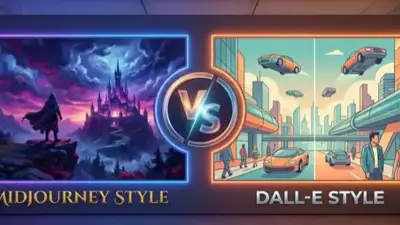
🎨 The Battle of AI Image Generators
In the world of AI image generation, two names stand above the rest: Midjourney and OpenAI's DALL-E. Each offers unique strengths — from Midjourney's artistic sensibility to DALL-E's seamless integration with ChatGPT and Microsoft Copilot. In 2026, with Midjourney V7 and GPT Image replacing DALL-E 3, the competitive landscape is shifting dramatically.
In this comprehensive guide, we'll examine every aspect: image quality, ease of use, pricing, capabilities, and — of course — the legal battles shaking the industry. We'll also cover Stable Diffusion's role as an open-source alternative.
🖼️ Midjourney: The King of AI Art
Midjourney was founded by David Holz, co-founder of Leap Motion, in San Francisco. It launched as an open beta in July 2022 through Discord — an unusual platform choice that proved key to building a devoted community. By August 2022, Holz told The Register that the company was already profitable.
Model Evolution
Midjourney's development pace has been remarkable. In just three years, it released 7 major versions:
V1-V3 (2022)
The early days. V1 (Feb 2022), V2 (Apr 2022) with better characters, V3 (Jul 2022) with improved accuracy.
V4-V5 (2022–2023)
V4 (Nov 2022) — trained on Google TPUs. V5 (Mar 2023) with photorealism. V5.2 with “zoom out” and aesthetic upgrades.
V6 (Dec 2023)
Trained from scratch over 9 months. Better text rendering, literal prompt interpretation. V6.1 (Jul 2024) with web interface.
V7 (Apr 2025)
The latest release — a major leap in photorealistic quality, character consistency, and text rendering.
Standout Features
What sets Midjourney apart is its suite of creative control tools:
- Style Reference: Upload an image as a stylistic guide — color palette, texture, and atmosphere are applied to the new creation
- Character Reference: Maintain consistent characters across multiple images — ideal for comics and branding
- Vary (Region): Select a specific area of an image for variation while keeping the rest unchanged
- Image Weight: Fine-tune the balance between an uploaded image and the text prompt
- Niji Mode: A dedicated model optimized for anime, with Niji 7 (Jan 2026) as the latest version
- Web Interface: Since August 2024, a full web editor that moves beyond Discord-only dependency
Landmark Moment
In September 2022, a Midjourney image titled "Théâtre D'opéra Spatial" won first place in the digital art competition at the Colorado State Fair. The judges didn't know it was AI-generated — but later said they would have awarded it the top prize anyway. The incident sparked a worldwide debate about the very definition of “art.”
🤖 DALL-E: The OpenAI Revolution
DALL-E was unveiled by OpenAI on January 5, 2021. Its name is a portmanteau of Pixar's WALL-E and surrealist painter Salvador Dalí — a reference that captures its goal of creating dreamlike compositions from text.
Model Evolution
DALL-E 1 (Jan 2021)
12 billion parameters based on GPT-3. 256x256 images. Groundbreaking for its time — “surreal” images from text descriptions.
DALL-E 2 (Apr 2022)
3.5B parameters, diffusion model + CLIP. Inpainting, outpainting, variations. Public access Sep 2022. API Nov 2022.
DALL-E 3 (Sep 2023)
Integrated into ChatGPT Plus (Oct 2023). Excellent understanding of complex prompts, improved text rendering in images.
GPT Image (Mar 2025)
Replaces DALL-E 3 in ChatGPT. Native image generation capabilities — fully integrated into the conversation flow.
Key Advantages
DALL-E's strength lies in its integration with the broader OpenAI/Microsoft ecosystem:
- ChatGPT Integration: Generate images within a conversation — describe, modify, and refine without leaving the chat
- Microsoft Copilot: Built into Bing Image Creator with access through the Edge browser
- C2PA Watermarks: Since February 2024, DALL-E images include authenticity metadata following the Content Authenticity Initiative standard
- API Access: Developers can integrate image generation into their own applications with per-image pricing
- Raven's Matrices: DALL-E's visual reasoning is sophisticated enough to solve Raven's Progressive Matrices — intelligence tests normally given to humans
Limitations & Content Filters
After integrating DALL-E 3 into Bing Chat, Microsoft and OpenAI faced criticism for excessive content filtering. Critics said DALL-E had been “lobotomized.” Prompts like “man breaks server rack with sledgehammer” were blocked, and even some of Bing's own suggested prompts were being flagged. TechRadar argued that leaning too heavily on caution could limit DALL-E's value as a creative tool.
⚔️ Head-to-Head: The Ultimate Comparison
How do the two tools stack up across every critical category? Here's a comprehensive breakdown:
| Criteria | Midjourney | DALL-E 3 / GPT Image |
|---|---|---|
| Artistic Style | Outstanding — dominant in art, concept design, photorealism | Very good — ideal for illustrations and clean designs |
| Prompt Accuracy | V7 significantly improved, but may “interpret” freely | Excellent in DALL-E 3 — follows complex prompts faithfully |
| Text in Images | Improved in V6+, fairly reliable in V7 | Excellent in DALL-E 3 — coherent text within images |
| Platform | Discord + web editor (Aug 2024) | ChatGPT, Bing Image Creator, API, Microsoft Copilot |
| Pricing Model | Subscription ($10-$120/month depending on plan) | Via ChatGPT Plus ($20/month) or API pay-per-image |
| Character Consistency | Excellent (Character Reference feature) | Improved in GPT Image but still behind |
| Open Source | Closed — proprietary model | Closed — proprietary (Craiyon as alternative) |
| Ethics & Transparency | Lawsuits from Disney, Universal, WB — “bottomless pit of plagiarism” | C2PA Watermarks, blocks public figures, but bias issues remain |
🎨 Stable Diffusion: The Open-Source Alternative
If you prefer to avoid closed systems, Stable Diffusion by Stability AI is the leading open-source option. Released in 2022 — just months after DALL-E 2 — it uses essentially the same diffusion model architecture. The key difference: its code and model weights are freely available.
This means you can run it locally on your own computer with no per-image charges. The community has created thousands of fine-tuned models (LoRAs) and custom UIs like Automatic1111 and ComfyUI. However, out-of-the-box quality falls short of Midjourney V7.
⚖️ Legal Battles & Copyright
No AI image tool escapes the legal storm around intellectual property. But Midjourney is facing far worse:
Midjourney Legal Timeline
- Jan 2023: Artists Sarah Andersen, Kelly McKernan, and Karla Ortiz filed a copyright infringement lawsuit — training on 5 billion images without consent
- Nov 2023: New lawsuit featuring 4,700+ artists against Midjourney, Stability AI, DeviantArt, and Runway AI
- Jun 2025: Disney and Universal Pictures sued Midjourney, calling it “a bottomless pit of plagiarism”
- Sep 2025: Warner Bros. Discovery followed, accusing “theft” of Superman, Batman, Wonder Woman, Tweety, and Scooby-Doo
On the OpenAI side, the issues are different but equally serious. The company hasn't disclosed DALL-E 2's training datasets, while Bing Image Creator integration drew criticism for excessive filtering. In January 2024, OpenAI quietly removed its blanket ban on military use, and Microsoft pitched DALL-E to the U.S. Department of Defense for training battlefield management systems.
📊 Which Tool Is Right for You?
The best choice depends on your specific needs:
| Use Case | Best Choice | Why |
|---|---|---|
| Concept Art & Illustration | Midjourney | Unique aesthetic, Style Reference, anime model Niji |
| Quick Social Media Posts | DALL-E / GPT Image | Ask ChatGPT, get an image in seconds |
| Branding & Consistency | Midjourney | Character Reference maintains consistent characters across projects |
| Developer Integration | DALL-E API | Mature API, pay-per-image, Microsoft ecosystem |
| Full Control & Privacy | Stable Diffusion | Runs locally, no cloud dependency, no charges, full freedom |
| Beginner / Zero Budget | DALL-E (Bing/Copilot) | Free access via Microsoft Copilot, easy to use |
🌐 Impact on the Art World
The impact of these tools on art — and misinformation — is already enormous. In March 2023, a Midjourney-generated image of Pope Francis in a white puffer jacket went viral — millions believed it was real. Around the same time, fake images of Donald Trump's arrest circulated widely, while an AI image of a “Pentagon explosion” briefly rattled stock markets.
In academia, things aren't much better: in February 2024, a Frontiers journal paper contained Midjourney images of a rat with anatomically impossible proportions — the paper was retracted after the images went viral on Twitter.
"AI doesn't create art — people create art. AI is a tool, like a brush or a camera. The question is whether this tool was trained by stealing other people's brushes."
— Karla Ortiz, artist & plaintiff against Midjourney🔮 What Lies Ahead in 2026 and Beyond
The AI image generation market is at an inflection point. Several trends will shape the future:
- Everywhere integration: OpenAI integrated image generation directly into ChatGPT via GPT Image (Mar 2025), eliminating the need for a separate tool
- Legal precedents: The Disney/Universal/WB lawsuits against Midjourney will set legal precedent — the outcome will define copyright across the entire sector
- Video generation: Midjourney is planning to enter video generation, following Sora, Runway, and Kling
- 3D & Real-time: The ultimate challenge — generating 3D assets in real-time from text
- Growing regulation: After viral deepfakes, pressure for regulatory frameworks (EU AI Act, C2PA initiatives) will intensify significantly
Whether you choose Midjourney for its unique aesthetic, DALL-E for its seamless integration, or Stable Diffusion for total freedom, one thing is certain: 2026 marks the year AI image generation becomes every creator's tool — no longer an experimental technology.