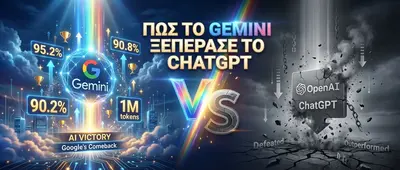
In early 2023, when ChatGPT made the world talk about artificial intelligence, Google seemed to have missed the train. Three years later, the situation has completely reversed. Gemini 3, Google's most advanced AI model, doesn't just surpass ChatGPT in benchmarks — it fundamentally changes the way we use technology every day. How did this turnaround happen? And what does it mean for the future of artificial intelligence?
🎬 The Comeback Nobody Expected
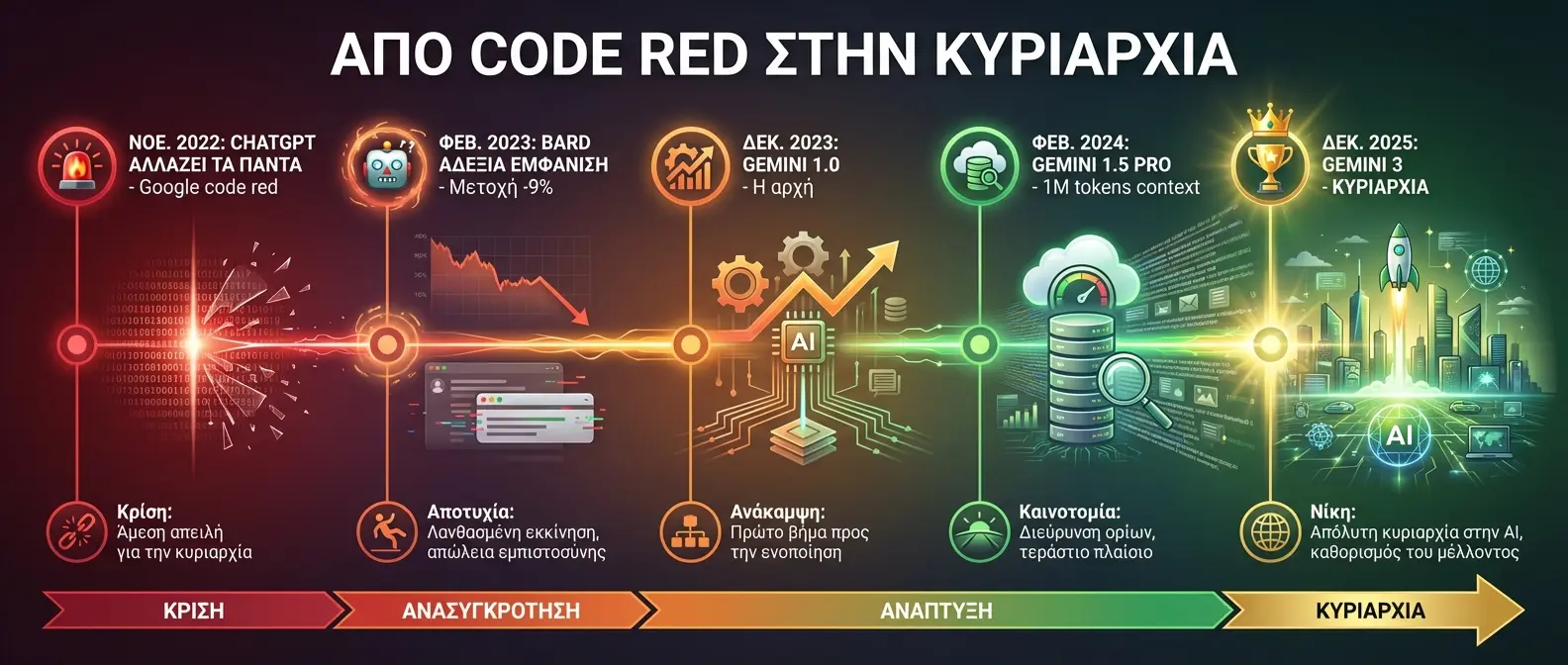
In November 2022, when OpenAI unveiled ChatGPT, the tech world changed forever. Within five days, the service had acquired one million users — a record no product had ever achieved. Google, despite decades of AI research and the acquisition of DeepMind, suddenly found itself on the defensive. The “code red” declared by Sundar Pichai was no exaggeration — it was an admission that the tech leader had been caught off guard.
Three years later, the picture is entirely different. Gemini 3, released in December 2025, isn't just an answer to GPT-4 — it's a technological leap that sets new standards in every field. From image and video understanding to complex mathematical analysis and programming, Gemini has claimed the top spot in nearly every evaluation. But how did Google go from “code red” to the top of AI?
OpenAI releases ChatGPT and it goes viral. Google declares “code red”.
Google's first response, Bard, makes an error during its presentation. The stock drops 9%.
The first Gemini shows its potential, but still falls short in certain areas.
A context window of 1 million tokens — 10 times larger than the competition.
The 3 Pro, 3 Flash, and Deep Think models sweep every benchmark.
The story of Gemini is one of persistence and strategic thinking. Instead of trying to copy ChatGPT, Google invested in what it knew best: multimodal AI — artificial intelligence that understands text, images, audio, video, and code simultaneously, designed that way from the ground up. This decision proved to be pivotal.
📊 The Numbers That Prove the Supremacy
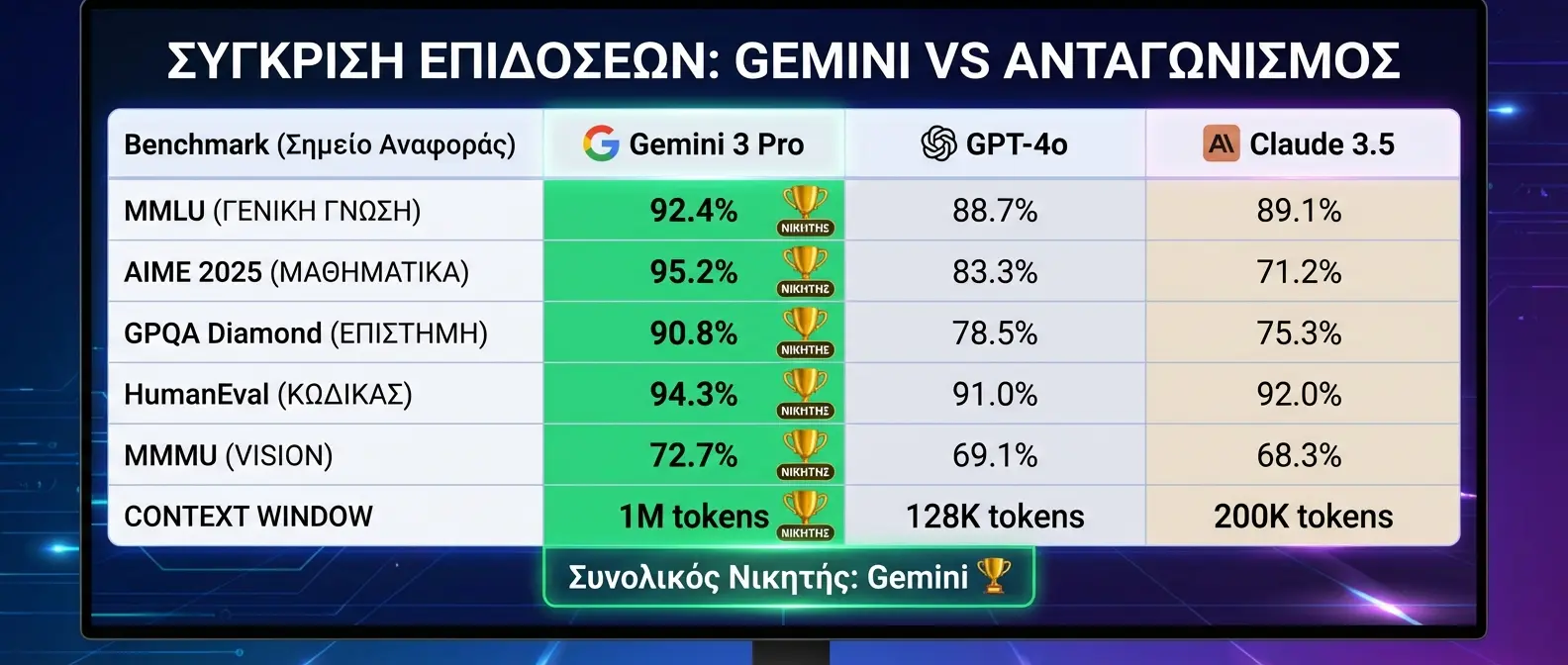
In the world of artificial intelligence, benchmarks are the objective way to compare models. These aren't marketing claims, but standardized tests that evaluate specific capabilities. And in the 2026 benchmarks, Gemini 3 dominates in a way few expected.
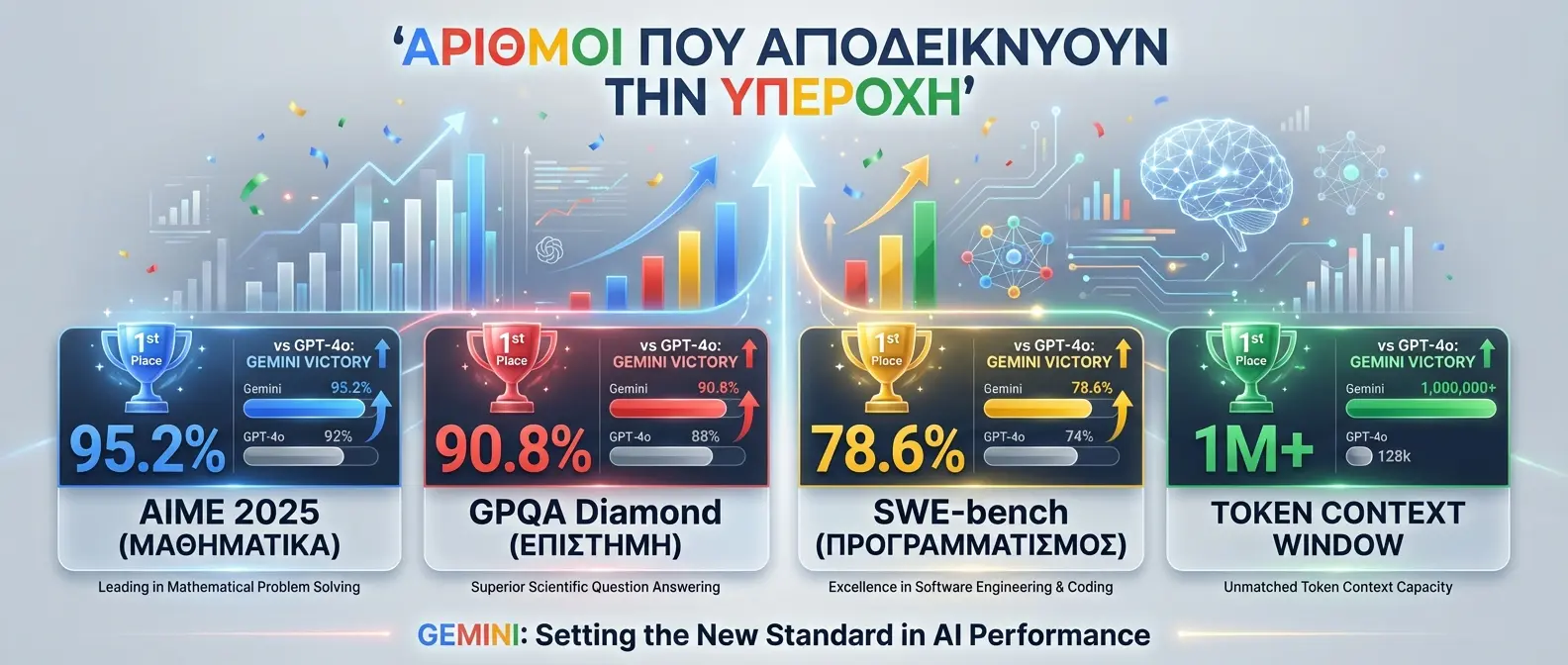
These numbers aren't just impressive — they represent a significant leap. The AIME 2025 (American Invitational Mathematics Examination) is one of the most challenging math tests, designed for the top 2.5% of students in the US. Gemini 3 Deep Think scored 95.2%, surpassing OpenAI's o1-preview which reached 83.3%. This gap of nearly 12 percentage points on such a demanding test is enormous.
| Benchmark | Gemini 3 Pro | GPT-4o | Claude 3.5 | Winner |
|---|---|---|---|---|
| MMLU (General Knowledge) | 92.4% | 88.7% | 89.1% | Gemini |
| AIME 2025 (Mathematics) | 95.2% | 83.3% | 71.2% | Gemini |
| GPQA Diamond (Science) | 90.8% | 78.5% | 75.3% | Gemini |
| HumanEval (Code) | 94.3% | 91.0% | 92.0% | Gemini |
| MMMU (Vision) | 72.7% | 69.1% | 68.3% | Gemini |
| Context Window | 1M tokens | 128K tokens | 200K tokens | Gemini |
What does Context Window mean?
The context window determines how much information an AI can “remember” in a conversation. Gemini's 1 million tokens means it can read and analyze entire books, thousands of pages of code, or hours of video in a single query — something impossible for the competition.
🎯 The Secret Weapon: Native Multimodal AI
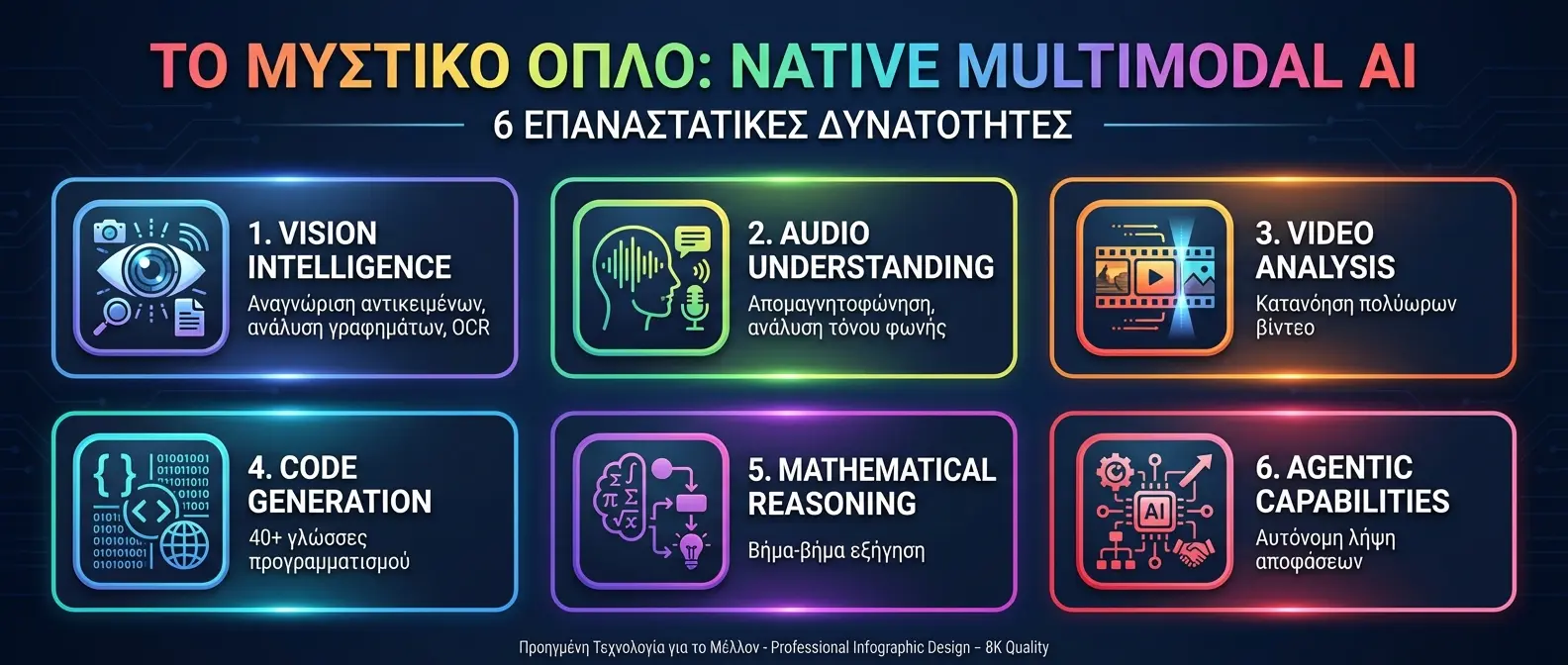
The biggest difference between Gemini and ChatGPT isn't in the numbers — it's in the architecture. While GPT-4 tries to “glue together” separate models for image, audio, and text, Gemini was designed from the start as a unified multimodal system. This means it truly understands the relationship between different data types, rather than simply translating them.
Think of it this way: when you show ChatGPT a photo and ask it to analyze it, it first “translates” the image into text, then responds. Gemini, on the other hand, understands image, text, and audio as a unified “meaning” — just like the human brain does. This difference becomes enormous in complex tasks.
Vision Intelligence
Object recognition, chart analysis, OCR, and real-time scene understanding
Audio Understanding
Transcription, speaker recognition, voice tone and music analysis
Video Analysis
Understanding hours-long videos, identifying key moments, content summarization
Code Generation
Code creation, debugging, and refactoring in 40+ programming languages
Mathematical Reasoning
Solving complex mathematical problems with step-by-step explanations
Agentic Capabilities
Executing complex tasks using tools and autonomous decision-making
Deep Think: When AI Thinks Before It Answers
One of the most impressive innovations in Gemini 3 is Deep Think mode. Instead of answering immediately, the model “thinks” internally, examines different approaches, and only then provides the final answer. This approach, similar to OpenAI's o1 but more advanced, allows Gemini to solve problems that were previously impossible for AI.
Deep Think isn't just a slower model — it's a model that learns to think the way experts think. It tests approaches, recognizes mistakes, and iterates until it finds the right solution.
In practice, this means Gemini 3 Deep Think can solve Math Olympiad problems, debug complex code by spotting errors that even experienced developers would miss, and analyze scientific papers while suggesting new research directions. The difference compared to the standard Gemini 3 Pro is striking: on AIME, Deep Think scores 95.2% versus 83.2% for the Pro mode.
🌐 The Ecosystem That Makes the Difference
While Gemini's technology is impressive, its integration into Google's ecosystem is what makes it truly revolutionary. Unlike ChatGPT, which operates primarily as a standalone tool, Gemini is now embedded in every major Google product — and that changes everything for hundreds of millions of users.
Google Search
AI Overviews now appear in 40% of searches, offering instant, synthesized answers instead of simple links. Search is no longer just indexing — it's understanding and synthesizing information in real time.
Google Workspace
Gemini writes emails, summarizes documents, creates presentations, and analyzes spreadsheets. Over 100 million workers have access to these capabilities through Workspace.
Android & Pixel
Gemini Nano runs locally on smartphones, offering AI without an internet connection. From text correction to live call translation — AI is now built into the operating system.
YouTube
Automatic video summaries, AI-generated chapters, and recommendations based on content — not just the title. Gemini understands what's happening in every second of the video.
Google Photos
“Find the photo of my dog at the beach from 2 years ago” — and Gemini finds it. Natural language search across billions of stored photos.
Google Home & Nest
Google Assistant becomes a true assistant with context understanding. It remembers what you said yesterday, understands what you mean, and executes complex commands.
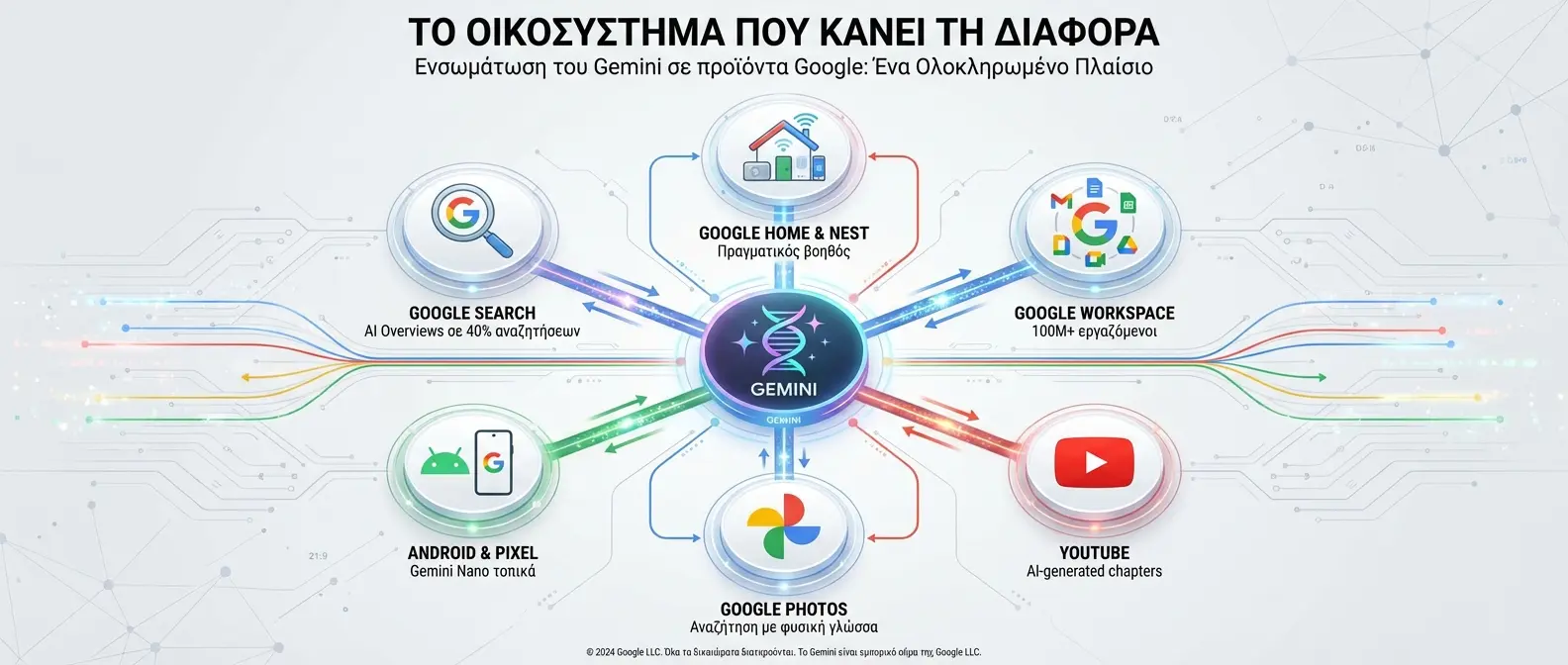
This penetration into everyday products is something OpenAI can't easily replicate. ChatGPT is an excellent standalone tool, but it requires users to go to it. Gemini, on the other hand, is everywhere — in your email, on your smartphone, in your searches, in your photos. This omnipresence creates a massive advantage in data and usage habits.
👨💻 For Developers: The Google Antigravity Platform
Google isn't content with dominating consumer products — it's also targeting the developer community. In January 2026, it introduced Google Antigravity, a comprehensive AI development platform that promises to make building AI applications as easy as building a website.
The platform includes:
- AI Studio: A web-based IDE for experimenting with Gemini models, fine-tuning, and prompt engineering without writing code
- Vertex AI: Enterprise-grade deployment with SLAs, security, and scalability for production workloads
- Gemini API: Access to the latest models with competitive pricing — the Flash model costs 75% less than GPT-4
- Grounding with Google Search: Real-time access to Google Search for always up-to-date answers
- Function Calling: The ability to connect Gemini with external APIs and tools
Important for Developers
Gemini 2.5 Flash-Lite is available for free with generous rate limits — ideal for prototyping and small applications. For production workloads, paid tiers offer unlimited usage with pay-as-you-go pricing.
Google's strategy is clear: make AI accessible to as many developers as possible, and build an ecosystem of applications that depend on Gemini models. The more apps built on Gemini, the harder it becomes for developers to switch platforms — a classic lock-in that Microsoft has successfully employed for decades.
⚔️ OpenAI's Response
OpenAI isn't sitting idle. The company has responded with GPT-5 (under development), while GPT-4o remains a strong competitor in many areas. However, the company faces challenges on multiple fronts:
Legal Problems
Elon Musk's $134 billion lawsuit, combined with similar lawsuits from the New York Times, Getty Images, and dozens of others, creates uncertainty about the company's future.
Brain Drain
Key researchers have left to found competing companies or join competitors. Anthropic, founded by former OpenAI executives, is now a serious player.
Funding
Despite $13 billion from Microsoft, OpenAI still needs more capital to compete with Google, which spends multiples of that on AI infrastructure.
OpenAI's biggest problem is its lack of distribution. Google has access to billions of users through Search, Chrome, Android, and Workspace. OpenAI has... a website and an API. The partnership with Microsoft helps, but even Copilot doesn't have the penetration that Google has in users' daily lives.
Furthermore, OpenAI's transition from a nonprofit to a for-profit company — which triggered Musk's lawsuit — raises questions about the company's priorities. The original mission of “beneficial AI for humanity” seems to be giving way to pressures for profitability and investor returns.
🔮 What the Future Holds
The AI race is far from over. Although Google is currently on top, the situation can change quickly. However, certain trends appear stable for the near future:
- Agentic AI: The next big challenge is AI that can autonomously execute complex tasks — not just answer questions. Gemini already has “agentic capabilities” that allow it to use tools and make decisions.
- On-device AI: With Gemini Nano, Google is leading the trend for AI that runs locally on devices — no cloud, no latency, no privacy concerns.
- Multimodal Evolution: Real-time video understanding, 3D content creation, and interaction with the physical world are the next challenges.
- Specialized Models: Instead of one “god model” that does everything, we'll see specialized models for coding, science, creative work, and more.
Personal Intelligence
The next major development is "Personal Intelligence" — AI that knows you personally, remembers your preferences, understands how you work, and adapts to you. Gemini for Android is already a step in this direction.

Artificial intelligence is becoming increasingly integrated into our daily lives
📝 What This All Means for You
Google's victory in the AI “war” isn't just a corporate success — it directly affects how we'll use technology in the years to come. If you're a Google product user (and statistically, you almost certainly are), you already have access to one of the most advanced AI systems in the world — often without even realizing it.
For professionals, the era ahead demands new skills. The ability to effectively use AI tools will become as fundamental as computer literacy is today. And with Gemini being integrated into tools like Google Workspace, this transition will happen faster than many expect.
The battle between Google and OpenAI will continue, and consumers will be the big winners. Competition pushes both companies to improve their products, lower prices, and innovate faster. But for now, Google has the lead — and with Gemini 3, it has sent a clear message: it's back at the top of AI for good.
🏆 The Conclusion
Three years after “code red,” Google isn't just responding to ChatGPT — it's surpassing it. With Gemini 3, the company has created an AI system that leads in benchmarks, integrates seamlessly into its products, and lays the foundation for the next generation of artificial intelligence. The AI “battle” isn't over, but for the first time, Google is playing offense — and winning.