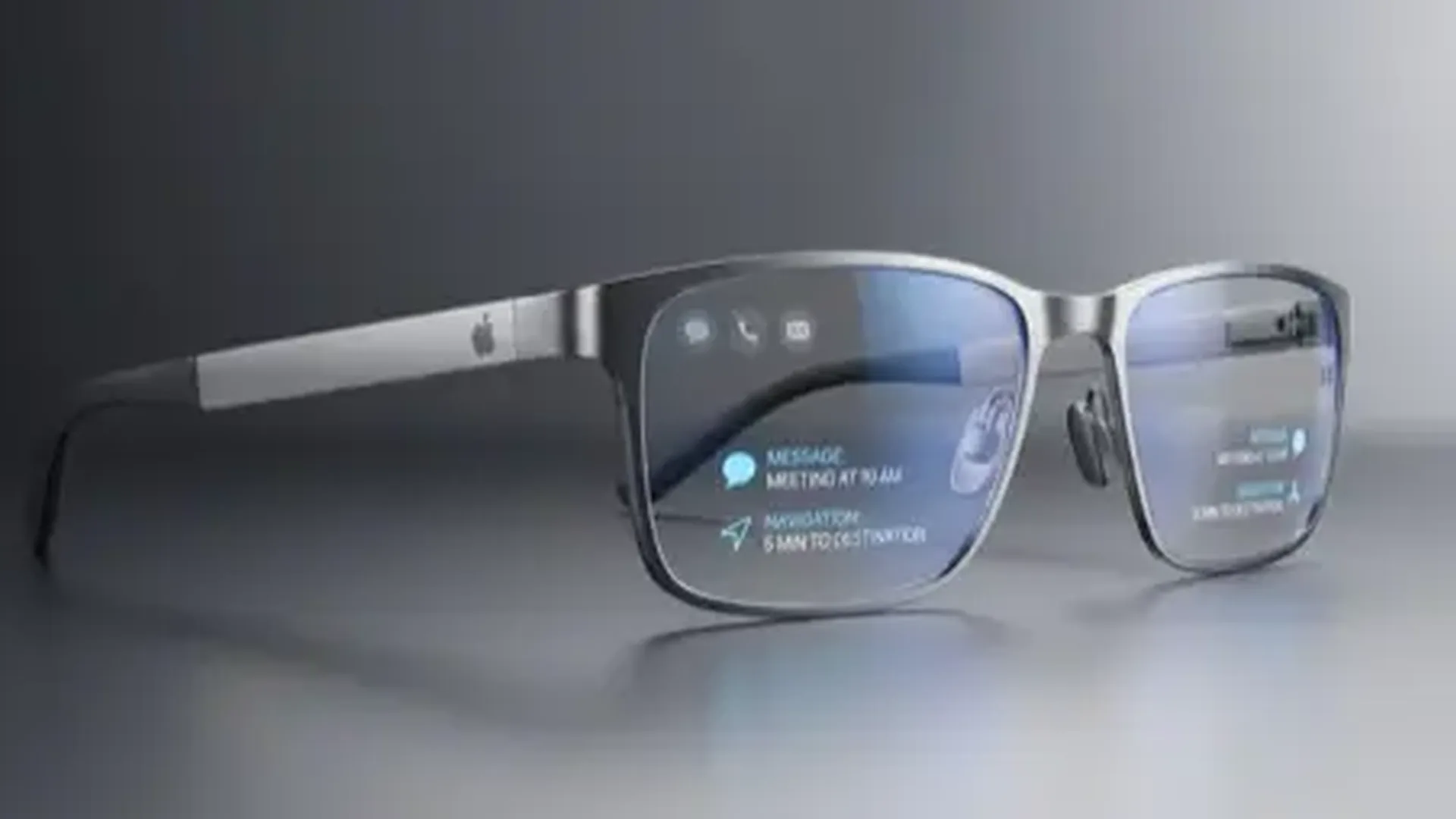
Apple didn't stumble into the wearables world — it has been architecting it with a decade of patience. From its first head-mounted display patent (2006) to the Apple Vision Pro in 2024, the company is methodically building a spatial computing ecosystem destined to dominate AI smart glasses of the future. In this article, we examine what Apple has accomplished, what's coming next, how it compares to the competition, and why real AI smart glasses are closer than you think.
📖 Read more: AI in Medicine: Diagnoses with Artificial Intelligence 2026
Apple Vision Pro: The Bridge to AI Glasses
On June 5, 2023, at WWDC, Tim Cook unveiled the Apple Vision Pro — Apple's first “spatial computer.” It launched on February 2, 2024 in the US at $3,499 and sold out in 18 minutes during pre-orders, with over 200,000 units sold within the first two weeks.
The Vision Pro packs two chips: the M2 for general computing and the R1 — designed exclusively for real-time sensor data processing. Its dual micro-OLED displays deliver a resolution of 3,660 × 3,200 pixels per eye (23 megapixels), surpassing every competitor on the market. Twelve cameras, 6 microphones, eye tracking, hand tracking, and iris recognition (Optic ID) create an interaction system that needs no controllers — just eyes, hands, and voice.
The Technology Behind Spatial Computing
Development started long before 2023. In 2015, Apple acquired German company Metaio, a pioneer in augmented reality. In 2017, it purchased Vrvana (a Canadian AR headset maker) for $30 million, while simultaneously launching ARKit for developers. To date, Apple has filed over 5,000 patents related to mixed reality, eye tracking, and spatial interfaces.
Apple AR/VR Timeline
- 2006: First Apple patent for head-mounted display
- 2015: Metaio acquisition (AR pioneer)
- 2017: Vrvana acquisition ($30M) — ARKit launch
- 2019: ARKit 3 with motion capture & people occlusion
- 2023: Vision Pro unveiled at WWDC23
- Feb 2024: Vision Pro launches ($3,499)
- Oct 2025: M5 variant — 120Hz, 10% higher resolution
The operating system, visionOS, is built on iPadOS and enables floating windows arranged three-dimensionally in space. Users control everything with gaze (eye tracking), finger gestures, and voice commands. EyeSight technology projects the wearer's eyes onto the external display, avoiding the “isolating effect” that plagues conventional VR headsets.
M5 Variant: The 2025 Evolution
In October 2025, Apple released the Apple Vision Pro (M5): an upgraded version featuring the M5 chip, 120Hz refresh rate (up from 90Hz), 10% higher display resolution, and a new Dual Knit Band with tungsten counterweight for improved ergonomics. The price remained at $3,499 — a signal of Apple's intent to make the device more mainstream.
"This is the most advanced electronic device we've ever created... The beginning of a new chapter in computing."
— Tim Cook, WWDC 2023However, even the M5 version remains a heavy headset — not glasses. Apple knows this. According to reports, it's already developing a cheaper model (estimated price $1,500-2,000) as well as lightweight AR glasses that will look like regular glasses — the real challenge of the future.
Lightweight Apple AI Glasses: What We Know
The Apple Vision Pro is simply the bridge. Apple's ultimate goal is lightweight smart glasses with built-in AI — glasses that look normal and project information directly into your field of vision. According to Mark Gurman (Bloomberg), Apple has been working on this project for years, but the technology “is not yet technically feasible” at the quality level the company demands.
Key features expected in future Apple smart glasses:
- Built-in Apple Intelligence: AI assistant fully integrated with natural language understanding and context awareness
- Waveguide display: Waveguide optics for projecting information onto seemingly normal lenses
- Miniaturized LiDAR: Real-time 3D environment scanning
- On-chip Neural Engine: Local AI processing without cloud dependency
- Zeiss partnership: Apple already collaborates with Zeiss for Vision Pro prescription lenses
- UWB & AirTag integration: Finding objects with spatial audio through the glasses
Comparison: Apple vs Meta vs Google
Competition in AI smart glasses is already fierce. Meta dominates “everyday smart glasses” with the Ray-Ban Meta (September 2025: new version with AR display), while the Meta Quest 3 offers mixed reality at just $499 — a fraction of the Vision Pro's cost. Mark Zuckerberg famously declared the Quest 3 is “the better product for the vast majority of people.”
Meta also developed the Orion AR glasses (prototype, September 2024) — full AR glasses with holographic waveguide display. Samsung is preparing the Galaxy XR in collaboration with Google (Android XR), while Snap (Spectacles), Brilliant Labs (Frame), and Xiaomi compete for market share in this emerging space.
Apple's Smart Glasses Advantages
- Ecosystem: iPhone, Apple Watch, AirPods — seamless integration
- Custom silicon: M-series & R-series chips purpose-built
- Privacy-first: On-device processing, Optic ID, data encryption
- Developer ecosystem: ARKit, RealityKit, visionOS — thousands of apps
- Brand trust: Users trust Apple more on privacy matters
AI Features & Apple Intelligence
Apple's AI glasses won't simply be a display strapped to your face. They'll be an AI-first device — hardware designed around artificial intelligence. Apple Intelligence (June 2024) already introduced AI capabilities to iOS 18, and the evolution for smart glasses will include:
- Visual Intelligence: Look at something, ask a question — the AI recognizes objects, text, faces, and locations
- Real-time translation: Live conversation subtitles in AR overlay
- Proactive Siri: The assistant knows what you see, where you are, what you're doing — suggests without being asked
- Health monitoring: Paired with Apple Watch, tracking fitness, sleep, even cognitive function
- Spatial audio: 3D sound anchored to real-world locations
The key is on-device processing. Unlike Meta's Ray-Ban glasses that send data to the cloud, Apple is designing its AI glasses to run on a local Neural Engine, ensuring both privacy and responsiveness. The camera recognizes what you see without data ever leaving the device.
Privacy & Ethical Concerns
Smart glasses raise enormous privacy questions. Someone wearing AI glasses could photograph you, identify your face, find your social media — without your knowledge. As early as 2013, Google Glass was banned in Las Vegas casinos, bars, and private venues. In China, police have been using smart glasses with facial recognition since 2018.
Apple positions itself firmly on the side of privacy:
- Vision Pro doesn't export eye-tracking data to developers
- Optic ID (iris recognition) never leaves the Secure Enclave
- EyeSight shows bystanders that the user is “seeing” through the device
- On-device AI processing — camera data never uploads to the cloud
- Accessibility features: VoiceOver, Dwell Control, Braille support
"Privacy is a fundamental human right. Every device we build is designed around this principle."
— Tim Cook, Apple Privacy StatementThe Future: When Will We See Apple Smart Glasses
Analyst estimates place the first lightweight Apple AR glasses between 2027 and 2029. Before that, Apple will launch a cheaper Vision Pro (estimated ~$1,500-2,000) to broaden the market. History shows that Apple never enters a category first — but when it does, it transforms it.
What to Expect
- 2026: Cheaper Apple Vision Pro edition (~$1,500)
- 2027: Third-generation Vision Pro with smaller form factor
- 2028-29: First Apple smart glasses (lightweight eyewear design)
- 2030+: Partial iPhone replacement for many use cases
The smart glasses market is poised for explosive growth. From 50,000 units in 2012, it's projected to reach tens of millions of units annually by 2030. Apple, with its ecosystem, custom silicon, brand trust, and commitment to privacy, is ideally positioned to lead this new era of computing.
AI smart glasses aren't just another gadget — they're the next computing platform. And Apple knows this better than anyone. The question isn't whether Apple will build them, but when they'll be perfect enough for its own standards.