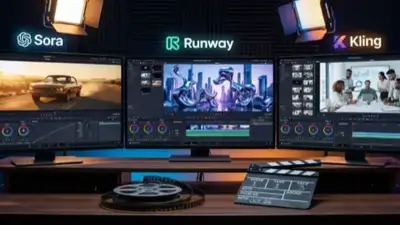
Artificial intelligence no longer just creates text and images — now it makes videos too. In 2026, three platforms dominate the AI video generation space: OpenAI's Sora, Runway (Gen-4), and Kuaishou's Kling. Each promises something different — but which one is actually worth your time and money?
According to OpenAI, Sora can generate videos up to one minute long from a simple text description. Runway, with its Gen-4 series, is already being used in Hollywood productions. And Kling, the Chinese competitor, produces 2-minute videos in 1080p at 30fps — specs that impressed both VentureBeat and MIT Technology Review.
📊 The AI Video Market in Numbers
🎬 Sora — OpenAI's Creation
Sora (Japanese for “sky”) was first unveiled in February 2024, with stunning demo videos featuring an SUV on a mountain road, fantastical creatures, and people walking through snow-covered Tokyo. According to Wired, the clips demonstrated “an emergent grasp of cinematic grammar” — with automatic shot changes without explicit prompting.
The first generation launched publicly in December 2024 for ChatGPT Plus and Pro users in the US and Canada. In September 2025, Sora 2 followed, along with an iOS app (Android two months later), which the New York Times described as “jaw-dropping (for better and worse).”
⚡ Key Sora Features
- Technology: Diffusion Transformer — architecture based on DALL-E 3
- Duration: Videos up to 1 minute (text-to-video)
- Capabilities: Text-to-video, extending existing videos, social platform
- Safety: Visible moving watermark, C2PA metadata, content moderation
- Access: ChatGPT Plus/Pro (US, Canada — gradually expanding worldwide)
- Copyright: Copyrighted content enabled by default — opt-out for rights holders
In December 2025, Disney announced a $1 billion investment in OpenAI, enabling the creation of over 200 characters (Disney Animation, Pixar, Marvel, Star Wars) on Sora 2. However, the platform faced serious backlash: the New York Times called it a “social network in disguise,” Hank Green dubbed it “SlopTok,” and families of famous personalities (Robin Williams, George Carlin) demanded restrictions on deepfake videos of deceased celebrities.
🎥 Runway — The Hollywood Pioneer
Runway was founded in 2018 by Cristóbal Valenzuela, Alejandro Matamala, and Anastasis Germanidis (from NYU Tisch School of the Arts). According to Time magazine, it was named one of the 100 Most Influential Companies globally in 2023. Its tools have been used in films like the Oscar-winning Everything Everywhere All at Once and shows like The Late Show with Stephen Colbert.
Runway's model evolution has been remarkable:
Gen-1 & Gen-2 (2023)
The first commercially available text-to-video models — video-to-video style transfer and text-to-video generation
Gen-3 Alpha
Improved fidelity, consistency, and motion — a step toward General World Models
Gen-4 (March 2025)
Consistent characters, objects, and environments across scenes — reference images + text prompts
Gen-4 Turbo (Apr. 2025)
Faster, more cost-effective version — fewer credits per second of video
In April 2025, Runway raised $308 million in a Series D round (led by General Atlantic), pushing its valuation above $3 billion. Its partnerships are impressive: Lionsgate created a custom AI model based on 20,000+ titles (September 2024), AMC Networks became the first cable company to partner for AI content creation (June 2025), IMAX screened AI Film Festival films in 10 cities (August 2025), and the Tribeca Film Festival hosted a “Human Powered” showcase featuring AI films.
Additionally, Runway introduced Act-One (October 2024) and Act-Two — tools that transform simple video recordings into fully animated characters without motion-capture equipment. The company also launched Game Worlds (2025), a tool for creating text-based adventures with AI-generated visuals.
🐉 Kling — The Chinese Challenger
Kling was developed by Kuaishou, a Chinese short video company (TikTok competitor in China) with over 200 million daily active users. In June 2024, Kling debuted as a diffusion transformer model capable of generating 2-minute videos in 1080p at 30fps — specifications that surpass many competing tools.
According to Tom's Guide, “Forget Sora — Kling is a killer new AI video model.” MIT Technology Review tested Kling and acknowledged its capabilities, while VentureBeat reported it was “wowing creators.” Access is available through the Kwai Cut app.
🔑 Kling: Pros & Cons
- ✅ Long duration: Videos up to 2 minutes (double Sora's max)
- ✅ Resolution: Native 1080p at 30fps
- ✅ Pricing: More affordable option, especially for Asian markets
- ❌ Access: Initially required a Chinese phone number
- ❌ Language support: Best results with Chinese-language prompts
- ❌ Privacy: Kuaishou has a state-owned golden share
⚔️ The Ultimate Comparison: Sora vs Runway vs Kling
| Feature | Sora (OpenAI) | Runway Gen-4 | Kling (Kuaishou) |
|---|---|---|---|
| Technology | Diffusion Transformer | Multimodal AI | Diffusion Transformer |
| Max Duration | ~60 seconds | ~10 seconds | ~2 minutes |
| Resolution | Up to 1080p | Up to 4K (upscale) | 1080p / 30fps |
| Character Consistency | Moderate | Excellent (Gen-4) | Good |
| Hollywood Partnerships | Disney ($1B) | Lionsgate, IMAX, AMC | — |
| Pricing | ChatGPT Plus ($20/mo) | From $12/month | Freemium + credits |
| Social Network | ✅ TikTok-style app | ❌ | ✅ (Kuaishou/Kwai) |
| Availability | US/Canada (expanding) | Worldwide | Primarily Asia |
🌍 Other Notable Competitors
Beyond the big three, several other platforms are vying for a share of the AI video market:
Pika
Silicon Valley startup popular for quick short clip creation with simple prompts
Google Veo
Google's answer to Sora — integration with the broader Google AI ecosystem
Luma Dream Machine
Focused on motion quality — ideal for realistic camera movements
Meta Make-A-Video
Meta's early model — foundation for future video generation tools
🎬 Impact on the Film Industry
The impact of AI video generation on Hollywood is already visible. Director Tyler Perry announced in February 2024 that he was putting his $800 million Atlanta studio expansion on hold, saying: “I just don't see how we survive.” His statement, published in the Hollywood Reporter, sparked widespread debate.
On the other hand, the industry is starting to embrace these tools. According to Vulture (June 2025), “everyone is already using AI (and hiding it).” Lionsgate created a custom model based on 20,000+ films and shows, expecting to save “millions” according to Variety. AMC Networks uses Runway for marketing visuals and scene pre-visualization. And films from Runway's AI Film Festival were screened on IMAX screens in 10 US cities in August 2025.
⚠️ Intellectual Property Concerns
- According to 404 Media, Runway trained Gen-3 on thousands of YouTube videos without permission
- In November 2024, Sora artists leaked an API key on Hugging Face, protesting “art washing”
- The MPA (Motion Picture Association) chairman criticized OpenAI for requiring copyright opt-out instead of opt-in
- Japanese publishers (Studio Ghibli, Square Enix) demanded through CODA that unauthorized use cease
- Families of Robin Williams and George Carlin demanded restrictions on deepfake videos of deceased celebrities
🎯 Which Tool Is Right for You?
| Need | Recommended Tool | Why |
|---|---|---|
| Quick social media clips | Sora 2 | Built-in TikTok-style platform, easy sharing |
| Professional video production | Runway Gen-4 | Only one with Hollywood partnerships, consistent characters, Act-One |
| Long-duration videos | Kling | Up to 2 minutes native — double the competition |
| Low budget | Kling / Pika | Freemium models, lower cost per video |
| Google integration | Google Veo | Integration with Workspace, Photos, YouTube |
🔮 What's Coming by the End of 2026
The AI video market is evolving at breakneck speed. Runway's AI Film Festival went from 300 submissions (2023) to over 6,000 (2025) — a 20x increase in two years. According to Fortune, Runway is now pivoting toward “immersive worlds” and game development, while OpenAI plans to integrate Sora into ChatGPT as a native feature.
On the technical front, expect: longer video durations, better character control, improved physics simulation (still a weakness for many models), real-time generation, and native 4K output. Meanwhile, ethical and legal issues will escalate — particularly around copyright, deepfakes, and the impact on entertainment industry jobs.
"It will be a very long time, if ever, before text-to-video threatens actual filmmaking."
— Steven Levy, Wired, February 2024Whether you're a content creator, filmmaker, marketer, or just curious, AI video generation in 2026 offers capabilities that seemed impossible two years ago. The right choice depends on your needs, your budget, and your ethical stance toward the intellectual property questions this technology inevitably raises.