📖 Read more: AI in Greece: Applications and Opportunities 2026
AI Entered the Classroom — And It's Not Leaving
In February 2026, no school or university can ignore artificial intelligence anymore. Since ChatGPT launched in November 2022, education has been in one of the biggest upheavals in its history.
Initially, many schools and universities banned LLMs. But as MIT Technology Review noted, "ChatGPT is going to change education, not destroy it." Most bans are gradually being lifted, replaced by integration policies.
What exactly is happening today in schools and universities worldwide?
AI Tutors: A Private Teacher for Every Student
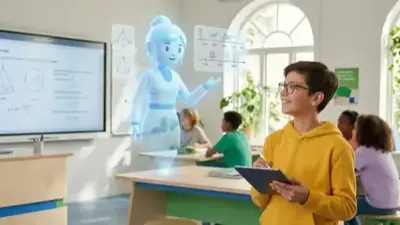
Intelligent Tutoring Systems (ITS) aren't a new idea — they've existed since the 1970s with early systems like SCHOLAR. The concept: an AI that simulates student-teacher interaction. What changed dramatically is the quality of that interaction.
According to recent research, Adaptive Learning Platforms have shown positive results in improving test scores, student engagement, and motivation.
The Big Problem: Cheating with AI
The hottest debate in education right now: academic integrity.
First-Hand Account
In September 2025, a high school senior published in The Atlantic an op-ed titled “I'm a High Schooler. AI Is Demolishing My Education.” She argued that the normalization of AI cheating is eroding critical thinking, academic integrity, creativity, and the shared student experience.
The evidence is concerning:
- Reliance on generative AI has been linked with reduced academic self-esteem and heightened “learned helplessness”
- AI detection tools have limited accuracy and create adversarial relationships between students and institutions
- Students may be falsely accused of misconduct based on probabilistic software
- AI hallucinations and errors make outputs unreliable as sources
📖 Read more: AI Resume & Job Applications: The Complete 2026 Guide
What Are Universities Doing?
Since 2023, higher education institutions have been developing AI policies:
According to NPR (Oct. 2025), new data shows that university professors are already using AI for research, curriculum design, and grading.
Top AI Tools for Students
Writing Help
- ChatGPT / Claude / Gemini — Brainstorming, essay structure, feedback
- Grammarly — Grammar, style, plagiarism checking
- Notion AI — Notes, summaries, organization
STEM Subjects
- Wolfram Alpha + ChatGPT — Step-by-step math solutions
- Photomath — Scan an equation, get solution with explanation
- Khan Academy (Khanmigo) — AI tutor built into lessons
Languages & Study
- Duolingo Max — AI roleplay conversations
- Anki + AI — Smart flashcards with spaced repetition
- Elicit / Consensus — AI for academic research
The Risks Nobody Talks About
5 Hidden Risks
- Digital divide — Urban schools have access; rural areas and low-income families fall behind
- Bias & Prejudice — LLMs are trained on biased data and reproduce societal prejudices
- Privacy — Student data (grades, weaknesses, learning difficulties) enters private companies' AI systems
- "Invisible labor" for educators — Teachers must design anti-AI exams, evaluate AI detectors, handle new ethical issues — without training or time
- Learned helplessness — Students who rely on AI at every step gradually lose their ability for autonomous thinking
📖 Read more: AI Autonomous Cars: Waymo vs Tesla 2026
What International Organizations Say
The Greek Reality
In Greece, the situation is behind but moving:
- Most schools lack an official AI policy
- Universities (NTUA, UoA, AUTH) are beginning to issue guidelines — but uncoordinated
- Students massively use ChatGPT — often without any guidance
- The Greek language acts as a partial “barrier” — LLMs are weaker in Greek
- Need for a National AI Strategy for Education
How AI Should Be Used in Education
Proper integration means neither a ban nor uncontrolled use. Experts recommend:
- AI Literacy at every level — Students need to understand what AI does, where it fails, and how it's biased
- Train the teachers — Educators need actual training, not just rules
- AI as assistant, not replacement — Use for brainstorming, feedback, practice — never as the final output
- Rethink assessment — New exam formats: oral, project-based, in-class writing
- Transparency — Clear policies: when AI is permitted, how much, in what way
- Data protection — Don't feed sensitive student data into AI platforms without guarantees
The Future: University 2030
What will education look like in 4 years?
- Personalized learning paths — Every student will have a customized study program
- AI teaching assistants — Helpers answering questions 24/7
- Real-time assessment — Evaluation in real time, not just during exams
- Hybrid learning — Combining in-person, online, and AI-assisted learning
- New degrees — “AI & [anything]” degrees at every university
Artificial intelligence won't replace teachers. But teachers who use AI will replace those who don't. The question isn't whether AI will enter education — it's whether it will enter correctly.