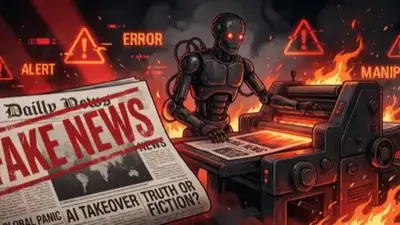
Artificial intelligence has fundamentally transformed how misinformation is created and spread. From deepfakes of political leaders to automated bot networks flooding social media with false content, the era of AI fake news represents an unprecedented challenge to democracy, journalism, and social cohesion. In this article, we examine how this phenomenon works, which technologies fuel it, and how we can protect ourselves.
How AI Creates Fake News
Generative AI tools have made crafting convincing false content easier than ever before. Large Language Models (LLMs) can produce text that closely mimics the tone of journalistic reports, while image and video generation tools create visual material nearly impossible to distinguish from authentic footage.
According to research published in Science (Vosoughi, Roy & Aral), false news on Twitter spreads three times faster than true stories. With AI automating content creation, that rate multiplies dramatically.
The 7 Types of Fake News in the AI Era
Claire Wardle of First Draft News has classified fake news into 7 categories, all of which AI significantly amplifies:
Satire / Parody
No harmful intent, but with potential to mislead. AI memes and satirical content can easily be misinterpreted as real news.
False Connection
Clickbait headlines that don't match the content. AI automates the creation of provocative headlines to maximize clicks.
Misleading Content
Real information with a distorted frame. LLMs can rephrase facts to convey an entirely different message.
Impostor Content
Genuine sources are impersonated. AI tools create fake sites that closely mimic CNN, BBC, or the Associated Press.
Manipulated Content
Authentic images or videos altered to deceive — the pinnacle of deepfake technology.
Fabricated Content
100% false, designed to deceive and harm. Content farms use AI for mass production of entirely fictional stories.
Deepfakes: The Greatest Threat
Deepfakes are perhaps the most alarming manifestation of AI fake news. Using deep learning techniques, autoencoders, and Generative Adversarial Networks (GANs), they can replace a person's face or voice in existing videos with remarkable accuracy.
Deepfakes vs Shallowfakes
Deepfakes require specialized AI software, but shallowfakes — videos manipulated with basic editing tools — can achieve a similar effect. Many viral false videos were technically flawed, yet widely believed because they confirmed viewers' existing biases. A video called “The Hillary Song” with over 3 million views was one such shallowfake.
Deepfakes extend far beyond politics. They're used in financial fraud, revenge pornography, cyberbullying, and even the creation of child sexual abuse material. The ease of creating them makes them particularly dangerous — especially in societies with low digital literacy.
Bots and Troll Farms: The Engines of Spread
Creating fake news is only half the equation — spreading it is equally critical. This is where AI-powered bots and troll farms enter the picture.
According to Northwestern University research, 30% of all fake news traffic can be traced back to Facebook, compared to just 8% for real news. Bots create fake profiles, acquire followers, and manufacture false “credibility” at massive scale.
Traditional vs AI-Generated Fake News
| Characteristic | Traditional Fake News | AI-Generated Fake News |
|---|---|---|
| Production speed | Hours/days | Seconds |
| Cost | Human labor | Nearly zero |
| Scale | Dozens of articles/day | Thousands of articles/day |
| Text convincingness | Moderate (spelling errors) | High (perfect grammar) |
| Visual material | Recycled images | Original deepfakes |
| Detection | Relatively easy | Extremely difficult |
Fake News Worldwide: The Situation 2024-2026
The misinformation crisis knows no borders. Around the world, governments and societies grapple with a wave of false news amplified by AI.
In the United States, a BuzzFeed News analysis revealed that the top fake news stories about the 2016 election generated more Facebook engagement than the top stories from credible outlets. Researchers from Princeton and Dartmouth College found that Trump supporters and Americans over 60 were far more likely to consume fake news. As researcher Brendan Nyhan stated: "People got vastly more misinformation from Donald Trump than they did from fake news websites — full stop."
In France, ahead of the 2017 elections, one in four social media shares came from sources that actively contested mainstream media narratives. Facebook deleted 30,000 accounts linked to false political information. In India, fake news spreads primarily through WhatsApp (200+ million users) and has triggered violent incidents between social groups.
Countries with Anti-Fake News Laws
- Malaysia: Up to 6 years imprisonment for spreading fake news (2018 law)
- Singapore: POFMA — Protection from Online Falsehoods (2019), 75+ enforcement actions
- Romania: Authority to remove fake news sites during pandemic (2020)
- Germany: NetzDG — requires removal of illegal content within 24 hours
- EU: Code of Practice on Disinformation (2018, strengthened 2022) + Digital Services Act
- Russia: 2019 law banning “false information” — widely criticized as censorship
How AI Fake News Is Being Fought
Combating AI-powered misinformation requires a multi-layered approach — technological, institutional, and educational.
Technological Solutions
Major tech companies employ two primary strategies: down-ranking (demoting false content in search results) and warning labels (tagging false content with alerts). Google invested $300 million through the Google News Initiative to combat fake news.
Facebook began partnering with independent fact-checkers as early as 2016. AI detection tools are being developed across Europe and the US, using NLP, machine learning, and network analysis to identify false narratives.
Fact-Checking Organizations
Fact-checkers remain crucial. Organizations like Snopes.com, FactCheck.org, and the International Fact-Checking Network (IFCN) at the Poynter Institute verify or debunk claims. The IFLA (International Federation of Library Associations) published an 8-point guide for spotting fake news:
Consider the Source
Understand the site's mission and purpose. Check whether it's a known outlet or a fake page.
Read Beyond the Headline
Clickbait headlines are a tool of misinformation. Never share based on the headline alone.
Check the Author
Real journalist or fake AI-generated profile? Credibility starts right here.
Check the Date
Old articles are recycled as “breaking news.” The publication date reveals a lot.
Why Our Brains Fall for Fake News
The psychology behind fake news explains why AI misinformation is so effective. Two primary mechanisms are responsible:
First, confirmation bias: people tend to believe information that confirms their existing beliefs. AI exploits this through “personalized misinformation” — targeted fake news tailored to each user's psychological profile.
Second, motivated reasoning: we evaluate information based on whether it fits our desires rather than the facts. Social media filter bubbles amplify this phenomenon by presenting users only with content they like — creating a false sense of consensus.
"People got vastly more misinformation from Donald Trump than they did from fake news websites — full stop."
Brendan Nyhan, researcher at Princeton/Dartmouth, in an interview with NBC NewsA Princeton/NYU study (2019) found that age correlates more strongly with sharing fake news than education, gender, or political views. 11% of users over 65 shared fake news, compared to just 3% of those aged 18-29.
Media Literacy: The First Line of Defense
Digital media literacy is now recognized as the most effective long-term solution against misinformation. Nolan Higdon, in his book The Anatomy of Fake News (2020), argues that critical media thinking is the most effective “vaccine” against propaganda.
Practical examples: Taiwan embedded a media literacy program in its schools, training students in critical reading of propaganda and source evaluation. Finland designed a cyber-warfare response center (involving 11 countries) in Helsinki. Inoculation theory — also known as prebunking — suggests that preventive exposure to manipulation tactics makes people more resilient to future misinformation.
What Lies Ahead (2026+)
The battle against AI misinformation is intensifying. Key trends include:
- Automated fact-checking: AI tools that detect false claims in real time
- Content provenance: Digital “signatures” on authentic content (C2PA standard) providing verified origin
- Regulatory pressure: New EU (AI Act) and US (state-level) laws with platform fines
- Watermarking: Mandatory labeling of AI-generated content
- Architectural changes: Platforms prioritizing reliable sources (Wikipedia, scientific journals)
- Digital immunity: Mass citizen education in critical information evaluation as public health policy
Andy Norman, in his book Mental Immunity, advocates for a new science of “cognitive immunology” as a practical guide to resisting bad ideas. He notes that logic alone isn't enough — we need to understand the cognitive biases that distort rational reasoning.
5 Rules for Digital Self-Protection
- Don't share before reading: The headline is never enough
- Check 2+ sources: If a story doesn't appear anywhere else, it's probably fake
- Watch the language: Fake news often uses excessively emotional language
- Use reverse image search: Many “exclusive” photos are recycled from other contexts
- Recognize your biases: If a story fits your beliefs “perfectly,” double-check it
AI misinformation is here to stay — and it will only grow more sophisticated. But the tools to combat it are evolving too. The ultimate solution isn't purely technological: it's building a society of digitally literate citizens, capable of critically evaluating every piece of information they encounter online.