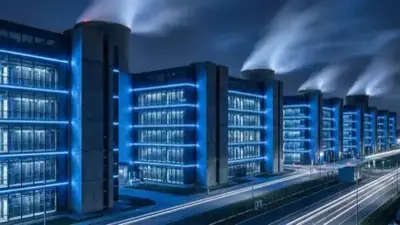
AI data centers are the backbone of the artificial intelligence revolution. In 2026, the construction of massive data centers is spreading to every corner of the planet, absorbing billions in investment, enormous amounts of energy and water. Who is building them, why, and what does this mean for the planet?
The Explosive Growth of AI Data Centers
The history of data centers dates back to the 1940s, with massive computer rooms like ENIAC. By the 2000s, the dot-com boom drove massive data center construction. But nothing compares to what's happening now.
The rise of artificial intelligence — and especially generative AI — has triggered unprecedented demand for computing power. According to the International Energy Agency (IEA), global data center electricity consumption was approximately 415 TWh in 2024, roughly 1.5% of global electricity. The projection? It could more than double to 945 TWh by 2030.
The United States dominates with 5,381 data centers (March 2024), the highest number worldwide. According to McKinsey, US demand is expected to double to 35 GW by 2030 (from 17 GW in 2022). Without data center investments, US GDP growth in the first half of 2025 would have been just 0.1%, according to a Harvard economist.
The Giants Building Data Centers
Behind this boom are the biggest tech companies: Google, Microsoft, Amazon (AWS), Meta, and now Elon Musk's xAI. Each is investing billions in building hyperscale data centers — massive facilities powering AI models, cloud services, and machine learning workloads.
Major Projects 2025-2026
- xAI Colossus — Musk's supercomputer data center, powered by off-grid natural gas and lithium batteries
- OpenAI Stargate — SoftBank-funded, using its own natural gas power plant
- Meta Prometheus — Massive facility with independent power supply
- Google — High-PUE data centers in Oregon, Finland, and other locations
- Microsoft — Deal to restart the Three Mile Island nuclear power plant
Google and Microsoft individually now consume more power than many countries, surpassing the consumption of over 100 nations. “Manhattan-sized” data centers are no longer hyperbole — they're reality.
The Energy Challenge
Energy is the largest operational cost for a data center. In the US, data centers are primarily powered by natural gas (40%), renewables (24%), nuclear (20%), and coal (15%).
A study by the Electric Power Research Institute (EPRI) estimates that US data center power consumption could reach 4.6% to 9.1% of the country's electricity generation by 2030. About 80% of the load is concentrated in just 15 states, led by Virginia and Texas.
Nuclear Power and Data Centers
Microsoft signed a 20-year deal to restart the Three Mile Island nuclear power plant to provide 100% electricity for its AI data centers. Google, Amazon, and Meta have expressed interest in nuclear energy, while in December 2025 the Federal Energy Regulatory Commission (FERC) unanimously approved direct connections between data centers and power plants.
US Secretary of Energy Chris Wright even expressed support for un-retiring coal plants to power AI data centers. Meanwhile, the increased energy demand has slowed or even reversed the phase-out of obsolete peaker power plants in the US.
Water Consumption
Beyond energy, AI data centers consume enormous amounts of water. According to the IEA, a single 100-megawatt data center can use up to 2 million liters of water per day — equivalent to the daily consumption of 6,500 households.
The global water footprint of data centers is estimated at 560 billion liters annually, a figure expected to double by 2030 due to increased AI demand. Alarmingly, since 2022, more than two-thirds of new data centers have been built in water-stressed areas — Texas, Arizona, Saudi Arabia, India.
"Is the increase in tax revenue and the relatively paltry number of jobs worth the water?"
— Kathryn Sorensen, Arizona State University, water policy expertCompanies like Microsoft, Google, and Amazon have pledged to become “water positive” by 2030, but critics note that this relies on water offsetting that doesn't solve local shortages.
Cooling and Energy Efficiency
The PUE (Power Usage Effectiveness) metric is a key indicator. The US average is PUE 2.0, meaning 2 watts of total power for every 1 watt delivered to IT equipment. State-of-the-art data centers achieve PUE 1.2, while immersion cooling has reached a PUE as low as 1.01.
Key cooling technologies include:
- Hot/Cold Aisle Containment — Separating hot and cold air streams in server racks
- Liquid Cooling — Direct chip cooling via liquid, ideal for GPU clusters
- Immersion Cooling — Submerging servers in dielectric fluid, PUE near 1.0
- Free Cooling — Using outside air in cold climates (Scandinavia, Canada)
- Seawater Cooling — Cooling via seawater at coastal locations
Google publishes quarterly efficiency data and in 2016 joined the Open Compute Project (OCP), sharing its 48V DC rack design that achieved a 30% increase in energy efficiency. OCP was founded in 2011 by Facebook and Rackspace to develop open standards for greener data centers.
Community Pushback
The rapid expansion of data centers isn't happening without opposition. According to Data Center Watch, projects worth $64 billion were stopped or delayed between May 2024 and March 2025. An additional $98 billion in projects were blocked between March and June 2025.
Residents are protesting about:
- Water stress in already dry regions
- Rising electricity bills — grid upgrade costs are passed on to consumers
- Noise pollution — “It's like being on a tarmac with an airplane engine that never leaves”
- Few jobs created — the Wall Street Journal calls it a “job-creation bust”
- Property devaluation in surrounding areas
In the Netherlands, protests led to a temporary national ban on new mega-centers in 2022. In Virginia, Wisconsin, and elsewhere in the US, local communities are actively resisting new projects. A farmer in Maryland stated: "They're turning our country into one giant extension cord for data centers."
Impact on Energy Prices
The IEA predicts that electricity demand from data centers could double between 2022 and 2026. According to one 2025 energy model, the US could see an 8% increase in energy prices by 2030.
A Harvard Law School report (March 2025) revealed that utilities are likely hiding subsidies to trillion-dollar tech companies by raising prices for American consumers. Similar problems are emerging in London, where data center energy demand is making it harder to build housing.
E-Waste and Sustainability
Data centers replace hardware every 2-5 years. Globally, e-waste reached 62 million metric tons in 2022. Generative AI is projected to add 1.2 to 5 million tons of e-waste annually by 2030, including valuable metals (copper, gold) and hazardous substances (lead, mercury).
Only 22% of global e-waste is formally recycled. In the US, data centers contribute to an annual loss of $10 billion in discarded e-waste value, including $4 billion in precious metals.
The Future: Modular, Edge, and Space Data Centers
Evolution doesn't stop at traditional data centers:
- Modular Data Centers — Prefabricated units in containers, rapid deployment, easy relocation
- Micro Data Centers — Small facilities near data sources, ideal for edge computing
- Edge AI — Processing data locally instead of in central data centers, reduced latency
- Lights-Out Data Centers — Fully automated, no human presence required
- Space Data Centers — Proposed deployment in low Earth orbit, leveraging solar power with no environmental impact on Earth
Green Initiatives
Countries with favorable climatic conditions — Canada, Finland, Sweden, Norway, Switzerland — are trying to attract cloud data centers. Singapore lifted its three-year ban on new data centers in April 2022, setting strict criteria: WUE 2.0/MWh, PUE below 1.3, and Platinum BCA-IMDA Green Mark certification.
Conclusion: Balancing Innovation and Sustainability
AI data centers are an inevitable part of technological progress. Without them, there would be no ChatGPT, Gemini, self-driving cars, or AI-powered medical diagnoses. However, their unchecked growth poses serious risks: climate change, water crises, and rising electricity bills for households.
The solution lies in balance: nuclear and renewable energy, immersion cooling technologies, modular designs that reduce e-waste, and — above all — transparency. Tech giants must be accountable to the communities hosting their facilities. AI can change the world, but only if it doesn't destroy it along the way.